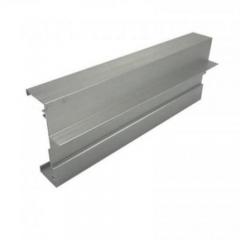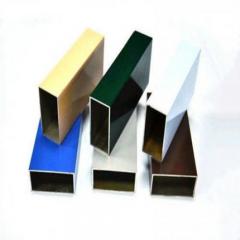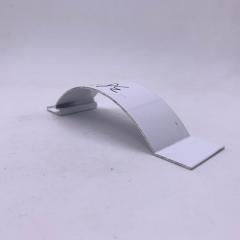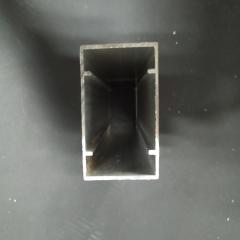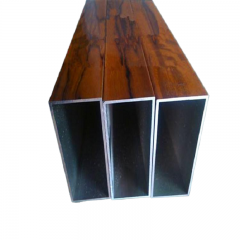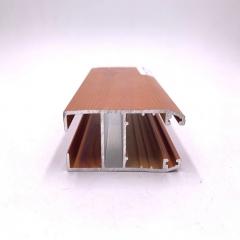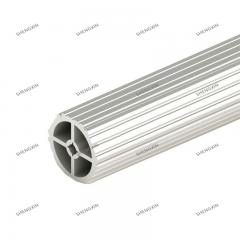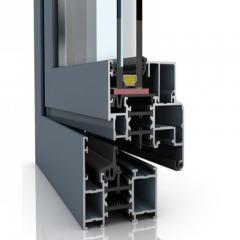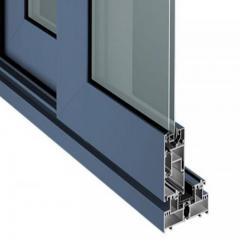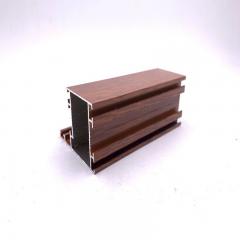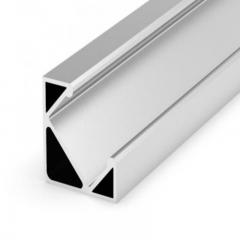
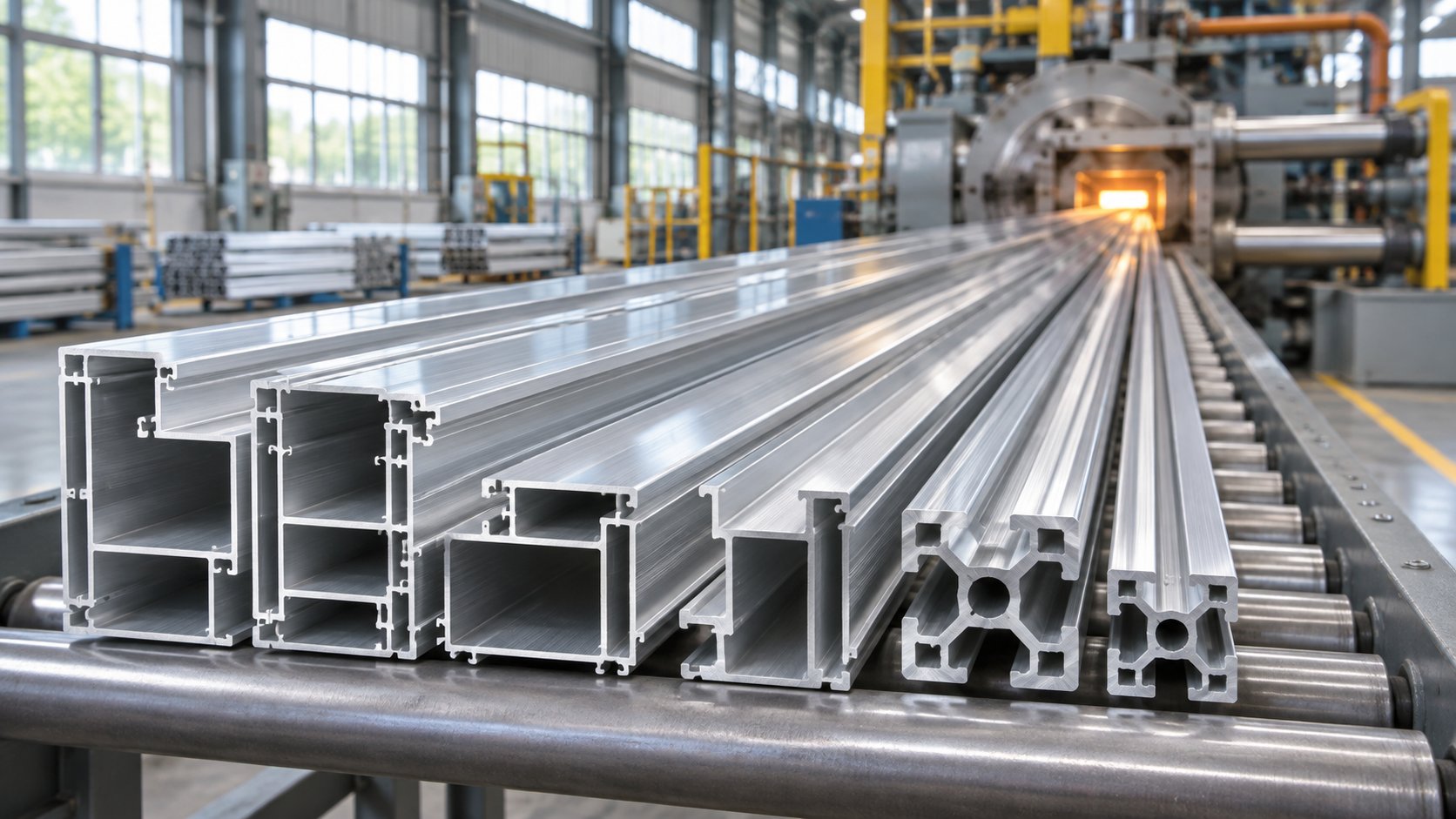
6063 aluminum is a wrought aluminum-magnesium-silicon alloy in the 6xxx series, registered with the Aluminum Association. Extruders choose it because it flows easily through a die into complex shapes and leaves a smooth surface that anodizes well, which makes 6063 aluminum extrusion a common choice for window frames, trim, tubing and heat sinks.
The name comes from the Aluminum Association's four-digit system for wrought alloys, published in its Teal Sheets. The first digit, 6, puts the alloy in the series whose main additions are magnesium and silicon. The second digit, 0, means this is the original alloy and not a later modification. The last two digits, 63, identify this particular alloy within the 6xxx family.
Magnesium and silicon are the reason the alloy can be heat treated. During aging, they combine into very fine particles of magnesium silicide (Mg2Si), which make the metal harder to deform and raise its strength. Extrusion is the shaping step. Every aluminum 6063 extrusion starts as a heated billet that a press pushes through a steel die cut to the profile's outline, a bit like squeezing toothpaste from a tube. The metal comes out as a long length with the same cross-section all the way along.
Look at a storefront frame or a sliding door track and you'll notice clean edges and an even, bright surface. That appearance is the main reason the alloy is often called architectural aluminum. 6063 has a low impurity content and a smooth surface straight off the press, so it builds a uniform anodized layer. Clear and colored finishes therefore look consistent from one length to the next. The trade-off is strength. 6063 sits at the moderate end of the 6xxx series and is weaker than 6061, so it fits frames, trim and light structures better than heavy load-bearing parts.
All of these uses depend on a tightly limited chemistry, so the guide starts with composition and then covers tempers, properties, the extrusion process, profile design, finishing and sourcing.
Why does one alloy slide easily through a die while a close relative resists? The difference comes from a few tenths of a percent of magnesium, silicon and copper. The Aluminum Association sets these limits in its registration record, the International Alloy Designations and Chemical Composition Limits for Wrought Aluminum and Wrought Aluminum Alloys, better known as the Teal Sheets. Standards and specifications around the world refer to this record, so any 6063 aluminum alloy extrusion sold as 6063 has to fall inside these limits.
| Element | 6063 limit (wt%) | What it does |
|---|---|---|
| Silicon (Si) | 0.20-0.6 | Combines with magnesium to form Mg2Si, the particles that strengthen the alloy during aging |
| Magnesium (Mg) | 0.45-0.9 | The other half of Mg2Si. More magnesium adds strength but makes the metal stiffer to push through a die |
| Iron (Fe) | max 0.35 | Mostly an impurity. It is kept low because iron-rich particles can affect surface quality |
| Copper (Cu) | max 0.10 | Kept to trace levels in 6063, which helps corrosion resistance and gives a cleaner finish |
| Manganese (Mn) | max 0.10 | Held to a low limit and not used as a deliberate strengthener in 6063 |
| Chromium (Cr) | max 0.10 | Held to a low limit in 6063 |
| Zinc (Zn) | max 0.10 | Impurity limit |
| Titanium (Ti) | max 0.10 | Small amounts help refine the grain when billets are cast |
| Aluminum (Al) | Remainder | The base metal, which supplies low density and corrosion resistance |
What this means for your choice: 6063 is mostly aluminum with small, tightly controlled additions. When anodized appearance matters, check that the mill test certificate shows every element inside these limits.
| Element | 6063 (wt%) | 6061 (wt%) | Effect of the difference |
|---|---|---|---|
| Silicon (Si) | 0.20-0.60 | 0.40-0.80 | 6061 has more Si available to form strengthening particles |
| Magnesium (Mg) | 0.45-0.90 | 0.8-1.2 | 6061's higher Mg raises strength and also the force needed to extrude it |
| Copper (Cu) | max 0.10 | 0.15-0.40 | 6061 adds copper on purpose for strength. 6063 keeps copper to trace levels |
What this means for your choice: 6061 is not simply a stronger version of 6063. It is a richer alloy, and you pay for the extra strength in how easily it extrudes and how it looks after finishing.
Imagine two pastes in a piping bag. The stiffer one takes more squeezing and leaves rougher edges. With less magnesium and silicon and almost no copper, 6063 has lower flow stress at extrusion temperature. The press can therefore run it faster, and it fills thin walls, rounded edges and narrow channels that would be harder to produce in many other alloys. 6061 gets its strength from the same additions that make it harder to push through a die. Extruders report that 6061 has lower extrudability, struggles with intricate hollows and leaves a rougher surface finish.
Finishing shows the same pattern. Catalogs that list anodized aluminum extrusion 6061 6063 options together are correct that both alloys take an anodic coating. 6063 is usually the one chosen when the part needs a cleaner, more uniform appearance. Composition also affects cooling after extrusion. 6063 can be air-quenched on the press runout table, while 6061 often needs aggressive water quenching, which can distort the profile if it is not controlled.
Most buyers compare the common aluminum extrusion alloys 6061, 6063 and 6005 by asking whether strength or shape matters more. These cues apply to most 6061 and 6063 aluminum extrusion shapes:
Published typical values differ from source to source, so treat these numbers as rough guides and not as design minimums. Chemistry also only sets the upper limit on strength. The same 6063 billet can come out soft enough to form easily or hard enough for a window mullion, and the temper on your order decides which one you get.
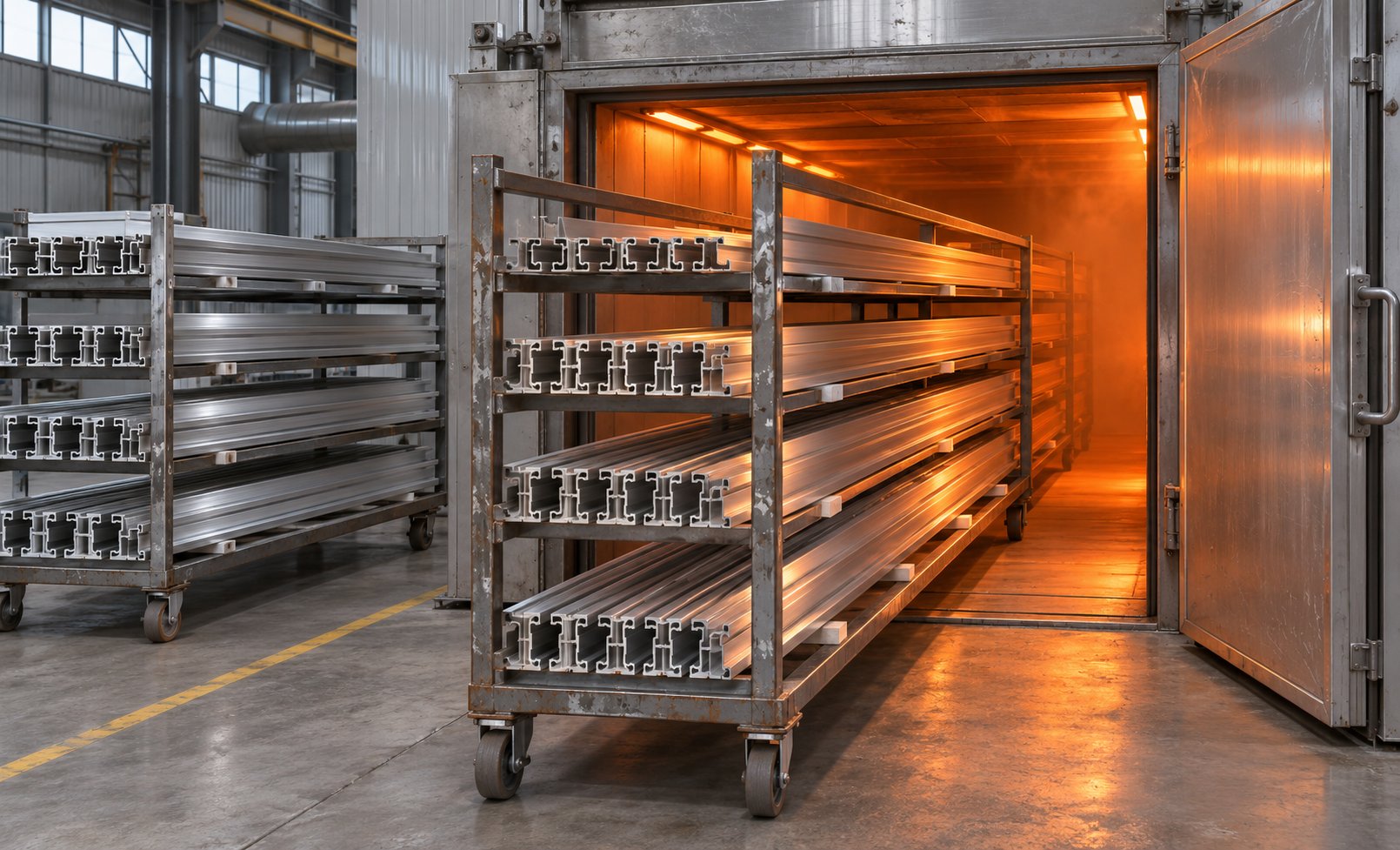
Suppose your purchase order says only 6063. Which version of the metal will arrive? The alloy number fixes the chemistry. The temper is the letter and digits after the dash, and it records how the profile was heated, cooled and aged. That history sets most of its strength and formability. The definitions below follow the temper system governed by ANSI H35.1, as summarized in Hydro's temper guide.
| Temper | How it is produced | Typical use | What this means for your choice |
|---|---|---|---|
| O (annealed) | Heated to roughly 380-420°C, held about 30 minutes, then cooled slowly, ideally in the furnace down to 250°C before air cooling | The lowest-strength condition, used to get the most workability and ductility | Specify O only when severe forming comes first and strength can come later or is not needed |
| T1 | Cooled from an elevated-temperature shaping process and naturally aged | Profiles where no aging oven step is planned | T1 skips the oven step, so expect lower strength than T5. Confirm property values with the extruder |
| T4 | Solution heat treated and naturally aged. Standard 6xxx alloys typically reach T4 within about 3 days at room temperature | Parts that will be bent or shaped after extrusion | T4 keeps more formability, so you can form the part first and strengthen it with a later aging step |
| T5 | Cooled from an elevated-temperature shaping process, typically by press quenching, then artificially aged | Architectural and secondary components | T5 is the common default when finish, dimensional control and cost matter most |
| T52 | A variation on the basic T5 treatment, defined in ANSI H35.1. The sources used for this guide do not reproduce that definition, so take it from the standard or your extruder | Cases where a drawing, system specification or customer standard names T52 | Get the written definition, aging practice and certified properties before you accept a quote |
| T6 | Solution heat treated and artificially aged | Primary structural members | T6 has higher strength and lower ductility than T4 |
T1 and T5 begin the same way. Both are cooled straight from the press. The aging step is what separates them. A T1 profile ages at room temperature, while a T5 profile goes into an aging oven. Hydro puts that oven stage at about 180°C for several hours. A Thermal Processing overview of artificial aging gives a wider typical range of 95-205°C (200-400°F) across aluminum alloys.
T5 and T6 differ in how solution treatment is achieved. A T6 profile must be solution heat treated, generally at 510-535°C, and then quenched. For most extrusions this happens on the press, because the metal leaves the die already hot. A profile sold as T6 may get that step from a controlled press quench or from a separate furnace reheat and quench. Upgrading T5 to T6 later is not a minor step. Engineering Express notes that it takes a full reheat to about 980-1,020°F, a rapid quench and a new aging cycle.
The route affects your tolerances. A harsh quench can leave internal stress and distort thin or complex sections. Aging relieves only part of that stress, about 10-35 percent in peak-aged T6 material. Ask your extruder whether a T6 profile gets furnace solution treatment or a controlled press quench. Also ask how they monitor aging loads. Thermal Processing explains that soak time should start once the coldest point in the load is within 5°C of the set temperature. Slow heating can over-age the metal, and timing the soak from total furnace time can leave it under-aged.
| Property | 6063-T5 (typical) | 6063-T6 (typical) |
|---|---|---|
| Ultimate tensile strength | About 27 ksi (186 MPa) | About 35 ksi (241 MPa) |
| Yield strength | About 21 ksi (145 MPa) | About 31 ksi (214 MPa) |
| Common role | Architectural and secondary parts where appearance and fabrication efficiency come first | Primary structural members where strength governs |
These figures are typical values, not minimums. The yield strength of a 6063 T5 aluminum extrusion averages about 21 ksi, but you should not design to an average. Engineering Express points out that design values come from the allowable stresses in the Aluminum Design Manual, and temper choice directly changes those allowables.
All of the strength figures above are production averages. Before any of them goes into a load calculation, you need to know which figure the governing standard actually guarantees.
Many datasheets rate 6063 as "medium" strength with "good" corrosion resistance and weldability. You can't put a rating like that into a load calculation. Numbers are more useful, but only if you know which kind of number you're looking at.
A typical value is an average measured on production material. These are the figures that appear on most datasheets. The 6063 figures published by Gabrian, for example, come from MatWeb, and the publisher notes they cannot be 100% verified. A specification minimum is the lowest value that every certified lot must meet. For extruded bar, rod, profiles and tube, the minimums come from ASTM B221, and engineers can design against them. Typical values usually sit several ksi above the minimums. A design based on averages therefore has less margin than it appears to.
The minimums below come from the ASTM B221 tensile tables. They apply to sections up through 0.500 in. thick unless noted otherwise. Check them against the current edition of the standard before you use them in a calculation.
| Temper | Typical UTS | Typical yield | ASTM B221 minimum (UTS / yield) | What this means |
|---|---|---|---|---|
| O | Not in sources. Confirm with extruder | Not in sources. Confirm with extruder | 19.0 ksi maximum UTS, no yield limit, 18% min elongation | Soft condition for forming. The standard sets a strength ceiling, not a minimum |
| T1 | Not in sources. Confirm with extruder | Not in sources. Confirm with extruder | 17.0 / 9.0 ksi (117 / 62 MPa) | Lowest guaranteed strength of the aged tempers |
| T4 | Not in sources. Confirm with extruder | Not in sources. Confirm with extruder | 19.0 / 10.0 ksi (131 / 69 MPa) | Formable starting point. Most of the strength comes after aging |
| T5 | About 27 ksi (186 MPa) | About 21 ksi (145 MPa) | 22.0 / 16.0 ksi (152 / 110 MPa). 21.0 / 15.0 ksi for 0.501-1.000 in. | Typical yield is about 5 ksi above the minimum. Design to 16 ksi, not 21 |
| T52 | Not in sources. Confirm with extruder | Not in sources. Confirm with extruder | 22.0-30.0 / 16.0-25.0 ksi, up through 1.000 in. | The only temper here with maximums as well as minimums, so expect a controlled strength band |
| T6 | About 35 ksi (241 MPa) | About 31 ksi (214 MPa) | 30.0 / 25.0 ksi (207 / 172 MPa), up through 1.000 in. | About 9 ksi more guaranteed yield than T5 |
| Property | Value | Basis |
|---|---|---|
| Density | 2.70 g/cm3 (0.0975 lb/in3) | Typical. Same in T5 and T6 |
| Elastic modulus | 68.9 GPa (10,000 ksi) | Typical. Same in T5 and T6 |
| Elongation | 8% min for T5, and for T6 under 0.125 in. 10% min for T6 from 0.125 to 1.000 in. | ASTM B221 minimum. Typical values were not available |
| Thermal conductivity | About 200 to 209 W/m-K (209 for T5, 200 for T6) | Typical |
| Thermal expansion (20-100°C) | 21.8 µm/m-°C | Typical |
Hardness and electrical conductivity are left out because the sources used here don't report them. Ask the extruder for test data if your design depends on either one. If you're specifying an aluminum 6063 heat sink extrusion, note that T5 conducts slightly better than T6 in these datasets. The difference is small next to the effect of fin count and spacing.
If you searched for a 6063 high-strength aluminum extrusion, the honest answer is that 6063 isn't one. In the same ASTM B221 tables, its guaranteed T6 yield of 25 ksi is below 6061-T6 at 35 ksi and 6082-T6 at 38 ksi. Within the 6xxx series, 6063 is a moderate-strength alloy.
Is it a 6063 lightweight aluminum extrusion? Yes, but the low weight comes from aluminum itself. Aluminum is about one-third the density of steel, and every 6xxx alloy has that advantage.
Stiffness works differently from strength. Metal Forming Magazine explains that all aluminum alloys have roughly the same elastic modulus, about one-third that of steel. A part's stiffness depends only on that modulus, its thickness and its geometry. Moving from 6063 to 6061 adds strength but almost no stiffness. Stiffness scales with thickness cubed, and changing an open C-channel to a closed section raises it further. If a frame rail sags under load, a deeper or closed profile will fix it. A stronger alloy in the same shape will sag almost as much.
This puts the burden on the shape of the profile. Whether a deep, closed or thin-walled shape is practical depends on how 6063 behaves in the press.
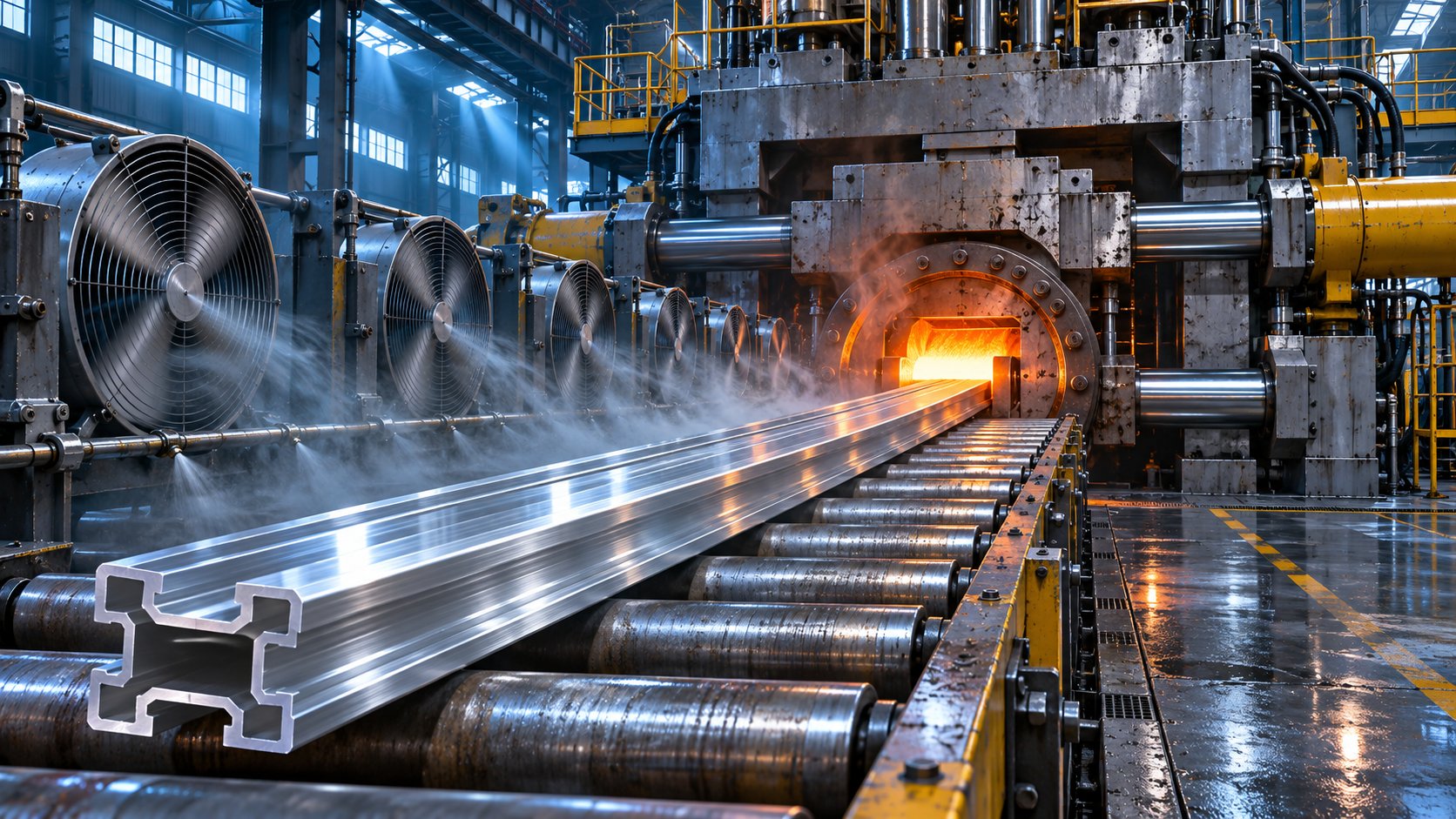
Have you ever wondered why two suppliers quote the same profile with different tolerances or finish notes? Much of the answer lies in how each one runs the press. On an aluminum extrusion 6063 line, every length goes through the same sequence of steps. Each step can raise or lower the strength, straightness and surface quality of the finished part.
Running the press faster produces more meters per hour, but it also generates more heat. In a direct-extrusion press, friction heats the billet unevenly during each stroke. Engineers writing in Aluminium International Today explain that this heating forces operators to limit ram speed to avoid defects. When the metal at the die runs too hot or too fast, the surface tears, die lines get worse, and blisters appear, mostly at the end of a run. When it runs too cool, the metal resists flow, the required pressure climbs, and the press can stall. 6063 has a wide window between those limits. The same guide lists exit speeds of 15-100 m/min for 6063, compared with 1.5-30 m/min for 6061.
The quench step connects the process to the temper on your order. Solution treatment dissolves magnesium and silicon, and the quench has to be fast enough to hold them in solution. A thin 6063 wall can reach that rate with fans on the runout table. Thicker walls or a T6 target may need water. If a section cools too slowly, it will not reach full T6 strength no matter which aging cycle it gets afterward.
Specific pressure is the force on the billet per unit of container area. The pressure a profile needs depends on four factors: the alloy's flow stress, the extrusion ratio (billet area divided by profile area), the billet temperature, and friction against the container and die. Required force rises almost linearly with extrusion ratio. The guide also advises planning 20-40% more tonnage for 6061 and 6082 than for 6063. That lower requirement is why mid-size presses can run 6063 hollows and thin walls that would need a larger press in a harder alloy.
Many engineers look for an aluminum extrusion specific pressure calculation formula that covers 6063, 6061 and 6082. The published formulas depend on flow stress and friction coefficients measured for a particular alloy, temperature and press, and the sources used for this guide don't provide verified values. Ask your extruder to check your profile's extrusion ratio against their press capacity. Don't rely on generic coefficients.
During quenching, the surface of a profile cools faster than its core. This locks in residual stress, which shows up as bow and twist. For 6063, the usual aluminum extrusion stress relieving process is controlled stretching: the length is pulled just past its yield point, which straightens it and evens out much of the stress. Some stress always remains. A study of a 7050 extrusion found residual stress left after a 2-4% stretch. In that study's machining simulation, the remaining stress moved surfaces by up to about 0.25 mm. 6063 is usually quenched more gently, but the same principle applies. If you plan heavy CNC pocketing, order stretched stock and plan the cutting sequence, because that study also found that the cutting path affects how the stress redistributes.
Many of these process limits are set before the billet is heated. Uneven walls, deep channels and multiple hollows in the profile drawing all make the press work harder.
When you send a drawing for custom 6063 aluminum extrusions, the die maker looks past the outline. They want to know how the metal will split, flow and join again on its way through the steel. Small changes on paper can make a profile much easier to run. The Aluminum Extruders Council notes that minor changes to a profile design often improve extrudability enough to lower its cost.
Every extruded shape falls into one of three classes, as defined in the AEC extrusion design tips:
A flat die cannot form a closed void, so hollow shapes need a porthole or bridge die. This type of die holds a mandrel that forms the inside of the void. The billet splits into streams that flow through ports around the mandrel and weld back together in a chamber inside the die before the profile exits. 6063 handles this rewelding well, and a DFMA cost guide rates it the best alloy for complex hollow sections.
The profile class also sets cost, timing and precision. The same guide estimates die lead times of 2-4 weeks for solid dies, 4-8 weeks for semi-hollow dies and 8-14 weeks for porthole dies. It also lists porthole dies as running at 30-80 ft/min, compared with 175-200 ft/min for solid dies, and notes that holding precision is harder with them. These figures come from one cost model, so your extruder's quote may differ.
Because 6063 flows easily, it fills thinner walls than 6061 or other harder alloys. Thin walls still have a cost. The DFMA guide estimates that thickening a wall from 0.05 in. to 0.080 in. and reducing the number of chambers can lower die cost by 20-30% and raise extrusion speed by 40-50%. The references used here give no universal minimum wall thickness, so confirm the limit for your shape and size with the extruder.
The circumscribing circle diameter (CCD) is the diameter of the smallest circle that fully encloses the profile's cross-section. The profile has to fit on the die face, and the die has to fit the press container, so CCD determines which presses can run your part. The AEC reports that most common profiles have a CCD under 12 in., and only a few extruders can reach 32 in. Extrusions are most economical with a CCD between 1 and 10 in., and staying under 8 in. reduces cost significantly. A custom size 6063 aluminum extrusion above the common range limits you to fewer suppliers.
The tongue is the piece of die steel that forms the inside of a channel. The tongue ratio compares the channel's depth with the width of its opening. A slot 1 in. deep with a 0.25 in. opening has a ratio of 4:1. A deep, narrow channel needs a long, thin tongue that is anchored only at its base while full extrusion pressure pushes on its face, so it can bend or crack. Above a certain ratio, extruders treat the shape as semi-hollow and need a more complex die to support the tongue. Widening the opening or making the channel shallower lowers the ratio.
Some features add cost to a 6063 aluminum extrusion profile more than others:
Before you approve a die, check whether each hollow, thin wall and deep pocket serves a function or was carried over from an older design. The AEC also notes that profiles that break these guidelines can still be the right answer. Check your drawing against the chosen extruder's press capabilities early. Geometry also affects finishing, because every bearing surface in the die leaves faint lines on the metal, and those lines are still visible after the profile is anodized.
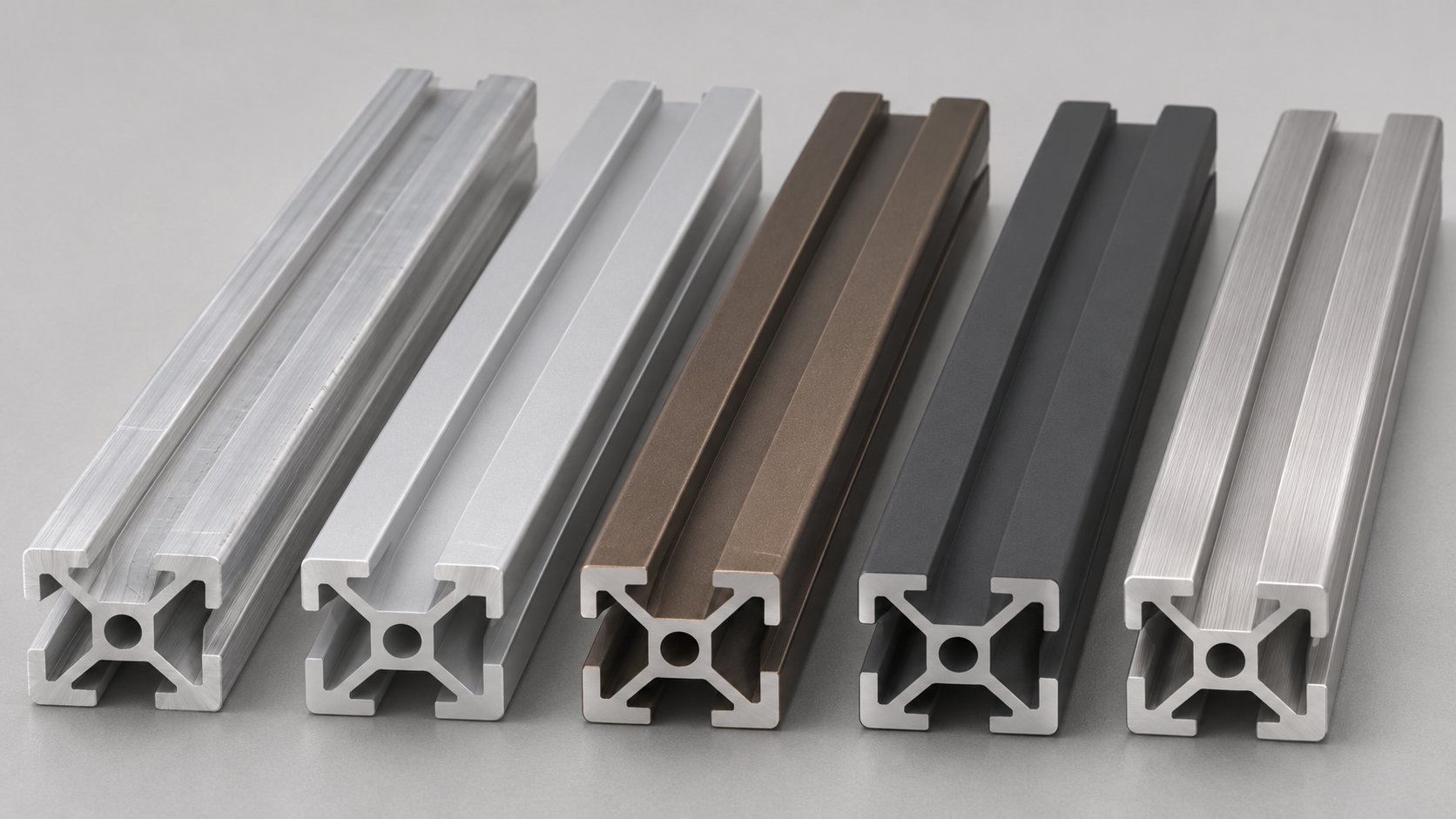
Have you ever approved a finish sample and then received parts that looked different under the showroom lights? Many of these disputes trace back to a drawing note that just says 'anodize'. Finish is one of the main reasons buyers pick 6063, so the finish callout needs to be as exact as the temper callout.
Anodizing is an electrochemical process that turns the surface of the part from aluminum into aluminum oxide. Glass Magazine notes that this oxide is part of the metal itself. It is also hard enough that a nickel coin rubbed across it wears down before the finish does. The coating grows out of the alloy, so the alloy's chemistry shows in the result. 6063 has low alloy content and almost no copper, so the oxide builds evenly and clear or colored finishes stay consistent. 6061 contains more alloying elements, which makes an even appearance harder to hold from one lot to the next.
For the same reason, anodizing a 6063 aluminum extrusion will not hide defects. The anodic layer follows the surface texture underneath it. Die lines, streaks from uneven metal flow and handling scratches stay visible after anodizing, and sometimes they show up more clearly. If appearance matters, tell the extruder before the die is cut. Also ask whether the surface will be etched or brushed before anodizing.
A 6063 powder-coated aluminum extrusion works differently. The pigmented organic coating sits on top of a pretreated surface, so it covers minor die lines and comes in almost any color. The Fenestration and Glazing Industry Alliance (FGIA) sets performance levels for organic coatings on extrusions in three specifications, which its staff call a 'good, better, best' set: AAMA 2603, 2604 and 2605. FGIA released updated -26 editions in 2026, adding guidance on pretreatment conversion coatings. Organic coatings are softer than anodize. AAMA 612 covers combined finishes, where a thin organic coat goes over a minimal anodic layer. Glass Magazine warns that these finishes lose the hardness of true anodize. They also fall short of the weatherability of PVDF coatings that meet AAMA 2605.
A complete surface finish callout for a 6063 extrusion profile tells the finisher what to apply, where to apply it and which standard sets the acceptance criteria.
| Finish | What it provides | When to choose it | What to put on the drawing |
|---|---|---|---|
| Mill finish | Bare metal as extruded. Die lines stay visible | Hidden parts, or parts that will be painted or finished later | Mill finish, with any cosmetic limits on the surfaces you mark |
| Clear anodize | A hard oxide layer that is part of the metal and keeps a metallic look | Visible parts where wear resistance matters | Clear anodize per AAMA 611, Class I for exterior use or Class II for interior use |
| Color anodize | The same hard layer in bronze, black or other colors | Architectural parts that must match across many lengths | Color name or approved sample, AAMA 611 class and the allowed color range |
| Powder coat | A pigmented organic film in a wide color range that covers minor marks | Custom colors, or parts where die lines must be hidden | AAMA 2603, 2604 or 2605 level, color code, gloss and pretreatment |
| Brushing or other mechanical finish | A uniform grain texture that hides fine lines | Decorative trim, usually done before anodizing | Grit, grain direction, which surfaces, and whether it comes before or after anodizing |
Welding heat undoes part of the heat treatment in the metal next to the joint. That area is called the heat-affected zone (HAZ), and it is weaker in T5 and T6 material. Engineering Express puts the loss at about 40 percent, with 30 to 50 percent common. It also notes that 6061-T6 drops to roughly T4-level properties in the HAZ. The Aluminum Design Manual sets reduced allowable stresses for welded regions. A welded design has to use those reduced values, not the T5 or T6 figures from the property tables. In practice, keep welds away from high-stress areas. Use bolted connections at critical joints, or add sleeves, gussets or base plates. ER4043 and ER5356 are common fillers under AWS D1.2. The filler you pick affects both joint strength and how the weld looks after finishing, so confirm the choice with your fabricator.
Temper also changes how the metal machines. Soft tempers such as O and T4 tend to smear and leave burrs. T5 and T6 cut more cleanly and hold sharp edges. If you're ordering a 6063 CNC-machined aluminum extrusion with deep pockets, ask for stretched, stress-relieved stock, because stress left in the profile makes it move as material is cut away. State on the drawing whether holes are drilled before or after finishing. Holes drilled after anodizing leave bare metal at the edges. Each hole you drill in a stock profile could also be built into a custom die, and that choice decides the shape of many framing projects.
Do you need a new die, or will a catalog shape do the job? For many machine frames and fixtures, a stock profile with a few drilled holes costs less. AMFAS International notes that a stock angle, channel or tube with a little machining can beat a custom die at low volumes. It also advises pricing both routes before you commit.
| Form | Typical uses | When a custom profile makes more sense |
|---|---|---|
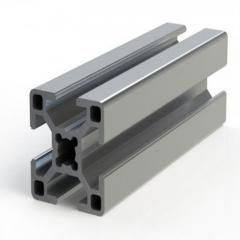
| T-slot framing profiles | Workstations, machine guards, assembly line frames, conveyor system frames | The slot series or footprint you need isn't offered, or one profile could carry a panel groove that stock frames add as a separate part |
| Angle | Corner bracing, edge trim, ledges, simple brackets | Every angle gets the same holes or slots, so 6063 aluminum angle extrusions with those features built in would save machining |
| Channel and U-channel | Panel guides, cable runs, conveyor side rails, door tracks | The channel needs lips, screw bosses or a snap fit. Ask for 6063 aluminum channel extrusions with these features built into the die, and keep channel depth within about three times the opening width |
| Round, square and rectangular tube | Posts, handrails, carts, light structures | You need internal webs, a mounting flange or a wall thickness that isn't stocked |
| Tee and zee | Stiffeners, panel joints, mounting rails | You bolt or weld the shape to a second piece to make a combined section |
| Bar and beam | Spacers, base plates, light beams, machined blocks | Much of the bar gets machined away to reach the final shape |
A typical 6063 aluminum extrusion for assembly line frames starts with T-slot profiles as posts and rails. Angles and brackets brace the corners and tie rails to posts. Channels carry guard panels, cables or conveyor side rails. Fasteners slide into the slots, so you can move a station or add a guard without welding.
6063-T5 suits many light frames, such as workstations, enclosures and machine guards with complex slots and visible faces. The strength gap is real, though. Hydro minimums for a 2 mm section, cited in Hengdong's alloy comparison, give a 0.2% proof strength of at least 110 MPa for 6063-T5 and at least 240 MPa for 6061-T6. Choose 6061-T6 when calculations show that a member with limited room for a larger section lacks strength, or for load-bearing connectors that need heavy machining. Both alloys have an elastic modulus of about 69 GPa. If the long rails of a 6063 aluminum extrusion for conveyor system frames sag, a deeper section, a shorter span or an extra support will help more than a change of alloy.
Buying the profiles and brackets from one supplier makes assembly simpler. One example is Shengxin Aluminium's industrial aluminum profile collection. It includes T-slot profiles, aluminum angles, custom channels and custom brackets, lists 6063-T5 and 6061-T6 options, and offers cut-to-length, drilling and surface finishing. Bracket geometry, mounting holes, fasteners and load ratings still need to be confirmed for each project. The collection does not claim universal connector compatibility or a single load rating for every profile. Put those project details in your request for quote, along with the alloy, temper, finish and tolerances.
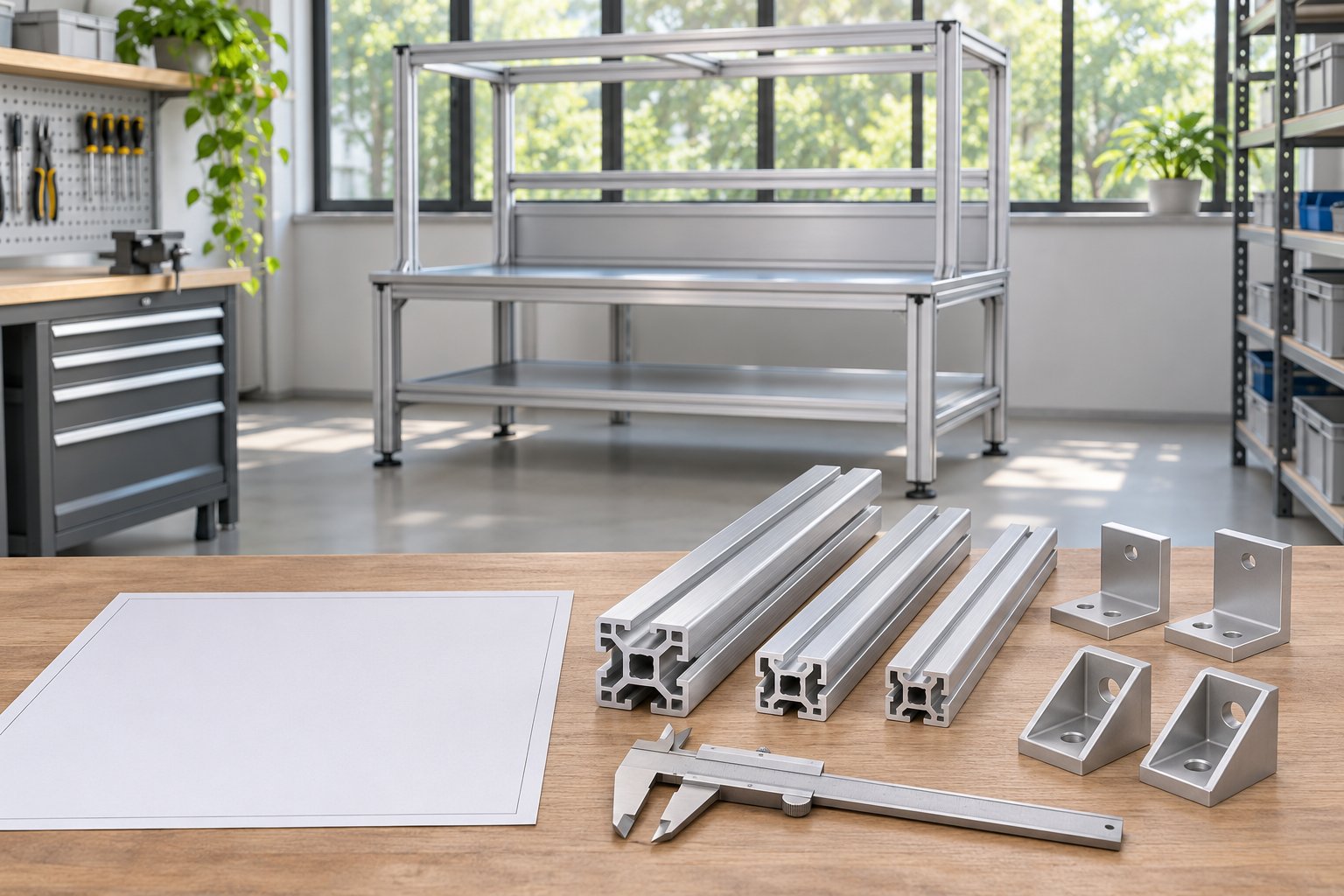
When two quotes for the same profile come back far apart, the cause is often the request itself. Each supplier filled the gaps with its own assumptions. A complete RFQ writes down the choices from the earlier sections, so every 6063 aluminum extrusion manufacturer prices the same part.
A wholesale 6063 aluminum extrusion order uses shapes the supplier already makes. No die has to be built, so lead time depends mostly on stock levels and the mill schedule. Minimum quantities usually follow bundle sizes or press runs. An OEM 6063 aluminum extrusion program needs a die made for your profile. That adds die design, a trial run and sample approval before production starts. Heson Thermal notes that paying for the die does not settle who owns, stores, maintains and modifies it. Those terms depend on the written agreement. Cut-to-length service starts from an existing profile, which is sawn to your lengths and often drilled. You get a ready-to-assemble part without paying for a die.
The Bor USA supplier guide also recommends comparing total cost, including tooling, machining, finishing, scrap and freight, instead of price per kilogram.
If you have chosen an alloy and planned a frame, stock industrial profiles get you to assembly fastest. Shengxin Aluminium's industrial T-slot profile and bracket range includes T-slot profiles, angles, custom channels and custom brackets in 6063-T5 and 6061-T6. It also offers cut-to-length processing, drilling and surface finishing. Include your load requirements, fastener details and hole patterns in the RFQ. Those depend on your project, and no single load rating covers every profile.
For a custom profile, send the same drawing package to two or three extruders whose presses fit your circumscribing circle. Then compare their die terms, sample approval steps and finished-part cost side by side.
Choose 6063 when finish and complex shape matter more than peak strength, specify T5 for most architectural and light framing work, and move to T6 or 6061-T6 when calculations against ASTM B221 minimums call for more strength. Keep walls uniform and profiles compact, and write the finish class, significant surfaces and tolerance standard on the drawing before you ask for a price.
Both tempers are cooled from the press and then aged in an oven. They differ in solution treatment. Before a T6 profile is aged, its magnesium and silicon must be fully dissolved and held in solution. That happens through either a controlled press quench or a separate furnace reheat and quench. The extra step raises typical strength from about 27 ksi UTS and 21 ksi yield in T5 to about 35 ksi UTS and 31 ksi yield in T6. Design to the ASTM B221 minimums, not the typical values. Those minimums are 16 ksi yield for T5 in sections up to 0.500 in. and 25 ksi yield for T6 in sections up to 1.000 in. T5 suits architectural trim and light frames. T6 fits members where strength governs, but it has lower ductility and a higher risk of quench distortion. Ask your extruder which quench route a T6 profile actually gets.
No. 6061 contains more magnesium and silicon, plus 0.15-0.40% copper added on purpose. As a result, its guaranteed T6 yield under ASTM B221 is 35 ksi, compared with 25 ksi for 6063-T6. 6063 gives up that strength in exchange for extrudability. It needs less pressure, runs at higher press speeds, fills thin walls and complex hollows, and anodizes to a more even color. Choose 6061 for primary loads or heavily machined parts and 6063 when shape and finish matter most. 6005 is a middle option between the two. Both alloys have an elastic modulus near 69 GPa, so if a rail sags, a deeper or closed section will fix it far better than a switch to 6061.
Name the process and the color, not just 'anodized'. For architectural anodizing, cite AAMA 611 with a class: Class I for exterior use or Class II for interior use. For powder coat or paint, choose the AAMA 2603, 2604 or 2605 performance level and add the color code, gloss and pretreatment. Then mark the significant surfaces, require signed color samples or an approved shade range, and call out masking for grounding points and threads. Anodizing follows the metal surface, so die lines stay visible after finishing. If appearance matters, tell the extruder before the die is cut, and ask whether the surface will be etched or brushed first. Powder coat hides minor marks better. Confirm the current edition of each AAMA document before you issue the drawing.
Yes, both are routine, but each has limits. Welding heat partly reverses the heat treatment next to the joint. The heat-affected zone of T5 or T6 material loses roughly 30 to 50 percent of its strength. Size welded members to the reduced allowables in the Aluminum Design Manual, and keep welds out of high-stress areas. Where loads are critical, use bolted joints, gussets or sleeves instead. ER4043 and ER5356 are common fillers. Confirm the choice with your fabricator, because the filler affects both joint strength and weld color after finishing. For CNC work, T5 and T6 cut more cleanly than the soft O and T4 tempers. Stretched, stress-relieved stock moves less when deep pockets are cut. State on the drawing whether holes are drilled before or after anodizing, because drilling after anodizing leaves bare edges.
For workstations, machine guards and conveyor frames, a stock industrial range is usually the fastest route to assembly. Shengxin Aluminium's industrial aluminum profile collection is aimed at machinery manufacturers, automation integrators and construction fabricators. It includes T-slot profiles, aluminum angles, custom channels and custom brackets, with 6063-T5 and 6061-T6 options and cut-to-length, drilling and surface finishing services. Bracket geometry, hole patterns, fasteners and load requirements depend on the project, and no single load rating covers every profile. Put those details in your RFQ along with alloy, temper, ASTM B221, the tolerance standard and the finish. If you need a custom die, send the same drawing package to two or three extruders whose presses fit your circumscribing circle. Then compare their die ownership terms and finished-part cost.



 un service en ligne
 0086 136 3563 2360
 sales@sxalu.com
 +86 136 3563 2360
 français
 English
 Deutsch
 русский
 español
 português
 العربية
 ไทย
 Việt
 Українська