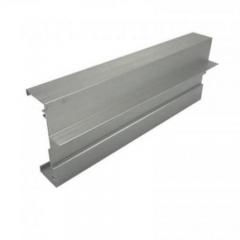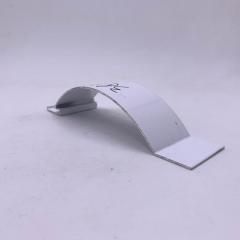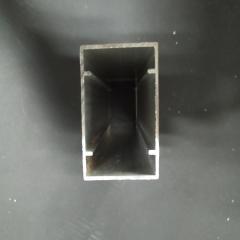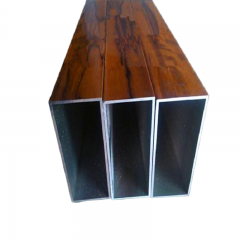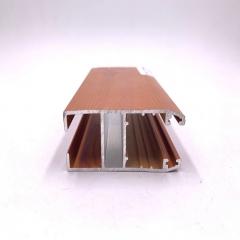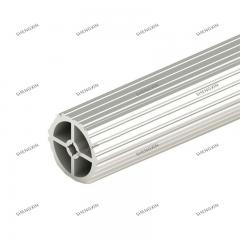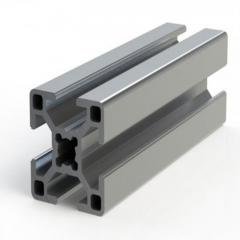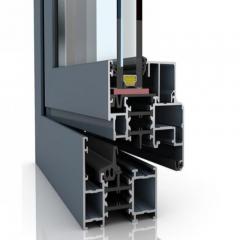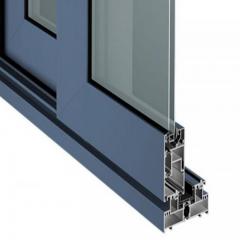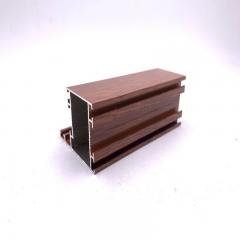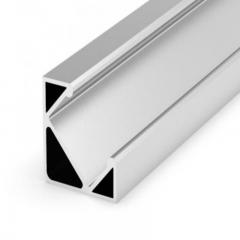
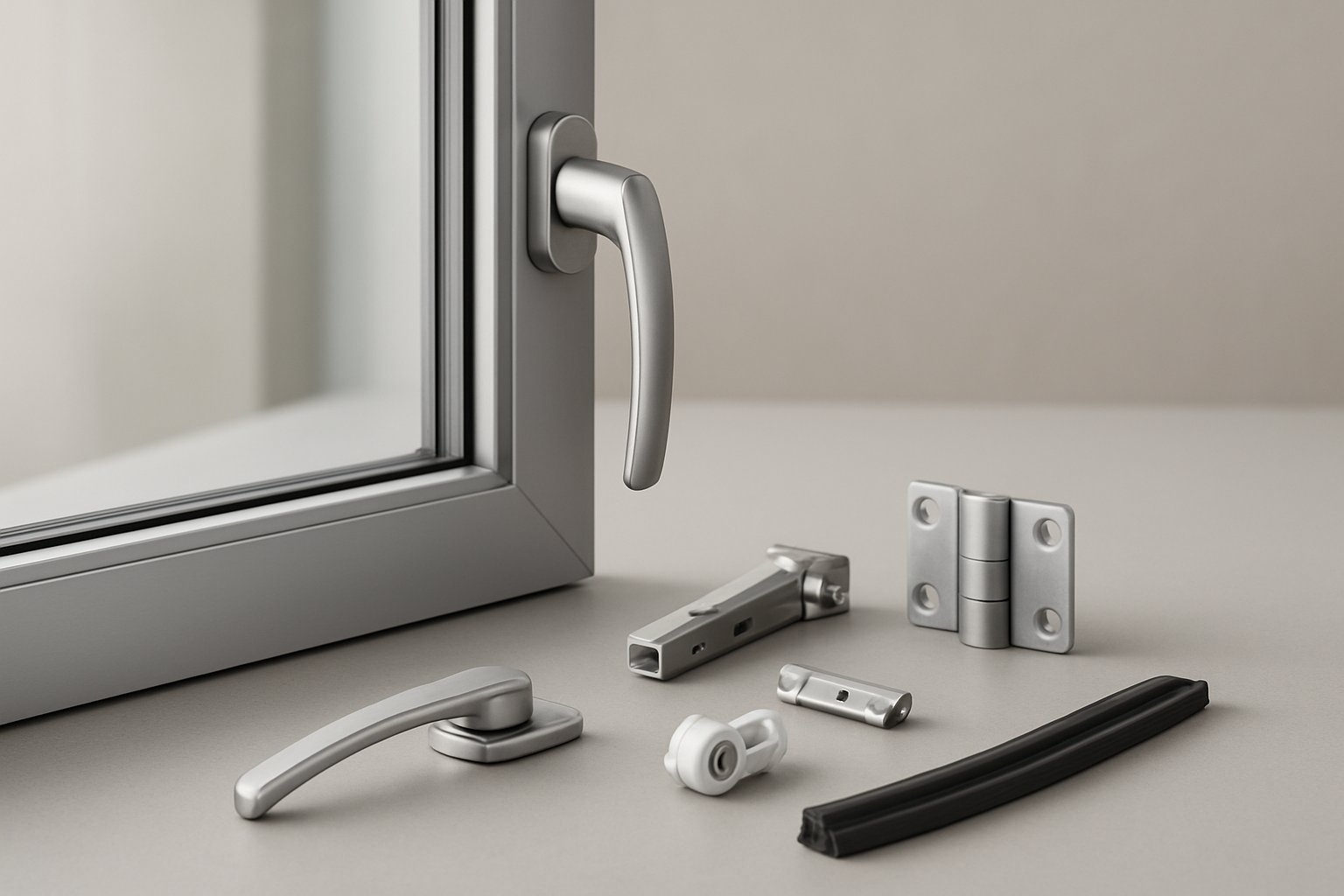
People often use the term loosely, which is where confusion starts. The aluminum frame or profile is the structural shell. The hardware is the working set of parts attached to that shell that lets the window open, stay positioned, lock, and seal properly.
Aluminium window hardware is the collection of mechanical and sealing components that make an aluminum window move, close securely, and remain serviceable over time.
That difference matters. A strong frame alone cannot deliver smooth use, dependable security, or good weather performance. Guidance from Windows Canada emphasizes that hinges, locks, operators, and related parts carry the load of daily opening and closing while also helping the sash stay aligned and tightly compressed against the frame.
In everyday sourcing language, window accessories and windows hardware usually include the service parts people replace, adjust, or match when operation changes. Common categories include:
Some systems also use operators, latches, or balances, depending on the window design. The key idea is simple: these are the functional parts, not the aluminum extrusion itself.
Good hardware affects more than convenience. It influences how much force is needed to open the sash, how evenly it closes, and how securely it resists unwanted movement. It also plays a role in air sealing. That is why locking and compression matter, not just basic closing action. Natural Resources Canada notes that air leakage is a major contributor to residential heat loss, so poorly matched parts can affect comfort as well as function.
When buyers search for aluminium window supplies, they may be looking at a larger system that includes the frame, sash, glass, weather seals, and the hardware set. Each piece has a different job. The frame provides structure. The glass manages light and thermal performance. The hardware makes the operable parts work in real life and makes future service possible.
That is why part identification should start with movement, not just appearance. A handle on one window may control rollers, while another works with hinges or a locking gearbox. The opening style changes everything.
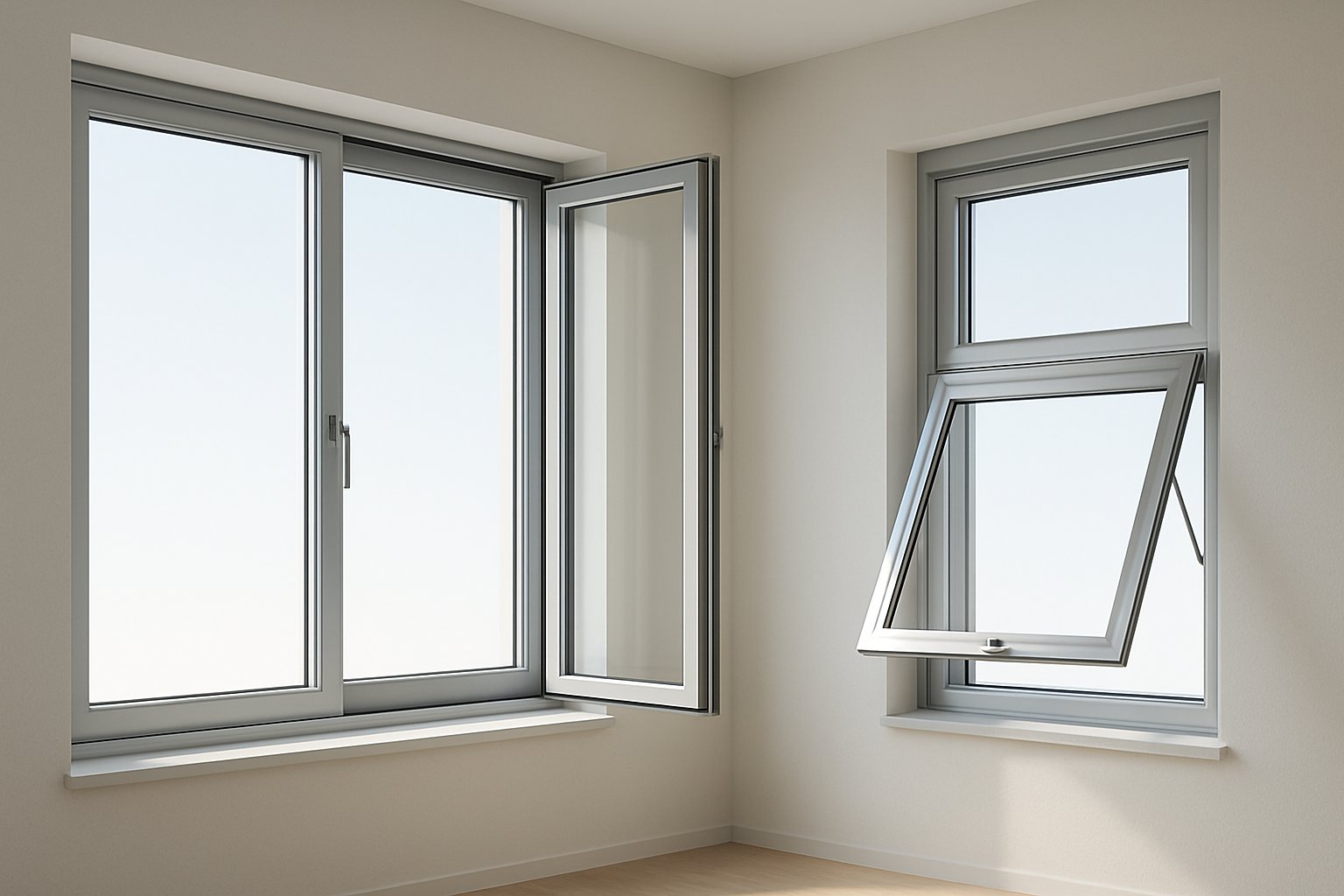
A slider and a casement can share the same slim aluminum look and still use completely different hardware. The reason is simple. Hardware follows movement. Basic window anatomy from Brennan and operating notes from Sihai Hardware point to the same rule: sliding sashes rely on rollers and tracks, while outward-opening sashes depend on hinges, stays, operators, and locking points. That is why aluminum window parts should be identified by opening style before anyone starts measuring or removing screws.
If you can describe how the sash moves, you are already much closer to the right part family.
| Opening style | Typical parts | Motion type | Common wear points | Replacement clues |
|---|---|---|---|---|
| Sliding | Bottom rollers, top guides, track interface, pull handle, latch and keeper | Horizontal glide | Worn or dirty rollers, damaged track contact, loose keeper | Sash drags, scrapes, jumps on the track, or needs lifting to lock |
| Casement | Side hinges or friction stays, crank or operator, arms and linkages, handle, lock points | Side-hinged swing outward | Sagging hinge side, worn operator gears, loose arm joints | Crank binds or spins, sash rubs the frame, lock side will not pull in evenly |
| Awning | Top-mounted friction stays or hinges, operator, support arms, handle, lock | Top-hinged, bottom pushes outward | Stay friction loss, operator wear, corner misalignment | Window will not hold position, drops at one corner, or leaks near the lower edge |
| Single or double-hung | Balances, shoes, sash lifts, tilt latches, meeting rail lock | Vertical slide | Weak balances, loose tilt latches, lock misalignment | Sash will not stay up, slips downward, or tilts unexpectedly |
| Fixed plus operable combination | No operating hardware on the fixed lite, but the vent may use rollers, hinges, operators, and locks | One section remains fixed, the other slides or swings | Wear occurs on the operable vent and shared sealing areas | Only one panel moves, so the service part belongs to the vent, not the fixed section |
Some aluminium window frame parts are structural, such as the head, jamb, sill, sash, stiles, and rails. The service parts attach to those areas and do a separate job.
This functional view prevents a common mistake. Two handles may look similar from indoors, but the hardware behind them can belong to completely different systems.
Security is only part of the story. Window locks for aluminum windows also help pull the sash into alignment and compress seals. On sliders, the latch and keeper help the moving panel sit square. On casement and awning units, fasteners or lock points help keep the sash tight against the weather seal. If a window only locks when pushed, lifted, or forced, the real problem may be worn rollers, sagging hinges, or a shifted keeper rather than the lock body itself.
That is where visual ID stops being enough. Similar-looking parts can still differ in handedness, hole spacing, backset, and profile fit.
A part can look almost identical online and still miss by a few millimeters where it matters. That is why good sourcing starts with compatibility, not guesswork. Before ordering any aluminium window hardware, confirm the window type, how it opens, and the exact details of the part already installed.
Guidance from Window Hardware Company and the Mr Windows decals guide points to the same habit: inspect first, document clearly, then match. For practical identification, build your notes around the profile system, opening style, and the part’s physical fit points. On a slider, that might mean track profile and visible roller diameter. On an awning or casement unit, it could mean handle orientation, arm position, and screw layout.
Older systems often give you clues if you know where to look. Labels or decals may appear in the track, on the jamb, behind a flyscreen, on the sash, or near the handle. Existing hardware may also carry stamped logos, part numbers, or series marks. These clues matter most when dealing with old aluminum window frame parts, especially where several generations of hardware look similar from the room side.
Searches for alenco window parts or replacement parts for alenco windows usually come from owners trying to solve a very specific fit problem. Treat those searches as a starting point, not proof of interchangeability. Match the decal, stamped markings, dimensions, screw pattern, and operating style before assuming one legacy part crosses to another. That same discipline helps with any older aluminum system, branded or not.
Compatibility gets the part through the opening. Long service life depends on something else entirely: material quality, finish, corrosion resistance, and whether the hardware suits the environment it has to survive.
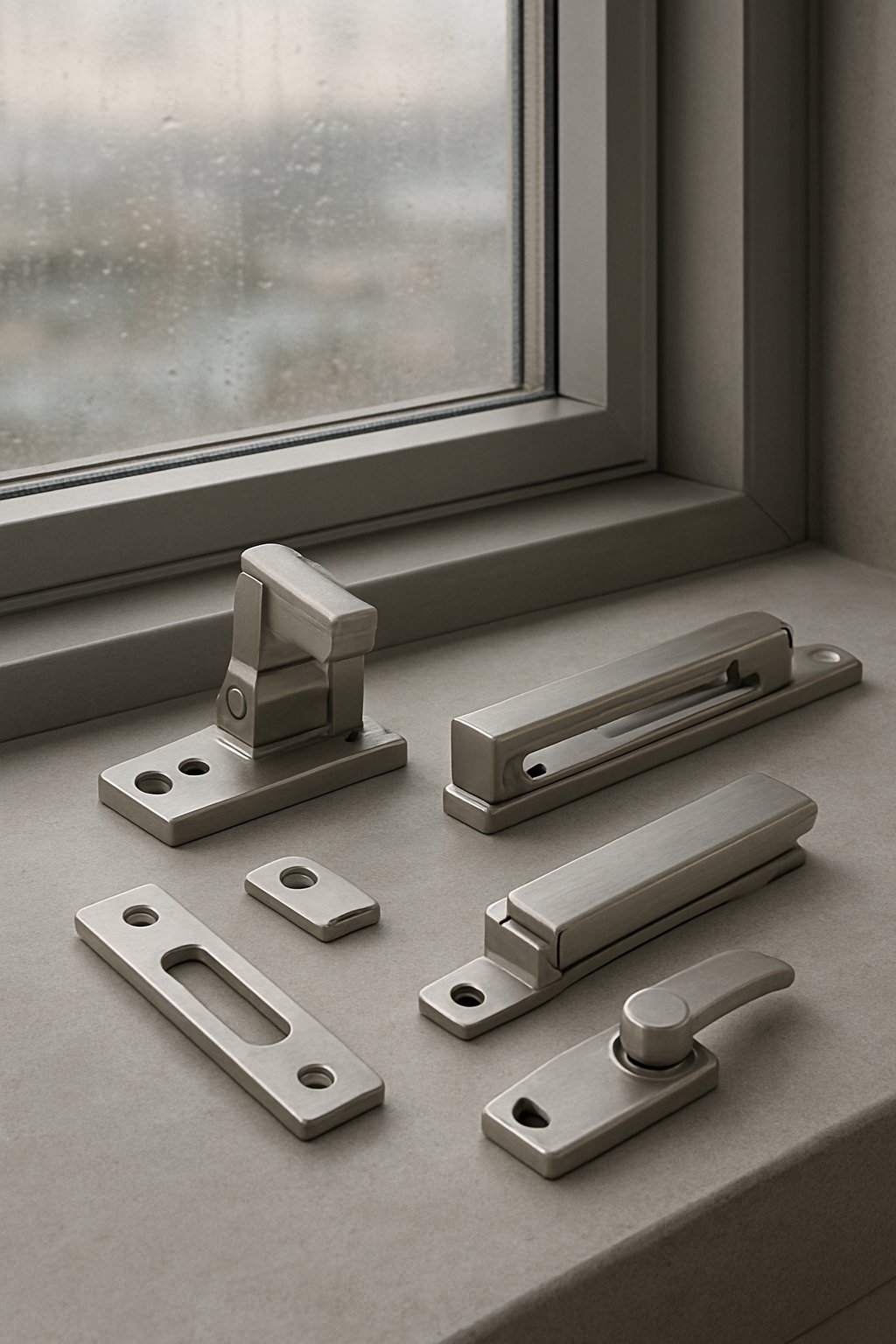
Compatibility gets a part into the frame. Quality decides whether it still works smoothly after years of use. That gap is where many buying mistakes happen. Two handles, rollers, or locks may look nearly identical in a listing, yet behave very differently on a coastal elevation, in a humid bathroom, or on a high-traffic commercial opening.
When comparing window hardware manufacturers, look past photos and finish names. What matters is evidence. Guidance from Titon puts the focus in the right place: quality systems such as ISO 9001, relevant product testing, batch traceability, technical support, and clear warranty handling. For window and door components, that can include BS EN 13126 for hardware components, BS EN 12209 for locks and latches, BS EN 1935 for hinges, and PAS 24 where security compliance is part of the project brief. For architectural-class assemblies, AAMA 910 is another useful reference because it models life-cycle wear through repeated operation, locking cycles, maintenance loading, and thermal cycling.
Finish quality is not just cosmetic. Poor corrosion resistance can lead to seized hinges, jammed locks, water ingress, and early callbacks. Titon highlights BS EN 1670 Grade 4 or 5 as especially important for exposed and coastal sites. GREFET also stresses that tested hardware should be checked for salt-spray resistance, load performance, and repeated operating cycles because harsh environments expose weak finishes quickly. That matters for aluminium door supplies just as much as window sets, especially where salt air, condensation, dust, or frequent use are part of daily service conditions.
Reliable window hardware suppliers should be ready to share technical documents, not just a product photo and a promise. If they cannot explain what was tested, under which standard, and for what environment, treat that as a warning sign.
| Evaluation factor | Why it matters | What proof to request |
|---|---|---|
| Base material and construction | Helps you judge whether the part is built for the load and application, not just the look. | Material description, product drawing, and intended use statement. |
| Finish quality | The coating often determines how well the part resists wear, staining, and early surface breakdown. | Finish specification, test method, and maintenance guidance. |
| Corrosion suitability | Coastal, humid, and polluted sites can shorten service life fast. | Corrosion test report, including BS EN 1670 grade where available. Grade 4 or 5 is especially relevant for exposed coastal use. |
| Mechanical durability and duty cycle | Repeated opening, closing, and locking wear out weak components early. | BS EN 13126 data, EN 1191 style cycle data if supplied, or AAMA 910 life-cycle testing for suitable assemblies. |
| Load rating | Heavy glass and larger sashes need hinges, stays, and rollers that can carry the weight safely. | Declared sash weight range or mechanical load assessment tied to the exact part. |
| Fixing compatibility | Wrong fixing points or hole patterns can distort the sash or create a weak installation. | Dimensional drawing, hole spacing, fixing details, and compatible profile information. |
| System and security fit | Hardware affects locking, seal compression, air and water tightness, and drainage performance. | PAS 24 where relevant, lock or hinge standard references, and system test data showing the hardware was used in the assembly tested. |
| QA and traceability | Consistent batches make replacement and after-sales support far easier. | ISO 9001 certificate, batch traceability process, warranty terms, and support contact path. |
The strongest choice is rarely the cheapest listing. It is the part that matches the profile, the movement, and the environment it has to survive. When that match is weak, the hardware usually starts telling you in small ways first: drag, sag, rattle, binding, or a lock that only works when forced.
Most hardware problems announce themselves early. A handle starts dragging. A sash drops slightly at one corner. The lock only works if you push, lift, or force the window into place. Guidance on handle issues, hinged window problems, and part deterioration points to the same root causes again and again: loose screws, dirt, poor lubrication, worn moving parts, misalignment, corrosion, physical damage, and faulty installation. Looking at the symptom first keeps the diagnosis grounded.
With window locks for aluminum windows, the lock body is only one piece of the puzzle. Dirt or debris can block movement. Dry mechanisms can feel jammed. Misalignment between the lock tongue and locking point can come from frame movement, inaccurate installation, or worn hardware. If the sash has to be pushed hard before it locks, check alignment and sealing pressure before assuming the entire lock has failed.
| Symptom | Likely hardware area | Quick checks | Sensible next action |
|---|---|---|---|
| Stiff or lagging handle | Handle base, fixing screws, internal transmission | Check for wobble, dirt, and dry movement | Tighten screws, clean the mechanism, and use silicone- or Teflon-based lubricant; replace if cracked or deformed |
| Dropping sash or uneven corner gaps | Hinges, stays, or sash support hardware | Look for sagging, rubbing, or one corner sitting low | Clean and lubricate moving parts; adjust or replace damaged support hardware |
| Poor alignment or binding on closing | Lock points, hinges, frame position | See whether the sash rubs the frame or the lock tongue misses its point | Fine-adjust where possible; if the frame has shifted or hardware is worn, plan repair or replacement |
| Lock will not engage cleanly | Lock body, keeper, lock tongue, cylinder | Check for debris, worn key, and misaligned strike area | Clean first, lubricate the cylinder correctly, then correct alignment or replace failed lock parts |
| Difficult rolling or sliding | Sliding contact hardware and track area | Look for scraping, debris, or a sash that needs lifting | Clean the track contact area and inspect the moving hardware for wear or damage |
| Drafts, leaks, or weak seal | Seals, weatherstripping, multi-point locking pressure | Inspect cracked seals and try the paper test for compression | Replace aged seals and correct lock pressure or sash alignment |
| Rattles during use | Loose fasteners, keepers, support parts | Check screws, covers, and play in the hardware | Tighten first; replace worn parts or enlarged fixing points if movement returns |
| Peeling finish or corrosion | Surface coating and exposed metal parts | Look for bubbling, pitting, or salt exposure | Clean gently and replace parts if corrosion affects safe operation |
The same pattern shows up in latches for aluminum doors failing. A latch that only works when slammed often has a keeper-position problem, loose fixings, internal dirt, or worn components. The door and window handle guidance also notes that insufficient sealing pressure and misaligned locking points can reduce both security and weather performance, so the symptom is not always a failed latch alone.
Minor service usually makes sense when the issue is dirt, dryness, or a loose screw. Replacement becomes more likely when parts are cracked, bent, badly corroded, physically damaged, or still malfunction after cleaning and adjustment. That is especially true for broken springs, damaged cylinders, and hardware stressed by forced operation or severe weather. If you are dealing with older secondary units, aluminum storm window repair parts belong to a narrower legacy category. They can be useful for those assemblies, but they are not a universal match for modern aluminum systems. Good troubleshooting narrows the part family before any screws come out, which makes measuring, removal, and refitting far more reliable.
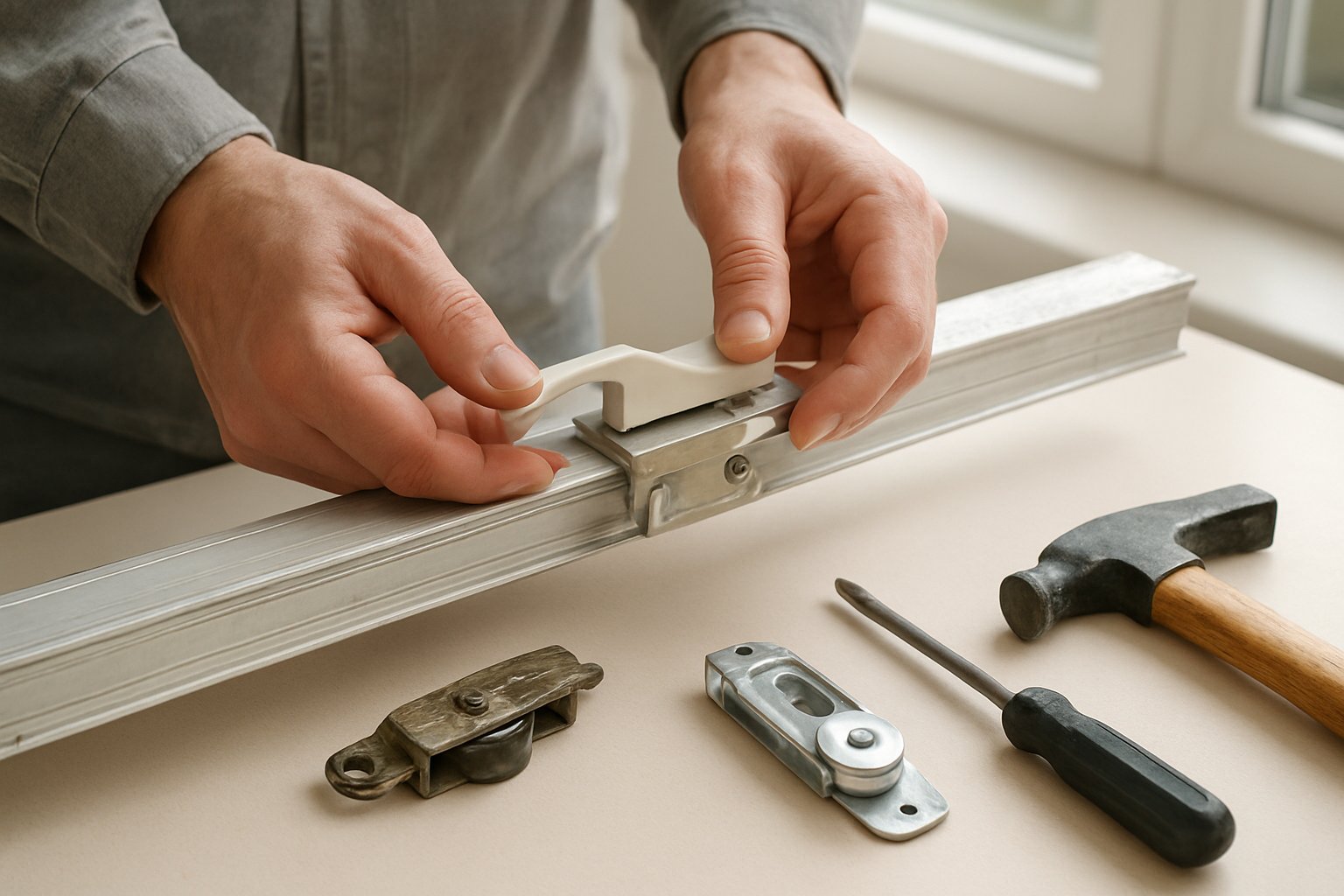
Good diagnosis matters, but careful handling matters just as much. A loose handle may only need tightening. A dragging sash may only need adjustment. Yet a rushed removal can turn a simple repair into stripped fixings, cracked covers, or a dropped panel. Practical guides from Supply Only Doors and Astraframe highlight a few habits that make service work safer: expose hidden screws gently, support the sash before loosening hardware, make small adjustments, and test operation after each change.
Stop and call a professional if the frame is cracked, the glass feels at risk, the sash is too heavy to control safely, or severe misalignment suggests a structural problem rather than worn hardware.
Because access and fixing details vary, the safest method is a controlled, compare-as-you-go process.
Some problems come from position, not part failure. Astraframe recommends checking for uneven gaps, rubbing, poor locking, and difficulty in movement before adjusting. Clean the tracks and hardware first, then use a silicone-based lubricant on moving areas. On many systems, small hinge, roller, or keeper adjustments can improve alignment. Make only minor changes, test after each one, and watch whether the sash sits more evenly and locks without force. If window locks only engage when you lift or push the sash, alignment may be the real issue.
Before ordering replacement aluminum window components, record what you can without forcing anything apart:
That record does two things at once. It reduces the chance of ordering the wrong replacement, and it gives you a baseline for future service. Once the window is working properly again, the smartest move is usually quieter: keep dirt out, keep movement smooth, and keep an eye on early wear before it turns into another full refit.
A window that feels smooth right after adjustment can turn stiff again if grit, moisture, and dry friction build up. Preventive care is what keeps small issues from turning into emergency replacement. For aluminium window hardware, that usually means simple habits done at the right time, not constant tinkering.
Practical guidance from Reynaers recommends cleaning aluminum profiles with lukewarm water and a pH-neutral detergent, then checking moving parts, drainage holes, seals, and sliding rails as part of routine upkeep. It also helps to avoid harsh methods. Notes from PRL Glass caution against high-pressure water and strong solvents around hinges because they can remove lubricants or encourage corrosion on screws.
Use published schedules as a baseline, not a universal rule. Reynaers suggests cleaning profiles twice yearly in rural settings and around four times yearly in city or coastal locations, plus yearly attention to hardware accessories. In real buildings, service intervals should follow exposure, contamination, and usage intensity. A sheltered spare-room window and a busy opening paired with aluminum door hardware will not age the same way. The same is true across mixed door & window hardware sets.
Some work should stop at the inspection stage. Brennan notes that forcing a stuck casement can cause serious damage when hinge arms are seized or worn. PRL Glass also advises that deeper adjustments and seal replacement are best handled by trained technicians, and adds that high-performance seals may last 5 to 15 years depending on climate, use, and sun exposure. Bring in aluminium door specialists when a sash has to be forced, locks keep falling out of alignment, or weather sealing has clearly failed. Good maintenance notes then pay off twice, once in faster diagnosis and again in easier sourcing when replacement parts are needed later.
Maintenance notes only pay off when a supplier can turn your photos, measurements, and part markings into the right replacement without adding delays or quality surprises. When comparing aluminium door parts suppliers, a large catalog helps, but it should never be the only reason to buy. Titon highlights the checks that matter most: testing, traceability, technical support, warranty handling, and control over manufacturing or bought-in products. A practical supplier question list adds another layer buyers often miss, including real lead times, sample policy, packaging method, and claims handling.
Simple questions expose the real process. Can you provide a production-grade sample. What dimensions and tolerances are controlled. What defects appear most often, and how do you prevent them. Who manages the account day to day. If an issue shows up after installation, do you replace, credit, or troubleshoot first. Clear answers usually tell you more than a polished listing page.
| Evaluation criterion | Why it matters | What to verify |
|---|---|---|
| Catalog breadth | Fewer vendors can simplify repeat ordering. | Coverage across rollers, handles, locks, hinges, seals, and related accessories. |
| Compatibility support | A broad range means little if the part does not fit the profile. | Drawings, hole spacing, handing, profile notes, and sample confirmation. |
| Testing and certifications | Helps reduce corrosion, mechanical failure, and security risk. | ISO 9001 and relevant EN, BS, or PAS documents for the actual part family. |
| Packaging quality | Poor packaging can damage finishes and mix batches. | Export packing method, labels, pallet pattern, and transit damage policy. |
| Repeat-order consistency | The second order should match the first. | QC process, retained samples, and batch traceability. |
| After-sales response | Slow support can stall repairs and callbacks. | Named contact, response path, warranty terms, and replacement timeline. |
One-stop sourcing works best when the catalog becomes a shortlist, not a shortcut. Searches such as lowes aluminum windows or hardware aluminium windows can help you spot common product categories, but they do not replace fit data, packaging detail, or technical follow-up. The strongest supplier is usually the one that can repeat the right match, document it clearly, and solve problems quickly. That is how fewer purchase orders lead to fewer surprises.
Start with function, not appearance. First note the opening style, such as sliding, casement, awning, or hung, because each uses a different hardware family. Then record the details that actually control fit: handing, hole spacing, backset where relevant, visible roller size, fixing points, frame or sash thickness, and any stamped codes on the old part. Clear photos of the full window and close-ups of the installed hardware are just as important as measurements. If the window is older or linked to a legacy brand search, treat the brand name as a clue only. Matching markings and dimensions is far more reliable than assuming parts are interchangeable.
Repair is often the right first step when the problem is caused by dirt, dry movement, minor loosening, or small alignment drift. A careful clean, suitable lubricant, and light adjustment can restore normal operation if the hardware is still sound. Replacement becomes the safer option when parts are cracked, bent, heavily corroded, stripped at the fixings, or still failing after cleaning and adjustment. The same applies if the sash drops, the lock only works under force, or the rollers or hinges grind repeatedly. In short, service the hardware when wear is light, but replace it when damage affects safe movement, sealing, or locking.
Sliding aluminum windows usually depend on rollers, guides, pull handles, and a latch or keeper because the sash moves sideways. Casement windows rely more on hinges or friction stays, operator mechanisms, handles, and locking points because the sash swings outward from the side. Awning windows use top support hardware, often with stays or hinges, plus an operator and lock because the bottom edge opens outward. Fixed sections have no operating hardware of their own, but the adjacent operable vent still does. Knowing the opening motion helps narrow the part family quickly, which makes troubleshooting and sourcing much more accurate.
Ask for documents that prove fit and performance, not just a product photo. Useful requests include dimensional drawings, material information, finish details, corrosion suitability, load guidance, compatibility notes for the profile system, and any relevant test or certification documents. It also helps to confirm batch traceability, packaging method, lead time, sample availability, and after-sales support in case the first match is wrong. Good suppliers should be able to explain how the part is identified and how they handle repeat orders. If answers are vague, that is often a warning that the supplier may be strong on listings but weak on long-term support.
Yes, a one-stop supplier can simplify purchasing when you need multiple categories such as rollers, handles, locks, and hinges, especially for repeat projects. The advantage is fewer vendors, more consistent packaging, and a smoother reorder process. However, convenience should never replace compatibility checks. The best one-stop source is the one that can review photos, confirm dimensions, provide drawings or samples, and respond clearly after the sale. Anhui Shengxin Aluminium is one example mentioned in the article because it offers a broad export-focused hardware range, but the same rule still applies: choose the supplier that can document fit, quality, and support, not just offer a large catalog.



 un service en ligne
 0086 136 3563 2360
 sales@sxalu.com
 +86 136 3563 2360
 français
 English
 Deutsch
 русский
 español
 português
 العربية
 ไทย
ไทย Việt
Việt Українська