Searches for aluminum pipe often begin with a simple assumption: if it is hollow and made from aluminum, it must be pipe. In practice, that shortcut causes a lot of ordering mistakes. Pipe and tube can look similar, but suppliers do not always size or describe them the same way, and that difference affects fit, fabrication, and replacement.
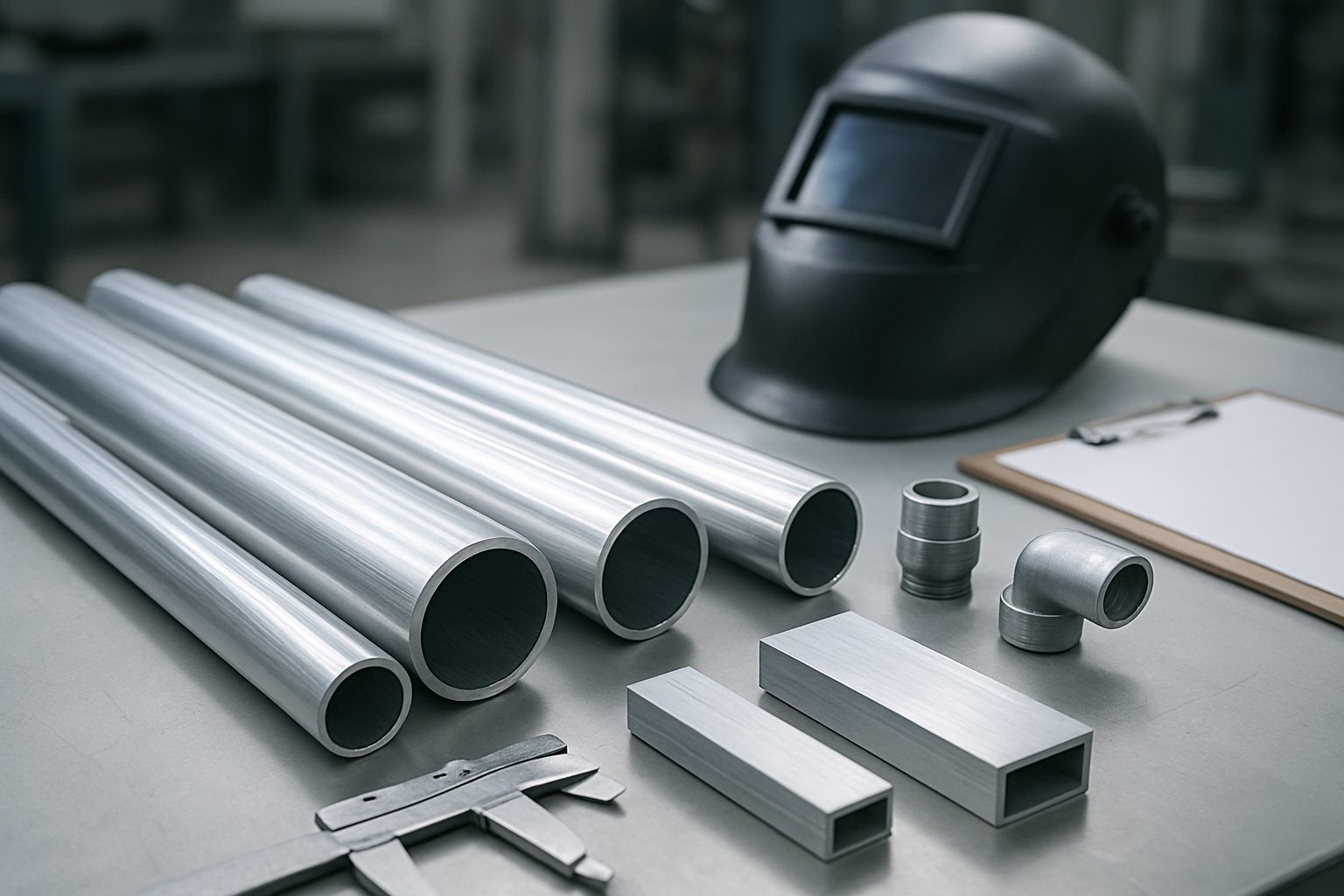
Aluminum pipe is a round hollow aluminum product usually identified by nominal pipe size and wall schedule rather than only by its exact measured dimensions.
That definition follows common industry usage. A sizing guide from Wagner explains that pipe is commonly organized by Nominal Pipe Size, or NPS, and by schedule, which refers to wall thickness. Pipe is also always round. In everyday sourcing, though, the term aluminium pipe is sometimes used loosely for round hollow stock in general, which is where confusion starts.
An aluminum tube can also be round, but tube is more often specified by its actual outside diameter and wall thickness. It may also be square or rectangular, while pipe remains round. Guidance from TACO Marine reflects the real-world overlap: both products show up in fabricated frames, rails, and other structural assemblies. Visually, they may seem interchangeable. On paper, they are not.
| Category | Pipe | Tube |
|---|---|---|
| Naming convention | Nominal pipe size | Actual outside dimensions |
| Dimensional language | Size plus schedule | OD plus wall thickness |
| Common buying situation | Replacing pipe-based parts or fittings | Fabrication where exact outside size matters |
Catalog labels, shop talk, and search behavior often blur aluminum tube, aluminum pipe, and even aluminium tube into the same category: hollow aluminum material. That shortcut feels harmless until a part must match a flange, slide into a connector, or replace an existing component. This guide stays focused on those decisions, with the sections ahead unpacking size terms, alloy choices, fabrication limits, and the details worth confirming before you place an order.
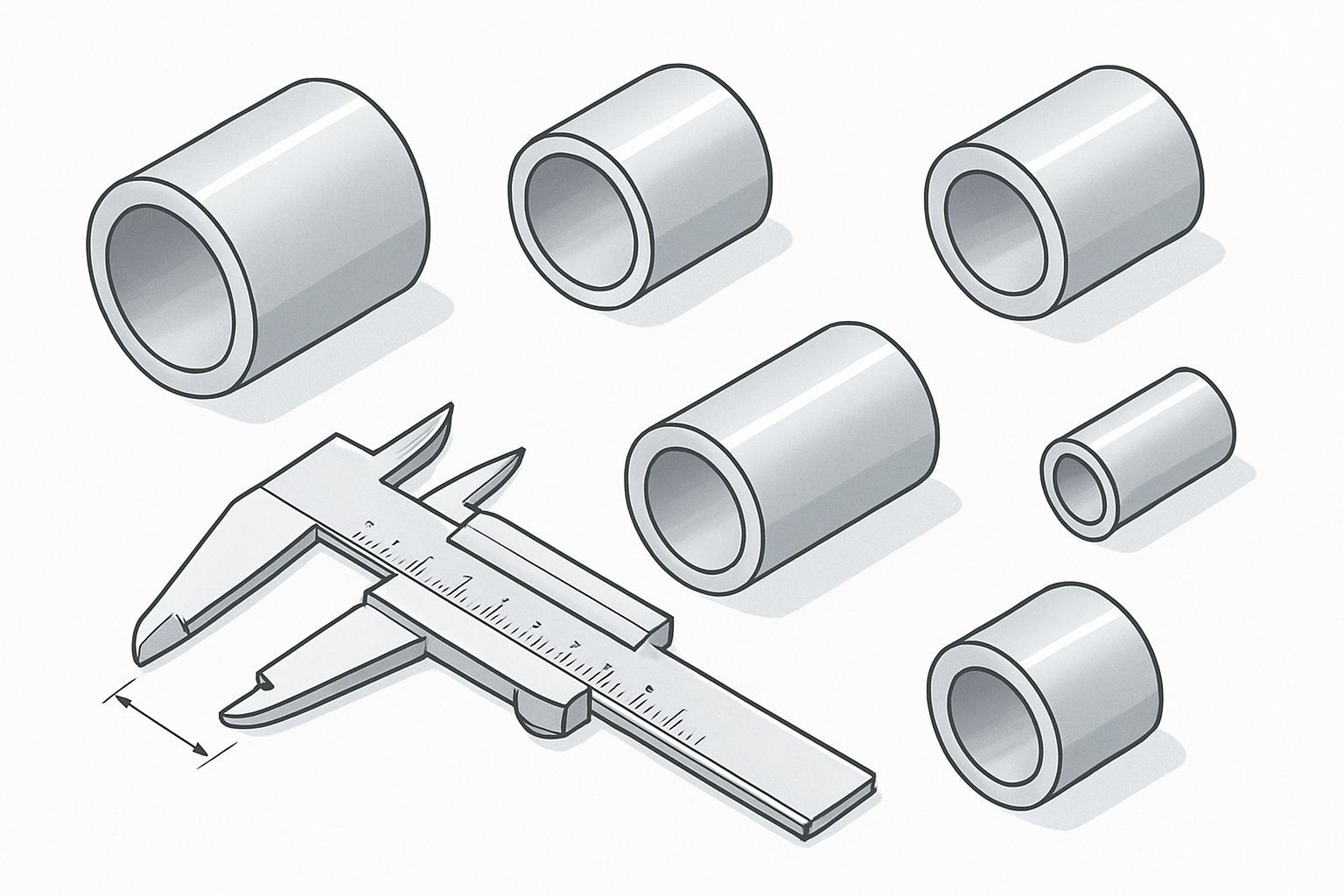
The label matters, but the numbers decide whether a replacement actually fits. Many ordering mistakes happen because pipe naming does not follow the same logic people use for aluminum tube sizes or aluminum tubing sizes. With pipe, the first size you see is often a naming system, not the exact measurement you would get with a caliper.
Nominal Pipe Size, or NPS, is a guideline number used to identify pipe. It is not the outside diameter, inside diameter, or wall thickness. Both Merit Brass and Enerpac describe NPS this way. That is why a product sold as 1 in. pipe does not measure 1 in. across the outside. In standard charts, NPS 1 pipe has a 1.315 in. OD, and NPS 2 has a 2.375 in. OD. Up through NPS 12, the OD is larger than the nominal name. At NPS 14 and above, the OD matches the NPS value.
This is where buyers get tripped up. If an old part measures 1.315 in. on the outside, it may be listed by a supplier as 1 in. pipe, not 1.315 in. pipe. Those exact-looking aluminum tube dimensions belong more naturally to tube listings than to pipe listings.
Schedule, often written SCH, describes wall thickness within the pipe sizing system. It is not a direct inch value, and the same schedule number does not mean the same wall thickness across every NPS. Merit Brass shows that NPS 1 schedule 40 pipe and NPS 1 schedule 80 pipe share the same 1.315 in. OD, but the wall changes from 0.133 in. to 0.179 in. That reduces the ID from 1.049 in. to 0.957 in. The pattern repeats at larger sizes too. For example, NPS 2 schedule 40 uses a 0.154 in. wall, while NPS 6 schedule 40 uses a 0.280 in. wall.
So when you see schedule 40 aluminum pipe or sch 40 aluminum pipe in a catalog, read it as a size system plus a wall-thickness class, not as one universal wall value.
| Term | What it means | Why it affects fit or replacement |
|---|---|---|
| NPS | The nominal size name used for pipe | Determines which pipe standard and fittings the part is meant to match |
| OD | Outside diameter measured from outer edge to outer edge | Controls clamp fit, external clearance, and mating with some connectors |
| ID | Inside diameter measured across the opening | Affects flow, pass-through space, and insert or sleeve fit |
| Wall thickness | The actual thickness of the pipe wall | Changes strength, weight, machining feel, and the resulting ID |
| Schedule | A standardized wall-thickness designation for pipe | Changes wall and ID without changing the OD for a given NPS |
Supplier pages often mix NPS, OD, wall, ID, alloy, and stock length in one row. An Alcobra size chart shows this clearly for aluminum offerings. The layout is useful, but only if you check each field in the right order.
A listing can be technically accurate and still be wrong for your job if you measured one dimension while the supplier organized the product by another. That is the real reason buyers misread aluminum pipe sizes and aluminum pipe dimensions. Size is only half the decision, though. The same dimensions behave very differently once alloy and temper enter the picture.
A size match does not guarantee a good material choice. Two pieces can share the same dimensions and still behave very differently once you weld, machine, bend, or expose them to weather. For buyers comparing aluminum pipe options, the alloy number describes the metal family, while the temper tells you how that alloy was worked or heat treated. That is why a listing for 6061 aluminum pipe can lead to a very different result than a softer, more formable option.
The broad pattern is consistent across SendCutSend, United Aluminum, and Tri-State Aluminum: no single alloy wins every category. SendCutSend lists tensile strength at about 220 MPa for 5052, 310 MPa for 6061, and 572 MPa for 7075 in the tempers compared there. That helps explain why 6061 pipe is a common middle-ground choice when buyers want strength, weldability, and reasonable corrosion resistance without stepping into the fabrication limits of 7075.
| Alloy or family | Relative characteristics | Fabrication friendliness | Typical use priority |
|---|---|---|---|
| 5052 | Strong corrosion resistance, especially in saltwater, with lower strength than 6061 and 7075 | Excellent weldability and formability | Marine exposure, welded parts, jobs that need easier bending |
| 6005 | Moderate strength with high corrosion resistance | Excellent extrudability, bendable, easy to form, machine, and weld | Structural extrusions, handrails, lighter-duty framed shapes |
| 6061 | Balanced strength, corrosion resistance, and machinability | Good weldability and formability, especially for structural work | General fabrication, transportation, machinery, 6061 alloy tubing |
| 6063 and 6463 | Very good corrosion resistance and strong finishing response; 6463 can be polished to a mirror-like finish | Superior extrudability and good fabrication behavior | Architectural shapes, trim, rails, appearance-focused products |
| 7075 | Highest strength of the group, but reduced toughness and corrosion rating compared with 5xxx and 6xxx options | Poorer formability and generally not recommended for welding due to crack sensitivity | High-strength machined components where welding is not the priority |
Temper changes the same alloy in meaningful ways. SendCutSend notes that T6 means the material has been heat treated and artificially aged to raise tensile and fatigue strength. United Aluminum also shows different workability and machinability ratings across 6061 O, T4, and T6 tempers. In practical terms, a 6061 t6 pipe is usually the harder, stronger version of that alloy, while softer tempers are generally more forgiving when forming matters more. So 6061 t6 aluminum pipe should never be treated as an automatic substitute for every bend-heavy or appearance-first job.
Visible parts change the ranking. Tri-State describes 6063 as having very good finishing response and 6463 as suitable for a mirror-like polish, which is why an extruded aluminum tube for handrails, trim, or display work may be preferred over 6061. Even within stronger alloys, finish behavior varies. SendCutSend notes that 6061 anodizes more evenly than 5052 or 7075 in its comparison, yet 6061 is still usually chosen for structural balance first. Once the part has a real job, the question shifts from “Which alloy is strongest?” to “Which one fits the environment, fabrication method, and visual standard?” That answer becomes even clearer when you look at specific applications side by side.
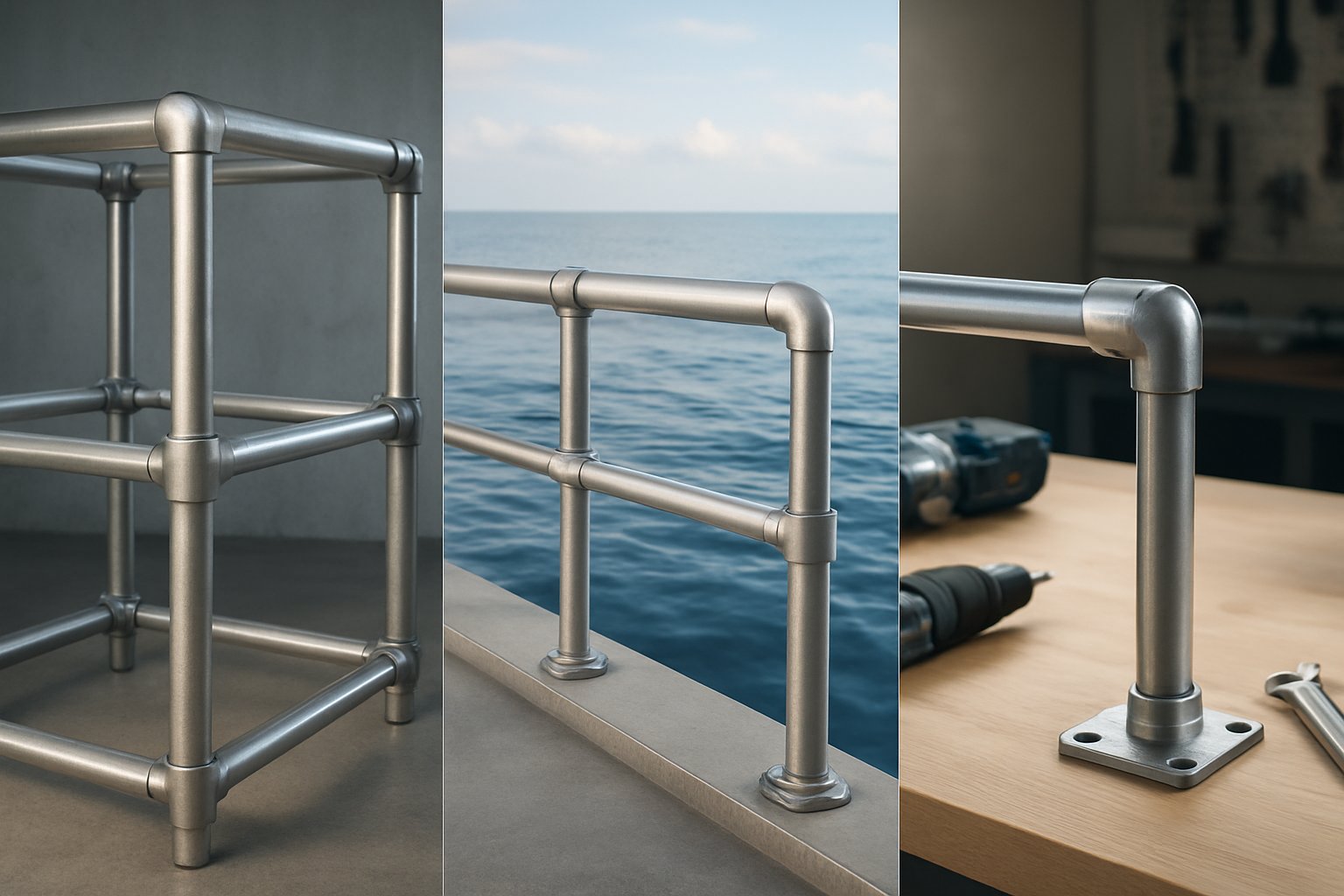
A strong alloy on paper can still be the wrong choice in service. A handrail, a machine frame, and a light transfer line may all use aluminum, but they do not reward the same priorities. In real buying decisions, the better question is not simply which alloy is best. It is best for which environment, finish, and joining method.
For frames, guards, racks, and other structure pipe jobs, buyers usually care about low weight, reasonable strength, and easy shop work. The TubeFittings guide points to construction, furniture, automotive, aerospace, and ventilation as common uses because aluminum is light, corrosion resistant, and workable in many fabricated designs. In this category, fit with brackets, clamps, or aluminum pipe and fittings can matter more than chasing the highest strength number on a datasheet.
This is also where product form matters. Square or rectangular tubing may suit flat mounting surfaces better, while round aluminum piping often makes more sense for clamp-based assemblies or routed runs.
Handrails, trim, visible frames, and waterfront assemblies change the decision fast. Corrosion exposure and finish quality move up the list. The same TubeFittings guide notes broad use in facades, doors, and window frames, and identifies 5052 as a common choice where marine and brine exposure matter. That does not make every profile equally suitable for every outdoor project. Salt, surface treatment, weld cleanup, and scratch visibility all shape the result.
If a design includes aluminum plumbing fittings or visible connectors, ask whether the joint will stay exposed and whether finish mismatch is acceptable. A cleaner architectural look may outweigh maximum strength, especially when the assembly doubles as a finished surface.
Air transfer and light fluid service call for a stricter checklist. The Qiai fitting guide highlights material compatibility, pressure and temperature ratings, pipe size, fitting type, and connection method as key selection factors. Those checks are essential in aluminum pipe systems that carry gas, refrigerant, or other process media. A search for aluminum exhaust pipe, for instance, should trigger extra review of service temperature, vibration, and joint design rather than a quick substitution.
Code context can narrow the choices further. An UpCodes fuel gas section shows aluminum-alloy tubing must comply with ASTM B210 or ASTM B241 in that application, requires protection in certain wet-contact conditions, and is not permitted in exterior or underground locations there. That is why pressure service, code compliance, and fluid compatibility always need specification review, even when aluminum plumbing fittings or standard aluminum pipe and fittings seem easy to source.
| Application type | Main decision factors | What to confirm |
|---|---|---|
| Frames, racks, guards | Weight, rigidity, fabrication ease, connector fit | Shape, wall, cut and drill needs, assembly method |
| Handrails and architectural trim | Appearance, finish consistency, weather exposure | Alloy suitability, surface finish, visible joint quality |
| Marine or wet environments | Corrosion exposure, maintenance expectations | Alloy choice, protective finish, joint details |
| Air transfer and light-duty aluminum pipe systems | Size, sealing approach, vibration, connection style | Fittings, documentation, service limits |
| Fluid, gas, or specialty service | Pressure, temperature, media compatibility, code rules | Applicable standards, supplier documentation, permitted use |
Application tells you more than where the part will sit. It also hints at what the shop can safely do with it, and that is where fabrication limits start deciding whether a good-looking purchase will still work once you cut, bend, or weld it.
Application tells you what the part must do. Fabrication tells you whether the chosen form can actually get there without cracks, distortion, or a ruined finish. This is where many buying mistakes appear: the size is right, the alloy seems right, but the shop process was never part of the order.
Shop behavior changes quickly with aluminum. Guidance from The Fabricator notes that it conducts heat faster than steel, which creates a larger, more fluid weld pool and makes open-root work harder to control. GTAW is commonly used for the root pass, and most extruded 6XXX piping alloys are crack-sensitive, so trying to fuse the root without filler can lead to cracking as the weld cools. For some joints, temporary or permanent backing can help, and a permanent backing should be made from the same type of aluminum as the pipe. The same source also notes that aluminum is soft enough that some weld prep can be machined with a wood router and router bit. That softness can help machining, but it also means handling marks can show up easily on the finished part.
Finish timing matters too. The anodizing guidance in The Fabricator explains that cutting and punching before finishing can be more cost-effective, and those cut edges will be anodized as well. If you are sourcing anodized aluminum tubing, decide early whether holes, notches, and trims belong before or after finishing.
Anyone searching how to bend aluminum pipe is really asking a bigger question: will this alloy, temper, wall, and finish survive the bend? The anodizing reference makes one point very clear. Do as much bending and forming as possible before finishing, because hard anodic films can craze and show a spider-web pattern after postproduction bending. That makes anodized aluminum tubing a poor candidate for last-minute forming. Wall thickness changes the risk profile as well. A thin wall aluminum pipe and a thick wall aluminum pipe should not be quoted as if they will react the same way, especially when the bend is visible or the tolerance is tight. Springback is another variable that belongs in a trial piece or fabricator discussion, not in a guess.
Joining choices affect both strength and appearance, and they should be locked in before material is ordered.
There is one more design limit worth catching early. For parts that will be anodized, the same anodizing source notes that drainage holes are essential because trapped solution can remain inside tubes, and even tight welded joints can let chemicals weep out later. Small details like that are exactly why quote requests need more than alloy and size. They need fabrication steps, finish sequence, and end-use conditions spelled out before the order leaves your desk.
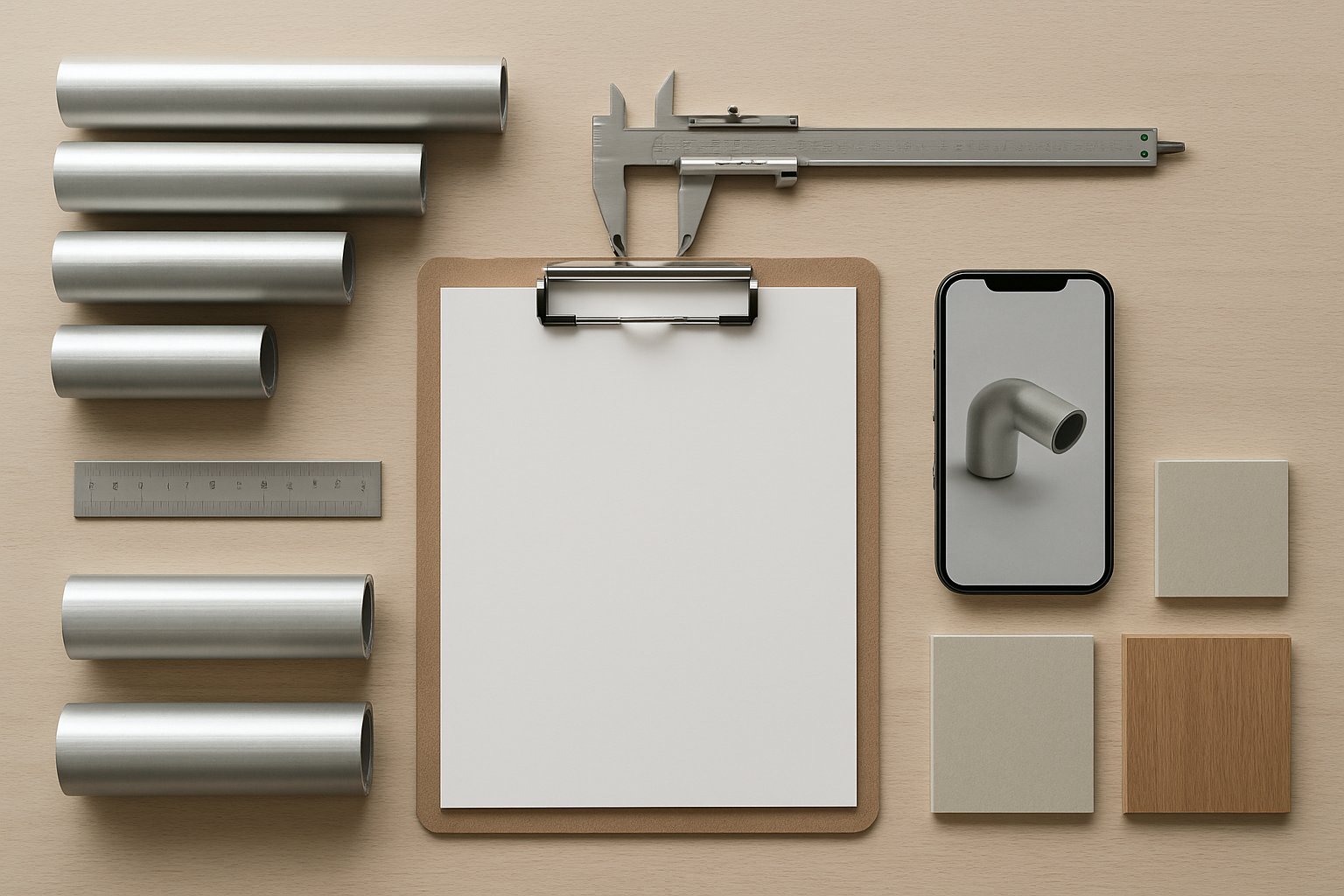
A surprising number of ordering problems start before the quote is even requested. Listings for aluminum pipe for sale, aluminum tubing for sale, and even aluminum tube for sale can look similar on a screen, but they may be built around different sizing systems. The MSCI chart for ordering pipe centers on nominal pipe size, ANSI schedule, OD, ID, wall thickness, and weight. The Wagner guide shows why that matters: pipe and tube are not described the same way, even when both are round.
Use this checklist before you send an RFQ, especially if the part must replace existing material or fit standard hardware.
Wagner gives a simple example that catches many buyers: 1-1/2 in. pipe has a 1.90 in. actual OD, while 1-1/2 in. tubing has a true 1.50 in. OD. That gap is exactly why common aluminum tube stock cannot be treated as a direct substitute for nominal pipe. If you are comparing aluminum tube for sale pages with pipe listings, check whether the seller is using NPS and schedule or actual OD and wall.
Measure replacement parts and specify them in the same system the supplier uses, or the “same size” may not fit at all.
If you are wondering where to buy aluminum pipe, start with suppliers that show the sizing method clearly in writing, not just the product name.
Dimensions alone do not tell the whole story. If the material will be welded, bent, threaded, or installed in a visible assembly, say so before ordering. A quick sketch is often enough for simple jobs. Send a drawing, marked-up photo, or assembly context when the part must slide into another component, match an existing fitting, or hold a visible gap. That small step can prevent a quote based on the right material in the wrong form. And once the form is defined correctly, one issue becomes impossible to ignore: standards and tolerances decide whether the delivered part is merely close or actually usable.
A careful quote request can still go sideways if the buyer and supplier are working from different rulebooks. When a listing names a standard, that reference is not just technical decoration. It usually tells you what form of product is being supplied, how it was produced, and what requirements may apply for chemistry, strength, or documentation.
For seamless pipe and round extruded tube, ASTM B241 covers aluminum and aluminum-alloy seamless pipe and seamless extruded round tube intended for pressure applications. The same ASTM reference also notes that nonstandard alloys, tempers, and sizes of pipe are produced as seamless extruded tube. In Note 2, it points buyers to ASTM B210 for drawn seamless tubes and ASTM B429 for seamless condenser and heat exchanger tubes with integral fins. In plain language, these designations help you confirm that you are comparing the right product family, not just the same alloy number.
| Standard designation | What category it generally relates to | What buyers should ask a supplier to confirm |
|---|---|---|
| ASTM B241 | Seamless pipe and seamless extruded round tube for pressure applications | Whether the quoted item is pipe or extruded tube, which alloy and temper are covered, and whether the supplied size is standard or nonstandard |
| ASTM B210 | Drawn seamless tubes | Whether the product is actually drawn tube, not extruded pipe, and which dimensions and tolerances apply to the order |
| ASTM B429 | Seamless condenser and heat exchanger tubes with integral fins | Whether the form, end use, and special geometry match this category before treating it like general pipe stock |
Standards identify the category. Tolerances explain how close the delivered part may be to nominal size. A general tolerance guide for aluminum extrusions describes common dimensional variation changing with section size and wall thickness, with rough width and height ranges often around 0.1 mm to 0.5 mm. That is not a universal rule for every aluminum pipe size, but it is a useful reminder that "to size" does not mean "exactly identical."
Tolerance questions matter most when parts must mate with fittings, slide into assemblies, replace existing components, or hold appearance-sensitive gaps.
In practical terms, buyers should pay attention to outside diameter consistency, wall uniformity, straightness over length, and surface condition. A piece can match the right alloy and still create trouble if it is slightly bowed, uneven in wall, or visibly marked.
Ask the supplier for the exact standard used, plus any dimensional tolerance information for OD, wall thickness, length, and straightness. If the job is appearance sensitive, ask what finish quality is normal and what surface marks are acceptable. If fit, compliance, or pressure-related service matters, request supporting certification or test documentation. Those simple questions do more than prevent rework. They quickly show which sources are fine for stock replacement and which are better suited to tighter, custom, or documentation-heavy orders.
A solid specification narrows the risk, but sourcing still decides whether the order arrives fast, fits correctly, and needs less rework. That is why comparing an aluminum pipe supplier on price alone is rarely enough. Some jobs only need standard stock. Others need cut lengths, finishing, or a custom aluminum tube that removes extra fabrication from your shop.
Stock material is usually the right call for common replacement sizes, prototypes, and simple fabrication. Paramount Extrusions describes stock extrusions as standard shapes kept in inventory, which means no tooling cost and faster availability.
A custom aluminum tube becomes more attractive when stock sizes force extra machining, awkward joints, or wasted weight. Eagle Aluminum notes that custom die creation often takes about 2 to 4 weeks, and added fabrication or finishing can add days or weeks more. That longer path can still be the smarter one if your part needs integrated features, special wall control, or post-extrusion processing.
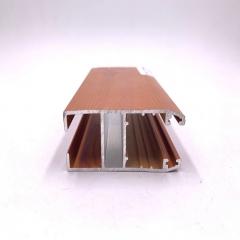
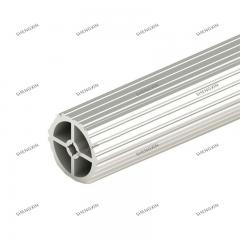
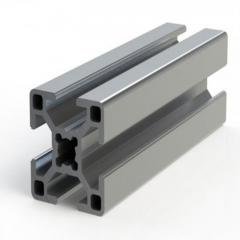
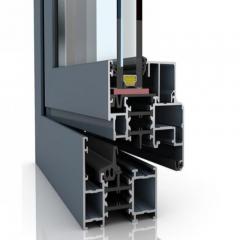
For buyers reviewing aluminum tube suppliers and aluminum tube manufacturers, Shengxin Aluminum is one custom-capable example worth checking when standard stock will not solve the problem. Its site lists aluminum tube products and multiple processing options, and a company page also describes a 5,500-ton extrusion line. Even then, verify alloy range, tolerances, minimum order requirements, finishing support, and lead times.
| Sourcing option | Best when | Main advantages | What to verify |
|---|---|---|---|
| Custom extrusion support, example: Shengxin Aluminum | Your part needs non-stock geometry, special finish options, or broader processing support | Design flexibility, integrated processing, potential to reduce later fabrication | Alloys, tolerances, MOQ, finishing capability, production schedule |
| Cut-to-length fulfillment | You need standard material but want less shop prep | Faster than full custom, less labor after delivery | Length tolerance, deburring, packaging, secondary operations |
| Stock-only sourcing | You need common sizes fast and can fabricate in-house | No tooling cost, quick availability, simpler ordering | Inventory depth, exact size system, finish condition, replacement fit |
Many aluminum pipe suppliers and aluminum tubing suppliers can sell metal. Fewer will slow down enough to ask the questions that prevent a bad order. The better source is the one that matches your job's real needs, not just the one with a familiar product label.
Aluminum pipe is usually sold through the pipe system, so buyers see nominal pipe size and schedule first. Aluminum tube is more often listed by its true outside dimension and wall thickness, and it may come in round, square, or rectangular shapes. The confusion starts because both are hollow aluminum products and many catalogs use the terms loosely. Before buying, ask whether the listing is based on NPS and schedule or on actual OD and wall.
Start by checking how the original part was specified, because measuring only one dimension can lead to the wrong match. Record the outside diameter, wall thickness if possible, cut length, end condition, and how it connects to the rest of the assembly. If the part works with fittings, sleeves, or clamps, include photos or a simple sketch with your quote request. That gives the supplier enough context to confirm whether you need pipe sizing or tube sizing.
The best choice depends on the job, not just the alloy name. 6061 is a common pick when buyers want a strong all-around material that machines well and handles many structural uses, but marine exposure, visible finish, or easier forming may point to a different option. Temper matters just as much as alloy, because a harder condition can behave very differently during bending or fabrication than a softer one. If the part will be welded, bent, and seen in finished form, discuss all three priorities together instead of choosing by strength alone.
Sometimes, but it should never be assumed from the material name alone. Pressure level, temperature, vibration, fluid or gas compatibility, and local code rules all affect whether aluminum is appropriate. Buyers should ask what standard category the material falls under, such as references like ASTM B241 or ASTM B210, and request documentation if compliance matters. This is especially important when the pipe must carry media safely rather than simply serve as a frame or cosmetic component.
Stock material is usually enough for common sizes, quick replacements, and simple shop work. Custom support becomes more valuable when standard sizes create extra machining, poor fit, visible joint compromises, or unnecessary weight. If you need tighter dimensional control, more uniform wall thickness, added finishing, or a custom extrusion profile, compare suppliers that can handle more than basic stock cutting. Shengxin Aluminum is one example resource to review when evaluating custom-capable aluminum tube manufacturers and aluminum pipe suppliers for more specialized requirements.



 un service en ligne
 0086 136 3563 2360
 sales@sxalu.com
 +86 136 3563 2360
 français
 English
 Deutsch
 русский
 español
 português
 العربية
 ไทย
ไทย Việt
Việt Українська