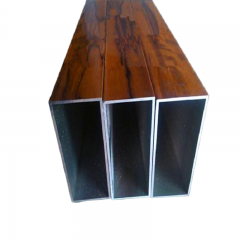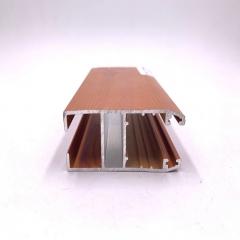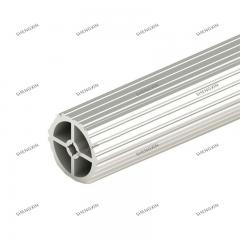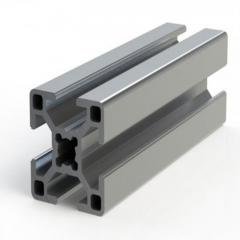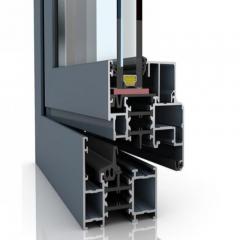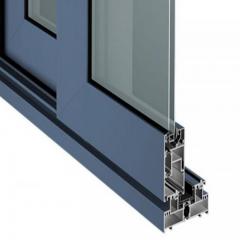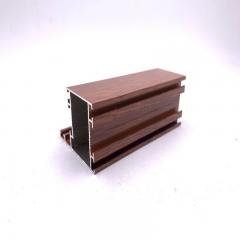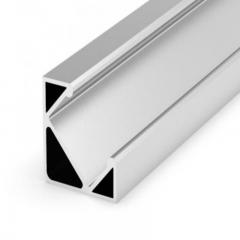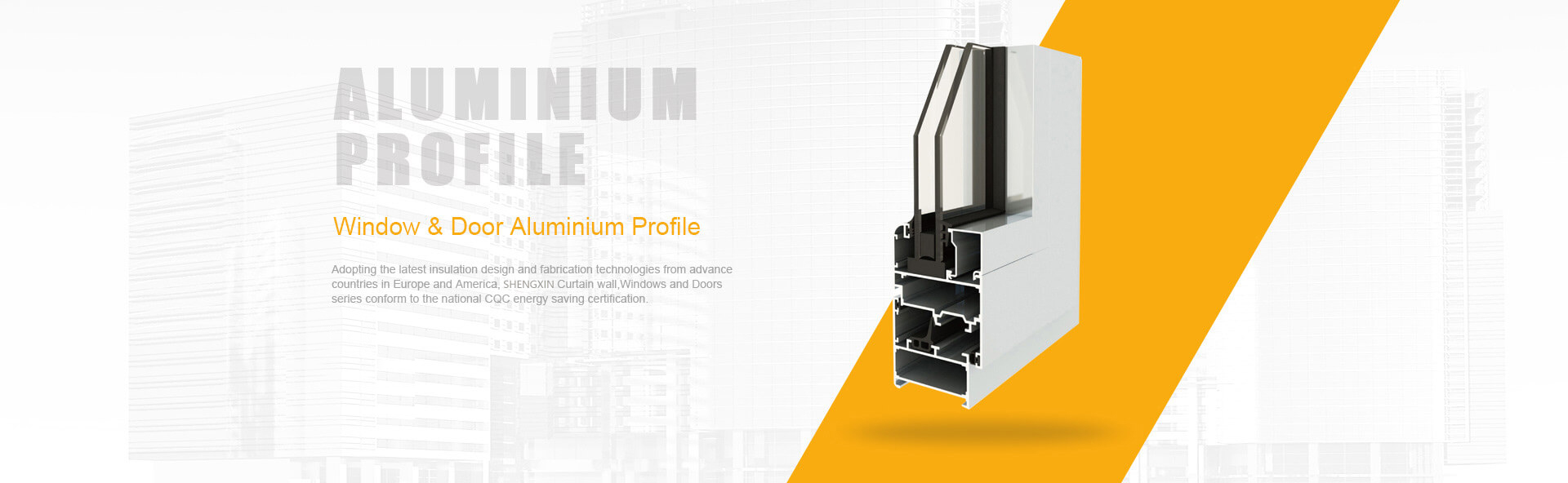

When you're sourcing materials for a construction project, machine frame, or custom furniture piece, you'll quickly discover that aluminum extrusion comes in dozens of shapes. But here's the thing—not all profiles are created equal. Flat aluminum extrusion stands apart as one of the most versatile yet often misunderstood options available. So what exactly makes this profile type special, and why should you care about the differences?
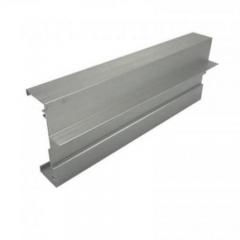
A flat aluminum extrusion is essentially a long, rectangular strip of extruded aluminum with uniform thickness throughout its length. Unlike complex shapes produced with intricate cross-sections and stiffening ribs, flat profiles maintain a remarkably simple geometry. This simplicity, however, is precisely what makes them so adaptable across industries—from architectural trim work to industrial mounting plates.
Imagine standing in front of a rack of aluminum profiles at a supplier's warehouse. You'll see T-slot extrusions with their distinctive grooved channels designed for modular assembly systems. Next to them, you might spot aluminum angle profiles forming L-shapes for corner reinforcement, U-channels for track systems, and Z-bars used primarily in roofing applications. Each shape serves a specific structural or functional purpose.
Flat profiles take a fundamentally different approach. While an aluminum T extrusion excels at creating adjustable frameworks where components slide into slots, flat bars prioritize surface area and straightforward mounting. They don't have built-in slots or complex geometries—and that's intentional. This means you're working with a blank canvas that can be drilled, cut, bent, or machined to meet virtually any specification.
The distinction matters when selecting materials because choosing the wrong profile shape can complicate your project unnecessarily. Need a structural connector with modular flexibility? T-slots make sense. Require a simple reinforcement strip or mounting surface? Flat aluminum delivers without the added complexity or cost of specialized router bit profiles that would be needed to modify more intricate shapes.
Understanding what defines a flat extrusion helps you communicate specifications clearly with suppliers and ensures you receive exactly what your project demands. Here are the key characteristics that set these profiles apart:
These characteristics combine to create a profile that's lightweight yet strong, corrosion-resistant, and remarkably easy to work with. Whether you're fabricating window frames, building machine bases, or creating custom storage systems, flat aluminum provides the foundation you need without unnecessary complexity.
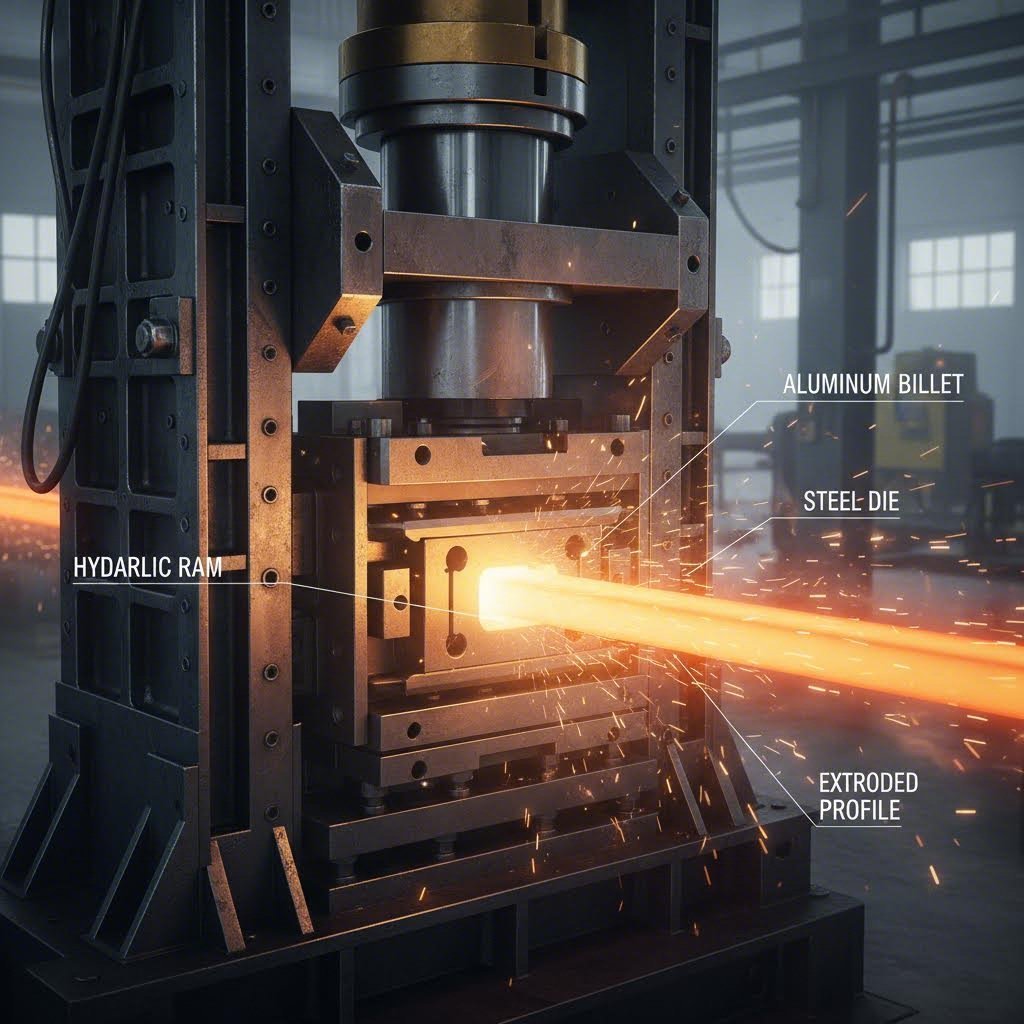
Ever wondered how a solid cylinder of aluminum transforms into that perfectly uniform flat bar sitting on your workbench? The answer lies in a fascinating manufacturing process that combines extreme heat, tremendous pressure, and precision engineering. Understanding how aluminum extrusions are produced helps you appreciate why quality varies between suppliers—and how to specify profiles that meet your exact requirements.
The aluminum extrusion process works on a principle you've probably experienced yourself. Think about squeezing toothpaste through a tube opening. The paste emerges in the exact shape of that opening. Now imagine scaling this concept up dramatically—applying up to 15,000 tons of hydraulic pressure to force heated aluminum through a steel die. That's essentially how every aluminum extrusion profile, from simple flat bars to complex architectural shapes, comes into existence.
The journey from raw aluminum to finished flat profile follows a carefully controlled sequence. Each step influences the final product's dimensional accuracy, surface quality, and mechanical properties. Here's how the process unfolds:
Temperature control remains the most critical variable throughout this entire sequence. According to Bonnell Aluminum, target exit temperatures vary by alloy—6063 series requires minimum 930°F, while 6005A and 6061 alloys need at least 950°F to develop optimal properties.
The die is essentially the heart of the extrusion process—a hardened steel tool with precisely machined openings that determine your profile's exact cross-section. For flat aluminum profile extrusion, die design might seem straightforward compared to complex extruded T slot shapes, but achieving tight tolerances requires careful engineering.
Press tonnage directly affects what profiles can be produced and at what quality level. Larger presses ranging from 600 to 5500 tons can extrude wider flat bars while maintaining consistent dimensioning and tolerancing across the entire width. Smaller presses may struggle to fill wider dies completely, potentially causing thin spots or surface defects.
The extrusion ratio—calculated by dividing the billet's cross-sectional area by the profile's area—indicates how much mechanical working occurs during extrusion. For flat aluminum extrusion profiles, this ratio influences grain structure and ultimately strength. Ratios below 10:1 may produce insufficient mechanical working, while ratios above 35:1 for harder alloys create excessive resistance that complicates production.
The preferred billet temperature is that which provides acceptable surface and tolerance conditions while allowing the shortest possible cycle time. Excessively high temperatures cause metal to resist entry into constricted die areas, pushing dimensions below allowable tolerances.
Why does all this matter for your project? Because understanding these process variables helps you evaluate suppliers more effectively. A manufacturer running outdated presses or poor temperature controls will struggle to deliver aluminum extrusions meeting tight specifications. When your application demands precision—whether for machine bases, architectural trim, or electronic enclosures—knowing the manufacturing fundamentals helps you ask the right questions and select partners capable of delivering consistent quality.
With the manufacturing process understood, the next critical decision involves selecting the right aluminum alloy and temper for your specific application requirements.
You've seen how flat aluminum extrusions are manufactured—but here's where things get interesting. The alloy grade and temper you select can dramatically change how your finished profile performs. Choose incorrectly, and you might end up with material that's too weak for structural demands or too difficult to achieve that perfect anodized finish. So how do you navigate these options confidently?
The 6xxx series dominates the world of extruded aluminum profiles for good reason. These alloys combine magnesium and silicon as their primary alloying elements, delivering an exceptional balance of strength, corrosion resistance, and workability. Within this family, two grades stand out as the workhorses for flat aluminum extrusion applications: 6061 and 6063. Understanding their differences—and when each shines—puts you in control of your material selection.
Imagine you're deciding between two candidates for an important job. Both are qualified, but each brings distinct strengths to the table. That's exactly the situation when comparing these two popular aluminum extrusion sizes and grades.
Aluminum 6061 is a precipitation-hardened alloy developed back in 1935, and it remains one of the most versatile options available. According to Eagle Aluminum, this grade contains silicon and magnesium as major alloying elements, along with iron, copper, and zinc. The result? Exceptional structural strength that makes it ideal when your flat profile needs to carry significant loads or withstand demanding conditions.
Think heavy-duty applications—scaffolding components, railroad car structures, truck frames, and marine equipment. When you need an aluminum T extrusion or flat bar that won't flex under pressure, 6061 delivers. It also offers excellent weldability and high corrosion resistance, making it forgiving during fabrication.
Aluminum 6063, on the other hand, takes a different approach. While sharing the same magnesium-silicon foundation, this alloy prioritizes surface quality and formability over raw strength. Its smoother surface finish makes it the preferred choice for visible architectural elements where appearance matters as much as function.
Custom flat extrusions for window frames, door trim, furniture components, and decorative architectural profiles typically use 6063. This alloy accepts anodizing beautifully, producing that consistent, attractive finish customers expect on premium products. If your flat bar will be visible in the finished application, 6063 should be on your shortlist.
| Property | 6061-T6 | 6063-T6 | Best Choice When... |
|---|---|---|---|
| Ultimate Tensile Strength | At least 42,000 psi | At least 28,000 psi | Structural loads require higher strength |
| Yield Strength | At least 35,000 psi | At least 23,000 psi | Deformation resistance is critical |
| Corrosion Resistance | Excellent | Excellent | Both perform well in corrosive environments |
| Surface Finish Quality | Good | Excellent (smoother) | Visible applications demand premium appearance |
| Machinability | Good | Better | Complex secondary machining is needed |
| Anodizing Response | Good | Excellent | Decorative anodized finishes are required |
| Typical Applications | Machine bases, structural framing, marine components | Architectural trim, window frames, furniture | Match application requirements to alloy strengths |
Here's where many buyers get confused. You'll see designations like 6063-T5 or 6061-T6 and wonder—what do those letters and numbers actually mean? Temper designations tell you exactly how the aluminum was processed after extrusion, directly affecting its mechanical properties.
According to the Aluminum Extruders Council, temper designations follow a standardized system. For heat-treatable alloys like 6061 and 6063, the most common tempers you'll encounter are:
What happens during aging? As explained by Engineering Express, the process involves heating the quenched alloy to between 325-400°F. At these temperatures, alloying elements form ordered atomic arrays called GP zones within the aluminum matrix. These zones strengthen the material significantly. Three common aging cycles produce equivalent results: one hour at 400°F, five hours at 350°F, or eight hours at 325°F.
Here's a practical tip: you'll often see T5 and T6 used somewhat interchangeably in specifications. Technically, T5 material comes from profiles quenched directly out of the extrusion press (called T3 before aging), while T6 starts from separately solution-treated material (T4 before aging). For most applications, T5 and T6 deliver comparable performance characteristics.
When choosing between alloy grades, ask yourself: Does my application prioritize structural strength, or is surface finish quality more important? The answer guides you toward 6061 or 6063 respectively.
The aluminum extrude process combined with proper heat treatment gives you remarkable control over final properties. A flat bar in 6063-T5 delivers that smooth, anodize-ready surface perfect for architectural applications. The same profile geometry in 6061-T6 provides significantly higher strength for demanding structural uses—even though both start as simple rectangular extrusions.
With your alloy and temper selected, the next consideration becomes surface treatment. How will your flat extrusion be finished, and which option best protects your investment while meeting aesthetic requirements?
You've selected your alloy and temper—now comes a decision that affects both how your flat aluminum extrusion looks and how long it lasts. Surface finishing isn't just about aesthetics. It's your first line of defense against corrosion, wear, and environmental damage. Choose the wrong finish for your application, and you could find yourself dealing with premature degradation or costly replacements. So what options are available, and how do you match them to your specific needs?
Think about where your anodized aluminum extrusion or powder-coated panel will ultimately live. Will it face coastal salt spray? Indoor climate control? Direct sunlight beating down year after year? Each environment demands different protective qualities from your finish. Understanding these options helps you balance durability, appearance, and budget effectively.
When your flat profile exits the extrusion press, it arrives in what's called mill finish—the natural state of aluminum after manufacturing. This bare surface has a slightly dull, silvery appearance with minor variations from the extrusion process. For some applications, particularly those hidden from view or used in industrial pipe shelving systems, mill finish works perfectly fine.
However, mill finish has limitations. While aluminum naturally develops a thin oxide layer (approximately 0.002 micrometers) that provides basic corrosion resistance, this protection isn't sufficient for demanding environments. Coastal areas, industrial settings with chemical exposure, or locations with dramatic temperature swings require more robust treatment.
Anodizing takes that natural oxide layer and dramatically enhances it through an electrochemical process. According to Gabrian, technicians submerge the aluminum piece into an electrolytic bath and run an electric current through it. By using aluminum as the anode in the circuit, oxidation occurs on the surface, creating an oxide layer significantly thicker than what forms naturally.
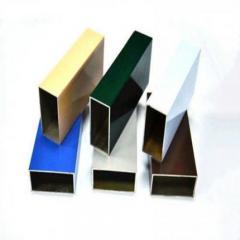
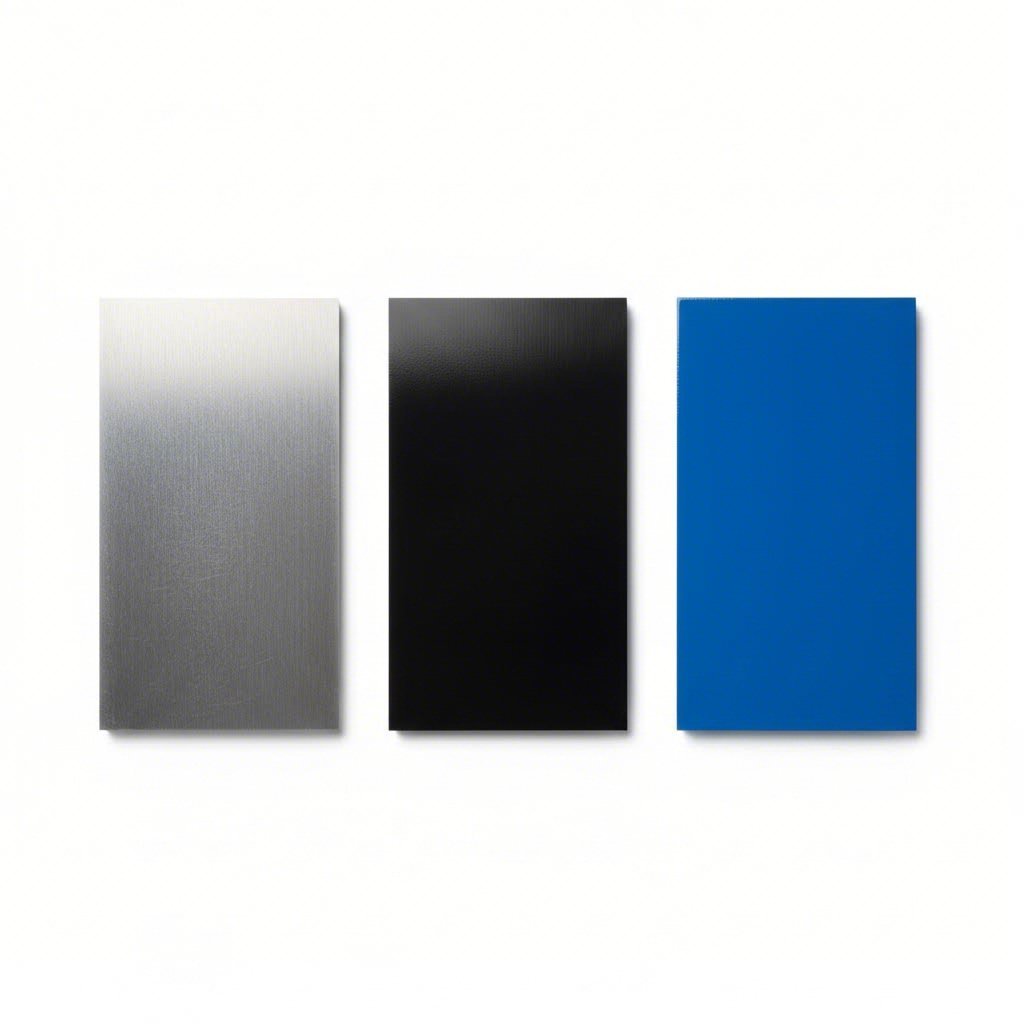
The result? Enhanced wear resistance, improved corrosion protection, and a surface that's perfect for adding dyes. Black aluminum extrusion finishes, bronze tones, and even custom colors become possible through this process. Clear anodizing preserves that metallic aluminum look while still providing protection.
Powder coating takes an entirely different approach. Instead of modifying the aluminum's surface chemistry, this process applies a dry powder using electrostatic attraction. A spray gun applies a negative charge to the powder, making it adhere to the grounded metal part. The coated profile then cures in an oven, transforming the powder into a uniform, solid protective layer.
What makes powder coating attractive? The color options are virtually unlimited—vibrant reds, deep blues, textured finishes, or even wood-grain patterns. For extruded aluminum systems where branding or architectural integration matters, powder coating delivers design flexibility that anodizing simply can't match.
| Finish Type | Durability | Appearance Options | Relative Cost | Ideal Applications |
|---|---|---|---|---|
| Mill Finish | Basic protection only; suitable for non-corrosive indoor environments | Natural silvery aluminum color with minor surface variations | Lowest (no additional processing) | Hidden structural components, temporary installations, budget-focused projects |
| Clear Anodizing | Excellent wear and corrosion resistance; Class I (0.7+ mils) for outdoor use | Metallic finish preserving natural aluminum appearance | Moderate | Architectural trim, electronic enclosures, heat sinks requiring heat dissipation |
| Colored Anodizing | Same as clear anodizing with added UV stability depending on dye quality | Black, bronze, gold, champagne, and custom colors; metallic appearance | Moderate to Higher | Curtain walls, window frames, consumer electronics, aluminum T channel applications |
| Powder Coating | Excellent impact and scratch resistance; good UV and weather resistance | Unlimited colors; matte, gloss, or textured finishes; wood-grain patterns available | Lower to Moderate | Extruded aluminum panels, outdoor equipment, architectural facades, furniture |
| Mechanical Finishes (Brushed/Polished) | Depends on subsequent protective coating; primarily aesthetic treatment | Brushed linear texture, mirror polish, or bead-blasted matte | Varies by complexity | Interior design elements, handrails, fixtures, signage |
Here's where your application environment becomes the deciding factor. According to industry standards referenced by Aplank, outdoor aluminum exposed to salt air, chemical exposure, or freeze-thaw cycles requires finishes specifically engineered for those conditions.
For exterior applications, anodizing thickness matters significantly. Class I anodizing—with a minimum thickness of 0.7 mils—is recommended for architectural uses where the profile faces weather exposure. Class II anodizing at 0.4 mils or more suits interior applications where environmental stress is lower. The sealing process after anodizing locks in dyes and keeps contaminants out, directly affecting long-term color retention and corrosion resistance.
Powder coatings designed for outdoor use often meet AAMA 2604 or AAMA 2605 specifications, which define performance requirements for colorfastness and weather resistance. These certifications give you confidence that your finish will maintain its appearance for years rather than months.
When selecting finishes for high-traffic areas like handrails or entry systems, brushed or bead-blasted mechanical finishes hide everyday wear better than polished surfaces—and they reduce fingerprint visibility significantly.
One critical factor many buyers overlook: surface treatments affect dimensional tolerances. Anodizing adds approximately 0.7 to 2 mils to surface dimensions, while powder coating typically adds 2 to 4 mils. If your flat profile needs to fit precisely into an assembly, you'll need to account for this thickness increase in your specifications. According to Daiwa KK, designing without considering film thickness increase can lead to assembly defects and costly rework.
For projects requiring both aesthetic appeal and practical durability—like building facades or outdoor furniture—combining treatments often delivers optimal results. A powder-coated finish over properly pretreated aluminum can provide weather resistance exceeding 30 years in demanding environments.
With your alloy, temper, and surface finish decisions made, the question becomes: where will your flat aluminum extrusion actually be used? The next section explores the diverse applications where these profiles solve real-world problems across industries.

Now that you understand alloy selection and surface finishes, here's the exciting part—seeing flat aluminum extrusions at work solving real problems. These profiles aren't sitting in warehouses gathering dust. They're supporting solar panels on rooftops, framing windows in commercial buildings, and reinforcing machinery in factories around the world. So where exactly do flat profiles make the most sense, and why do engineers keep reaching for them instead of more complex shapes?
The beauty of flat aluminum extrusion lies in its adaptability. Unlike specialized profiles designed for single purposes, flat bars serve as building blocks that fabricators cut, drill, weld, and bend into exactly what each project demands. This flexibility explains why you'll find them across industries as diverse as construction, manufacturing, renewable energy, and transportation.
Walk through any modern commercial building, and flat aluminum profiles are working all around you—often invisibly. According to Zetwerk, aluminum extrusion profiles are extensively used in contemporary architecture for curtain walls, windows, and doors. Their lightweight yet sturdy design makes them ideal for constructing both aesthetically pleasing and functional structures.
Flat profiles specifically excel in applications where you need a clean mounting surface or continuous support. Here's where architects and builders rely on them:
Why choose flat over more complex shapes for these applications? Simplicity translates to cost savings. A flat bar requires less complex dies to produce, reducing both tooling costs and per-unit pricing. When your application doesn't need the built-in slots of T-slot profiles or the angular geometry of channel sections, flat extrusions deliver exactly what you need without paying for unnecessary features.
Step onto a manufacturing floor, and you'll spot flat aluminum working harder than almost anywhere else. The combination of rigidity, lightweight handling, and corrosion resistance makes these profiles indispensable for equipment builders. According to Hugh Aluminum, aluminum flat bars provide excellent strength and stability, keeping construction firm and safe—qualities crucial in industrial settings where safety is a top priority.
The renewable energy sector has embraced flat aluminum profiles enthusiastically. As noted by Profall, these profiles enable mounting systems for photovoltaic panels, creating lightweight structures that withstand decades of outdoor exposure. Solar installers appreciate how easily flat bars can be cut to length on-site and assembled with standard hardware.
Selecting the right flat profile means matching dimensions to the specific demands of your project. Here's practical guidance for common application categories:
When calculating required profile dimensions, consider both static loads and dynamic forces. A flat bar supporting a stationary sensor needs far less cross-section than one subjected to vibration or impact loading.
The transportation industry increasingly turns to flat aluminum profiles for weight reduction without sacrificing strength. Truck bodies, rail car interiors, and marine vessels all benefit from the approximately one-third weight savings compared to equivalent steel sections. This weight reduction directly translates to improved fuel efficiency and increased payload capacity.
Understanding where flat profiles excel helps you specify correctly from the start—but dimensions and tolerances must align precisely with your requirements. The next section covers how to navigate dimensional specifications and tolerance standards to ensure your extrusions fit perfectly every time.
You've selected your alloy, chosen your finish, and identified the perfect application—but here's where many projects hit unexpected snags. Dimensional specifications might seem like dry technical details, yet getting them wrong can mean profiles that don't fit, assemblies that require costly rework, or production delays while you wait for replacements. So how do you specify flat aluminum extrusion dimensions correctly the first time?
Understanding dimensional tolerances isn't just about reading numbers from a chart. It's about knowing what's achievable, what costs extra, and when your application demands tighter control. According to Engineers Edge, the industry's standard tolerances were developed by technical committees of The Aluminum Association and the American National Standards Institute, balancing manufacturing capabilities with designer requirements.
When sourcing flat profiles, you'll encounter two distinct categories: stock extrusions and custom profiles. Stock extrusions—sometimes called standard shapes—come in predetermined dimensions that manufacturers produce in high volumes. Think of them like lumber at a hardware store: specific widths and thicknesses ready to grab off the shelf.
For flat aluminum bars, stock dimensions typically range from narrow 1/2-inch strips to wide bars exceeding 6 inches across. Thicknesses commonly span from 1/16 inch for thin trim applications up to 1 inch or more for heavy structural uses. Lengths usually run 12 to 21 feet, though suppliers often cut to your specified requirements.
| Dimension Type | Common Stock Ranges | Custom Capability | Standard Tolerance (Approximate) |
|---|---|---|---|
| Width | 0.5" to 6" in standard increments | Virtually unlimited with custom die | ±0.012" to ±0.024" depending on size |
| Thickness | 1/16" to 1" in fractional steps | Custom thicknesses available | ±10% of nominal wall thickness |
| Length | 12' to 21' standard mill lengths | Cut-to-length services available | +1/8" typical for saw cutting |
| Straightness | N/A | N/A | 0.0125" per foot of length |
| Twist | N/A | N/A | 0.5 degrees per foot |
| Flatness | N/A | N/A | 0.004" × width |
When do stock sizes work? If your project uses common dimensions—similar to how standard stud spacing in construction follows predictable patterns—stock profiles offer immediate availability and lower costs. A 4x8 aluminum sheet or 2 square tubing pulled from inventory ships faster than custom-extruded material.
Custom extrusion becomes necessary when your design requires non-standard dimensions, integrated features, or unusual width-to-thickness ratios. According to Sinoextrud, custom aluminum extrusions are engineered to your specifications, enabling better functionality, fit, aesthetics, and performance—ideal for unique or complex applications.
Here's where understanding tolerance classes becomes crucial. The industry publishes standard tolerances in ANSI H35.2 and the Aluminum Standards and Data (ASD) handbook. These tolerances account for the manufacturing realities of extruding aluminum through steel dies under tremendous pressure and heat.
Mechanical tolerances vary based on several factors:
All critical dimensions should be discussed between the purchaser and extruder to determine the most practical tolerances for each specific application. Extra effort to achieve tighter tolerances leads to higher costs.
Can you specify tighter tolerances than standard? Absolutely—but expect cost implications. According to Engineers Edge, achieving tighter mechanical tolerances may require significant die modifications, slower extrusion rates, increased inspections, and sometimes higher rejection rates. This extra effort directly increases your per-piece costs.
Conversely, looser tolerances can sometimes reduce costs when your application permits. If your flat profile serves as a non-critical backing plate where ±0.030" variation causes no functional issues, specifying standard tolerances rather than demanding precision saves money without sacrificing performance.
When specifying flat aluminum extrusion, always note whether dimensions are nominal or actual, and whether tolerances are bilateral (±) or unilateral (+ or - only). This clarity prevents costly misunderstandings.
The decision between stock and custom ultimately depends on volume, timeline, and dimensional requirements. Stock profiles ship quickly with no tooling investment—perfect for prototypes or small runs. Custom extrusions require die development (typically 3-5 weeks for the first order) but deliver exactly what your design demands. Once the custom die exists, reorders move as quickly as stock material.
With dimensional specifications locked down, the next logical question becomes: how does flat aluminum compare against alternative materials and profile shapes? Understanding these comparisons helps confirm whether flat extrusion is truly the optimal choice for your application.
You've specified your dimensions and tolerances—but before finalizing your material choice, there's one more critical question to answer: Is flat aluminum extrusion actually the best option for your project? Sure, it works beautifully in countless applications, but so do steel flat bars, plastic alternatives, and more complex aluminum profile shapes. Understanding when flat aluminum outperforms these alternatives—and when it doesn't—ensures you're making the smartest investment for your specific needs.
The comparison isn't as straightforward as picking the cheapest option. According to Speciality Metals, the debate between aluminum and steel flat bars has been ongoing for decades, with both materials showcasing unique properties and strengths. Factors like weight constraints, environmental exposure, fabrication requirements, and total lifecycle costs all influence which material delivers the best value.
Imagine you're designing a machine frame that needs to handle moderate loads while remaining portable enough for two workers to reposition. Steel offers impressive strength—but at what cost to your handling requirements? This scenario illustrates exactly why material comparison matters so much in real-world applications.
The weight difference alone often decides the competition. Aluminum weighs approximately one-third what steel does for equivalent dimensions. A flat bar measuring 2 inches wide by 1/4 inch thick by 10 feet long weighs roughly 2.9 pounds in aluminum versus 8.5 pounds in steel. Scale this across an entire project—whether you're building steel stud framing alternatives or industrial equipment—and the cumulative weight savings become substantial.
| Property | Flat Aluminum Extrusion | Steel Flat Bar | Plastic (HDPE/PVC) |
|---|---|---|---|
| Weight (relative) | 1x (baseline) | 3x heavier | 0.3-0.5x lighter |
| Tensile Strength | Good (6061-T6: 42,000 psi) | Excellent (A36: 58,000 psi) | Low (2,000-5,000 psi) |
| Corrosion Resistance | Excellent (natural oxide layer) | Poor (requires coating/galvanizing) | Excellent (inherently non-corroding) |
| Workability/Machinability | Easy cutting, drilling, bending | Moderate (harder on tooling) | Very easy but limited heat tolerance |
| Thermal Conductivity | Excellent (heat sinks, dissipation) | Good | Poor (insulating) |
| Initial Cost | Moderate to Higher | Lower | Lowest |
| Total Cost of Ownership | Lower (minimal maintenance) | Higher (rust prevention, repainting) | Moderate (UV degradation concerns) |
| Best Applications | Aerospace, marine, architecture, equipment | Heavy structural, bridges, metal stud framing | Non-structural, chemical resistance needed |
According to BRT Extrusions, aluminum is inherently lightweight, making it easier to handle and transport—but it doesn't compromise on strength. With proper alloy selection, aluminum extrusions provide impressive structural integrity comparable to many other materials. This strength-to-weight advantage translates directly to reduced shipping costs, easier installation, and improved energy efficiency in transportation applications.
Corrosion resistance presents another decisive advantage. Flat aluminum naturally forms a protective oxide layer, offering resistance against rust without additional treatment. Steel, conversely, requires galvanizing, painting, or powder coating to prevent corrosion—adding ongoing maintenance costs throughout the product's lifecycle. In coastal environments, outdoor installations, or anywhere moisture exposure occurs, aluminum's inherent corrosion resistance often justifies its higher initial cost.
Here's where many buyers face an interesting decision. Modular 80/20 aluminum framing systems—using T-slot rail profiles—have become incredibly popular for workstations, equipment frames, and custom enclosures. These 80 20 aluminum systems offer remarkable flexibility: components slide into T-slots, adjust with simple tools, and reconfigure as needs change. So when does a basic flat extrusion make more sense than investing in a t slotted rail system?
Consider these scenarios where flat profiles outperform more complex alternatives:
Choose T-slot systems when modularity and adjustability matter more than initial cost. Choose flat profiles when permanence, simplicity, and surface area drive your requirements.
The total cost of ownership calculation often favors aluminum over steel despite higher purchase prices. According to Speciality Metals, while steel often offers a cost advantage initially, buyers should consider lifecycle costs, maintenance requirements, and potential weight-related savings before making their choice. A steel frame requiring repainting every three years in a corrosive environment quickly exceeds the total investment of a properly finished aluminum alternative.
Plastic materials enter the conversation primarily when chemical resistance or electrical insulation matters more than strength. However, plastics struggle with heat tolerance, UV degradation, and load-bearing capacity—making them unsuitable for most applications where flat aluminum extrusion excels.
With your material comparison complete and flat aluminum confirmed as your optimal choice, the final piece of the puzzle becomes finding the right manufacturing partner to deliver profiles meeting your exact specifications.
You've done your homework—alloy selected, tolerances defined, finish specified. Now comes the moment that can make or break your project: finding a manufacturing partner who can actually deliver. Sounds straightforward, right? Unfortunately, the aluminium extrusion market includes suppliers ranging from world-class operations to facilities barely meeting minimum standards. Selecting the wrong partner means missed deadlines, quality issues, and costly rework. So how do you separate reliable manufacturers from risky vendors?
The sourcing process extends far beyond comparing price quotes. According to Inquivix Tech, choosing the right supplier affects your product design, manufacturing process, product quality, and cost—regardless of what kind of product you create. A methodical evaluation approach protects your investment and builds relationships that support long-term success.
Before sending RFQs to every supplier you find online, take time to define exactly what you need from a manufacturing partner. This clarity saves countless hours filtering through responses from companies that can't actually meet your requirements.
Start by assessing press capabilities. Extrusion presses range from small 500-ton machines suitable for simple small aluminum extrusions to massive 5500-ton presses capable of producing wide, complex profiles. The press size directly affects what profiles can be manufactured efficiently. A supplier running undersized equipment for your profile dimensions will struggle with quality consistency and may reject your project entirely.
Processing services matter equally. Many applications require more than raw extruded aluminum rails or flat bars—they need machined aluminum extrusion with precision-cut holes, tapped threads, or complex CNC-machined features. Suppliers offering comprehensive deep processing services including CNC cutting, drilling, milling, and bending streamline your supply chain dramatically. Instead of coordinating between an extruder and separate machine shop, you receive finished components ready for assembly.
Quality certifications provide objective verification of a supplier's systems. Look for ISO 9001 certification as a baseline, with additional certifications relevant to your industry—automotive suppliers should hold IATF 16949, while aerospace applications may require AS9100 compliance.
An experienced supplier brings more than just technical expertise—they bring lessons learned from years of solving complex extrusion challenges across diverse industries.
Here are essential questions to ask potential aluminum frame extrusion suppliers during your evaluation:
Understanding the complete production journey helps you evaluate whether a supplier can truly support your project from concept through delivery. The process begins long before aluminum ever touches an extrusion press.
Die development represents the first critical milestone. For custom flat profiles, suppliers create hardened steel dies machined to your exact specifications. This tooling investment typically requires 3-5 weeks and costs anywhere from a few hundred dollars for simple shapes to several thousand for complex geometries. Quality die engineering affects every extrusion that follows—invest in suppliers who take this step seriously.
Production capability assessment should consider both current capacity and scalability. According to Inquivix Tech, you should communicate whether your need is for a one-time low-volume run, prototyping, or ongoing high-volume production. Some suppliers specialize in small batch or custom orders, while others are more cost-effective for large-scale production.
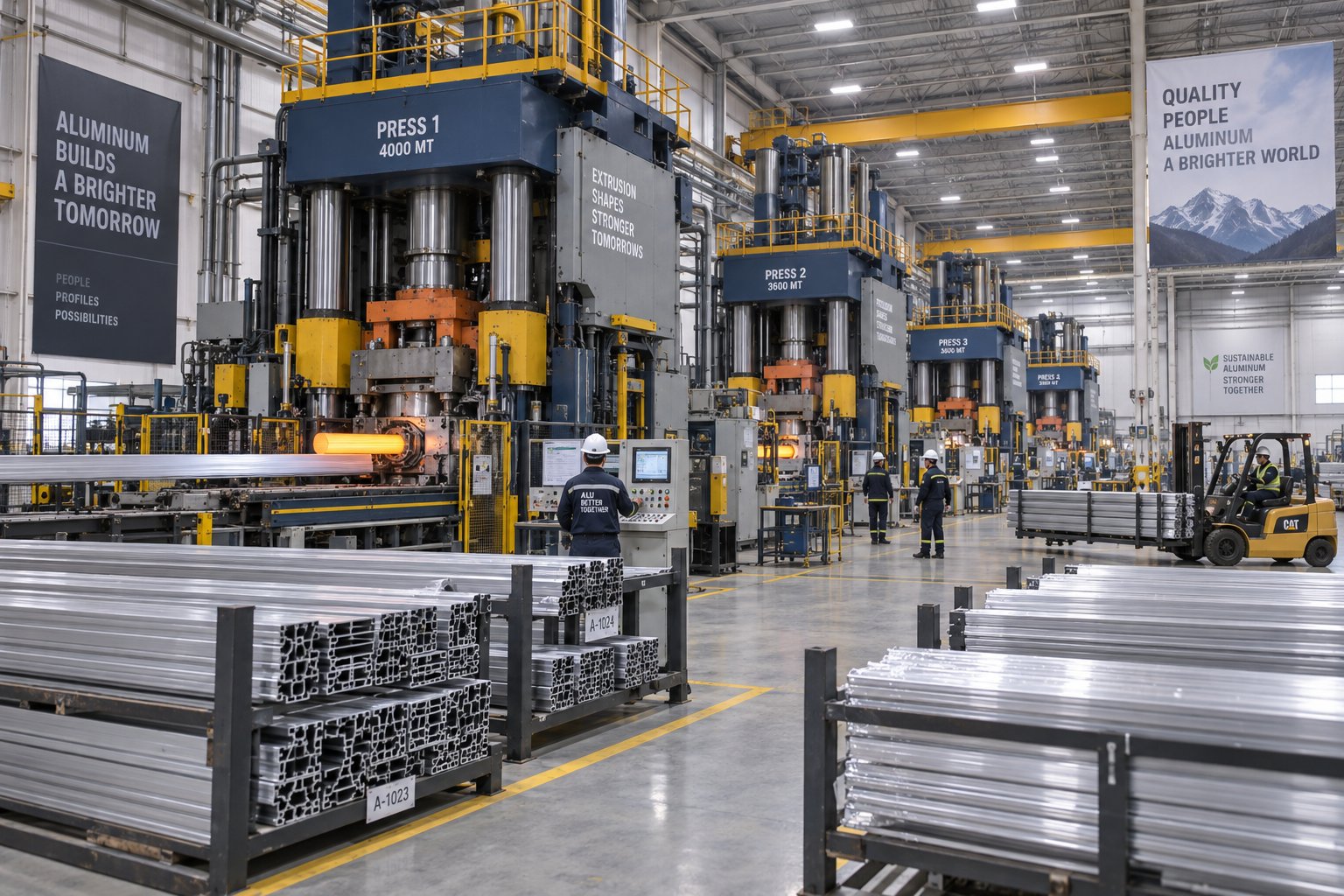
When evaluating production capabilities, look for suppliers with diverse press configurations. Operations running multiple extrusion presses across a range of tonnages—from 600T for smaller profiles up to 5500T for wide, heavy sections—can match the right equipment to your specific requirements. This flexibility ensures optimal quality without paying premium rates for oversized equipment.
Surface treatment integration separates full-service suppliers from basic extruders. Finding a partner offering comprehensive finishing options—anodizing in standard and custom colors, powder coating, PVDF treatments, and specialized processes like micro-arc oxidation—eliminates coordination headaches and reduces your vendor count.
Consider this evaluation approach when comparing potential partners:
| Evaluation Criteria | Questions to Ask | Why It Matters |
|---|---|---|
| Experience & Track Record | How many years in business? What industries served? | Experienced suppliers anticipate problems before they occur |
| Press Capabilities | Number of presses? Tonnage range? Maximum profile dimensions? | Equipment must match your profile requirements |
| Processing Services | CNC capabilities? Cutting/drilling/bending? Assembly? | Integrated services reduce lead time and coordination burden |
| Surface Treatments | In-house finishing? Color options? Specialty treatments? | Integrated finishing improves quality consistency |
| Quality Systems | ISO certification? Inspection capabilities? Testing equipment? | Documented systems ensure repeatable quality |
| Technical Support | Design assistance? DFM feedback? Engineering team access? | Partners optimize designs before costly tooling investment |
Beware of suppliers offering suspiciously cheap aluminum extrusion pricing without explaining how they achieve lower costs. According to industry experts, red flags include unusually low quotes without explanation, reluctance to share references, lack of certifications or poor documentation, and resistance to facility tours or video calls. These may indicate future issues with reliability or service.
For projects requiring complete manufacturing support, look for partners offering end-to-end capabilities. Shengxin Aluminium, for example, combines over 30 years of industry experience with 35 advanced extrusion presses ranging from 600T to 5500T, providing comprehensive support from custom die development through surface finishing and precision machining. This full-service approach—including anodizing in custom colors, powder coating, and CNC processing—delivers finished components rather than raw material requiring additional coordination.
A t slot table or extruded aluminum workbench built from profiles sourced through a capable full-service supplier arrives ready for assembly. The same project sourced piecemeal—extrusions from one vendor, machining from another, finishing from a third—multiplies coordination effort, extends timelines, and introduces quality variables at every handoff.
With your supplier evaluation complete and manufacturing partner selected, the final step involves confirming all specifications align with your application requirements and establishing clear expectations for the partnership moving forward.
You've journeyed through alloy selection, temper designations, surface treatments, dimensional specifications, and supplier evaluation. Now it's time to pull everything together into actionable decisions. Whether you're building an extruded aluminum track system, designing an aluminum extrusion rail for industrial equipment, or specifying profiles for architectural trim, the choices you make at this stage determine your project's ultimate success.
Throughout this guide, several critical themes have emerged. Each specification decision connects to the others—choosing the wrong alloy affects finishing options, selecting inappropriate tolerances impacts assembly, and overlooking surface treatment requirements leads to premature failure. Let's crystallize the most important considerations:
The most successful flat aluminum extrusion projects start with clear application requirements. Define your loads, environment, appearance expectations, and budget constraints before selecting alloy, temper, or finish.
For structural applications like machine bases or aluminium rail extrusions supporting heavy equipment, 6061-T6 delivers the strength you need. When surface appearance matters—think architectural trim, furniture components, or an extruded aluminum workbench destined for a showroom—6063-T6 provides that smooth, anodize-ready finish customers expect.
Surface treatment selection depends entirely on your operating environment. Mill finish works for hidden components; anodizing protects visible parts while enabling t slot mounting hardware integration; powder coating opens unlimited color possibilities for branded equipment or architectural features.
Ready to move forward? Use this specification checklist to ensure you've addressed every critical requirement before contacting suppliers:
Working with an experienced manufacturing partner who offers comprehensive services—from custom die development through surface finishing and precision machining—eliminates coordination headaches and ensures consistent quality throughout your project.
For readers ready to take the next step, partnering with a full-service supplier streamlines the entire process. Shengxin Aluminium offers factory-direct pricing backed by technical team support, helping you navigate specifications from initial concept through delivered components. Their integrated capabilities—including t slot roller compatible profiles, custom finishes, and precision CNC processing—mean you receive finished parts rather than raw material requiring additional coordination.
Your flat aluminum extrusion project deserves a partner who understands the complete picture. Armed with the knowledge from this guide, you're now equipped to specify confidently, evaluate suppliers effectively, and deliver results that exceed expectations.
Yes, aluminum flat bars are produced through the extrusion process. Heated aluminum billets are forced through flat-shaped steel dies under extreme pressure (up to 15,000 tons), creating uniform rectangular profiles. The 6061 and 6063 alloys are most commonly used for extruded flat bars, with 6061-T6 offering higher tensile strength (42,000 psi) for structural applications, while 6063 provides superior surface finish quality ideal for architectural uses requiring anodizing.
Common aluminum extrusion issues include dimensional inaccuracies from irregular cooling, worn dies, or incorrect extrusion speeds that affect assembly fit. Surface defects like scratch marks or die lines result from improper lubrication or billet contamination. Temperature control is critical—excessively high temperatures cause metal to resist die entry, pushing dimensions below tolerances. Working with experienced suppliers who maintain proper process controls, use quality dies, and employ rigorous inspection minimizes these production challenges.
The key difference lies in strength versus surface quality. 6061-T6 aluminum delivers higher tensile strength (42,000 psi vs 28,000 psi) making it ideal for structural applications like machine bases, marine equipment, and load-bearing components. 6063-T6 prioritizes smoother surface finish and better anodizing response, making it preferred for visible architectural elements, window frames, and decorative trim where appearance matters as much as function.
Choose anodizing when you want to preserve aluminum's metallic appearance while adding corrosion protection—it creates a durable oxide layer that accepts dyes for colors like black or bronze. Select powder coating for unlimited color options, textured finishes, or wood-grain patterns with excellent impact resistance. Anodizing adds 0.7-2 mils to dimensions while powder coating adds 2-4 mils, which affects tight-tolerance assemblies. Both offer excellent outdoor durability when properly specified.
Choose flat profiles for permanent installations where modularity isn't needed, applications requiring maximum uninterrupted surface area (mounting plates, heat sinks), clean architectural aesthetics without visible grooves, cost-sensitive projects (simpler dies mean lower pricing), and components requiring significant drilling or welding. T-slot systems excel when you need adjustable, reconfigurable frameworks. Flat extrusions deliver equivalent strength at lower cost when flexibility isn't a priority.



 un service en ligne
 0086 136 3563 2360
 sales@sxalu.com
 +86 136 3563 2360
 français
 English
 Deutsch
 русский
 español
 português
 العربية
 ไทย
ไทย Việt
Việt Українська