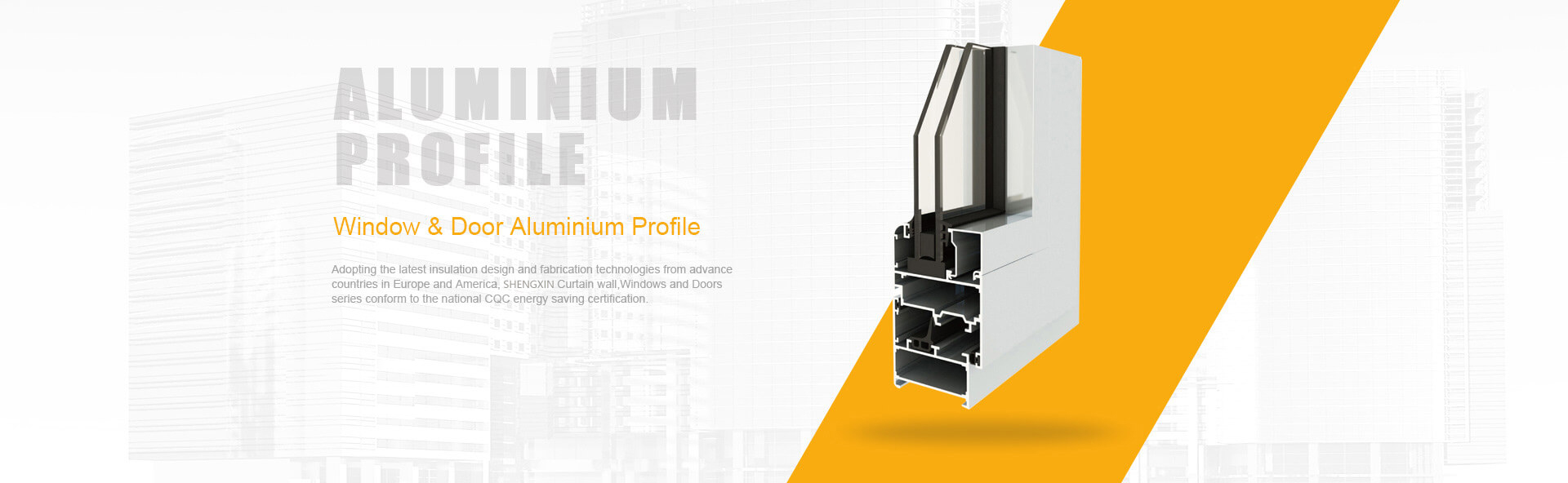
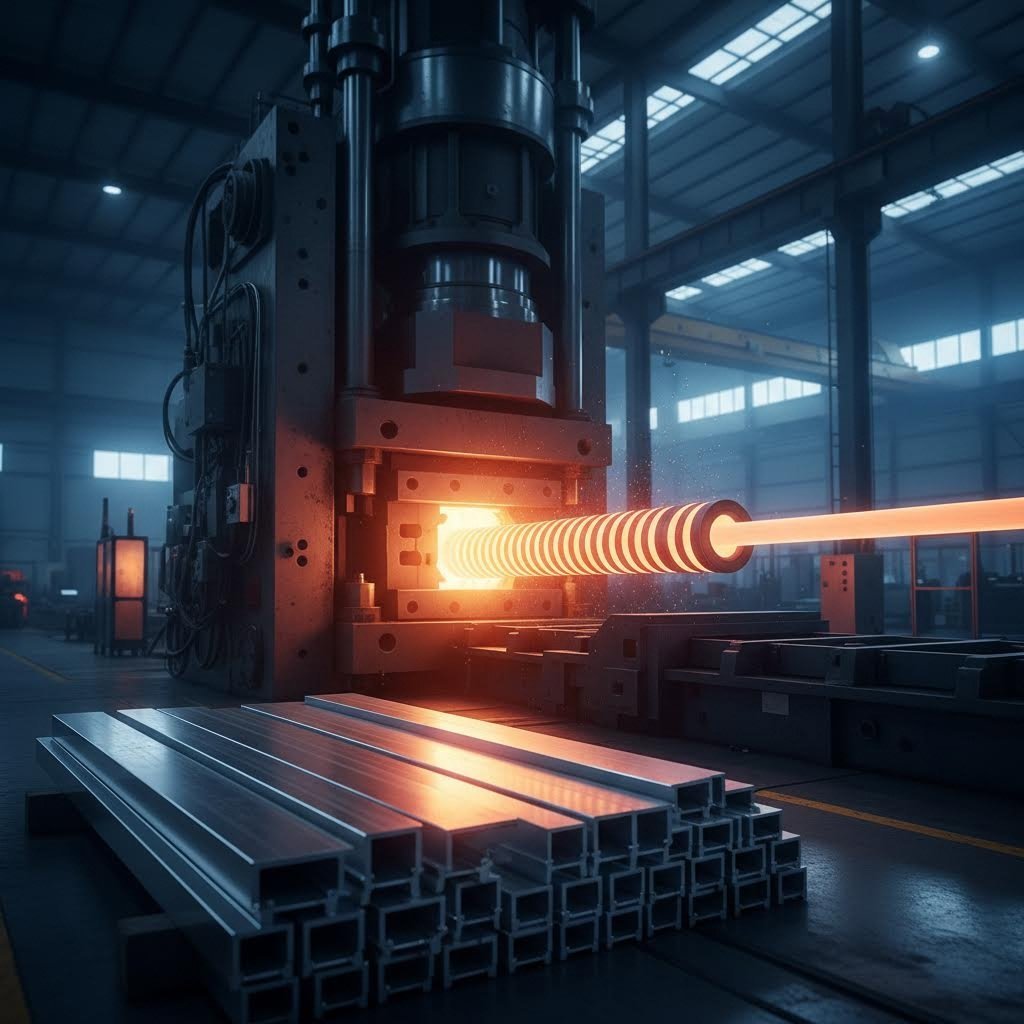
Ever received a quote for custom aluminum extrusions and wondered how suppliers arrived at that number? You're not alone. The pricing structure behind custom extruded aluminum is notoriously complex, involving multiple cost variables that most suppliers rarely break down transparently. This lack of clarity leaves buyers guessing, negotiating blindly, and often paying more than necessary.
This guide changes that. Rather than simply listing cost factors, you'll learn exactly how to evaluate quotes, identify hidden expenses, and make informed purchasing decisions that protect your budget.
The reality is straightforward: buyers who don't understand pricing mechanics are at a disadvantage. When you can't distinguish between fair pricing and inflated quotes, you're left relying entirely on supplier goodwill. Consider this: custom extrusion dies typically cost around $400 to $1,000 for standard profiles, yet some buyers unknowingly accept quotes with significantly higher tooling fees without questioning them.
Overpayment usually stems from three common scenarios:
Why don't suppliers simply explain their pricing? Part of the challenge lies in the genuinely dynamic nature of aluminum costs. Raw material prices have fluctuated dramatically in recent years, ranging anywhere from $1,500 to $3,500 per metric ton. Political events, environmental regulations, and global supply chain disruptions all influence these swings.
Beyond raw materials, custom extrusions require specialized dies, skilled labor for design and manufacturing, and often secondary operations like machining or finishing. Each element adds layers to your final price, and without a clear framework, comparing quotes from different suppliers becomes nearly impossible.
Think of this guide as your pricing literacy toolkit. In the steps ahead, you'll discover how to:
By the end, you'll approach your next custom aluminum extrusion project with confidence, knowing exactly what questions to ask and which costs to negotiate. Let's get started.
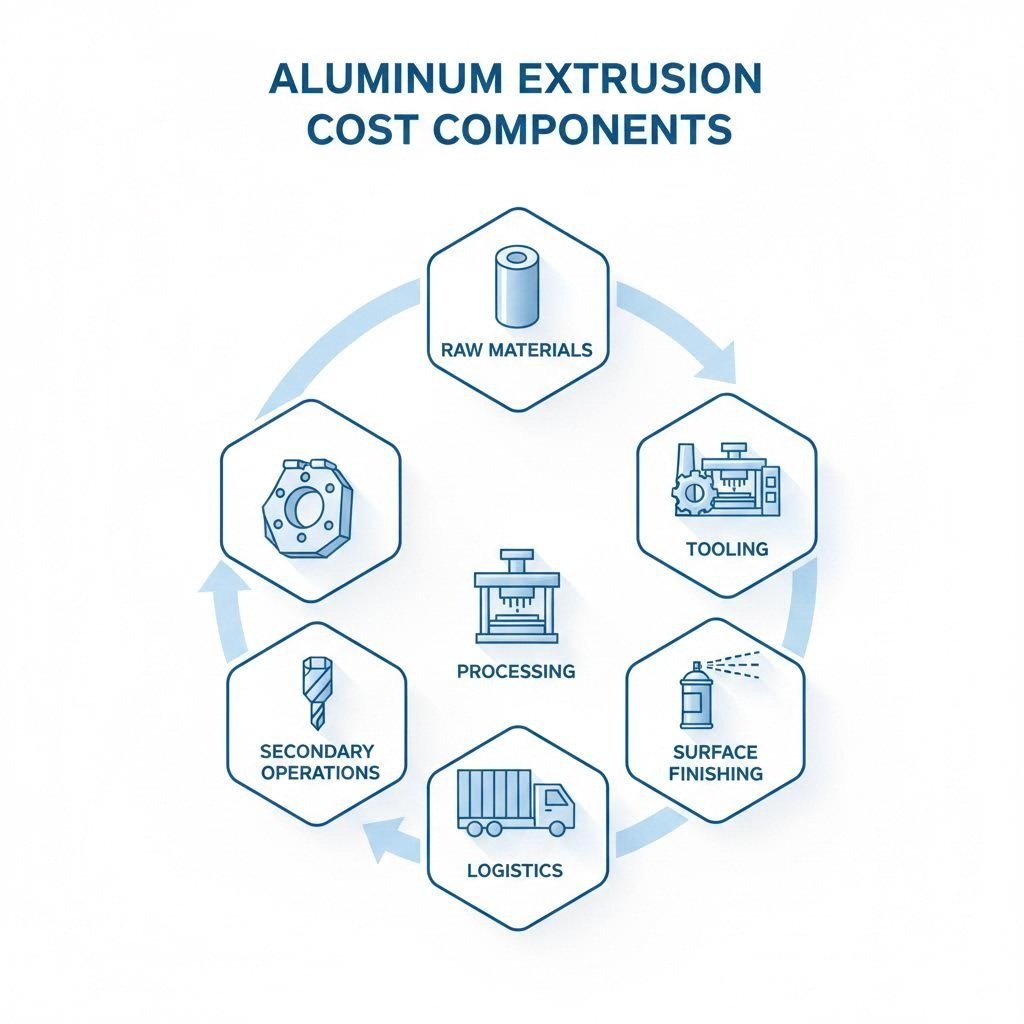
Now that you understand why pricing transparency matters, let's break down exactly what you're paying for. Every custom extrusion quote consists of six fundamental cost components. Understanding each one helps you evaluate whether a quote represents fair value or inflated margins.
When you receive a quote for custom aluminum extrusions, the final number reflects a combination of distinct expenses. Here's how they stack up:
| Cost Component | Description | Typical Impact on Total Cost |
|---|---|---|
| Raw Material (Aluminum Billet) | The base aluminum alloy used for extrusion, priced based on LME rates plus smelter premiums | 40-60% of basic extrusion cost |
| Die/Tooling Costs | Custom dies machined specifically for your profile design | $400-$2,000 one-time investment |
| Extrusion Processing | Labor, equipment operation, and production overhead | 15-25% of production cost |
| Surface Finishing | Anodizing, powder coating, or specialty treatments | $800-$1,400 per metric ton |
| Secondary Operations | CNC machining, drilling, cutting, bending, or assembly | $200-$500+ per metric ton |
| Logistics | Packaging, shipping, duties, and tariffs | Highly variable by region |
Each component contributes differently depending on your project specifications. A simple mill-finish profile with high volume will weight heavily toward raw material costs. Meanwhile, a complex profile requiring anodizing and precision machining will see secondary operations and finishing consume a larger share of your budget.
Here's something most buyers don't realize: raw material expenses constitute approximately 90% of basic extrusion costs before any finishing or secondary work. This means aluminum pricing volatility directly affects your bottom line.
The base price of aluminum fluctuates based on several factors:
Processing costs, by contrast, remain relatively stable. These include equipment operation, labor, and facility overhead. Regional differences play a role here. Manufacturing in regions with lower labor costs can offset some expenses, though shipping and import duties may balance the equation depending on your location.
When evaluating quotes, ask suppliers to separate raw material costs from processing fees. This transparency allows you to understand how much of your quote fluctuates with commodity markets versus fixed production expenses.
Aluminum extrusion tooling represents one of the most cost-effective aspects of custom manufacturing. Consider this comparison: while casting tools can exceed $30,000, custom extrusion dies typically cost $400 to $1,000 for standard architectural and industrial applications. Larger profiles requiring 2,000-4,000 ton presses may reach $2,000, but this still represents a fraction of alternative manufacturing methods.
Die costs depend on several design factors:
Here's a valuable insight: many manufacturers refund tooling costs if you purchase a stipulated volume within two years. Additionally, most suppliers won't charge for replacement dies after their useful life expires, provided you continue ordering. Normal turnaround time runs 3-4 weeks, with production following within a week of sample approval.
When reviewing your quote, confirm whether the aluminum extrusion die cost is a one-time expense or amortized across your order. Understanding this distinction helps you calculate true per-unit costs and negotiate effectively on larger production runs.
With these six cost components clearly mapped, you're ready to explore how your specific profile design influences each category. The complexity of your extrusion shape plays a surprisingly significant role in determining final pricing.
Your profile design is where the rubber meets the road in custom aluminum extrusion pricing. Every curve, cavity, and corner you specify directly influences die manufacturing difficulty, extrusion speed, and scrap rates. Understanding these relationships empowers you to make design decisions that balance functionality with cost efficiency.
Imagine pushing modeling clay through a cookie cutter. A simple star shape slides through easily. Now imagine that same star with internal channels, varying wall thicknesses, and asymmetrical features. Suddenly, the process becomes far more challenging. Custom aluminum extrusion works similarly.
Profile complexity affects your costs through three primary mechanisms:
Here's how different profile types rank from least to most expensive:
The circumscribing circle diameter (CCD) also matters significantly. This measurement defines the outermost dimension your profile fits within. Small aluminum extrusions typically have CCDs of 100-150 mm, while architectural or structural sections can exceed 250 mm. Larger CCDs require bigger die blocks, more raw material, and high-capacity press equipment, all of which increase costs.
Precision comes at a price. When your design demands tight dimensional tolerances, suppliers must invest in longer machining cycles, additional inspection checkpoints, and specialized processes like EDM (Electrical Discharge Machining) or 5-axis CNC work.
Features that drive up tolerance-related costs include:
General tolerances typically fall within ±0.15 mm for dimensions under 25 mm, but specifying tighter requirements can increase die costs by 15-30% or more. Before demanding extreme precision, ask yourself: does this application truly require it? In many cases, slightly relaxed tolerances deliver identical performance at significantly lower cost.
Wall thickness presents another critical consideration. Reducing wall thickness from 0.050 inches to 0.040 inches on a 1.00-inch diameter tube cuts aluminum weight by nearly 20%. However, very thin walls require more precise tooling and slower extrusion speeds, potentially offsetting material savings. Most manufacturers recommend maintaining consistent wall thicknesses between 1.2 and 2.5 mm for optimal balance between weight reduction and manufacturing efficiency.
The aluminum alloy you choose affects both your material costs and processing expenses. Not all alloys extrude equally, and selecting the wrong one can inflate your budget unnecessarily.
For most applications, the 6000 series alloys offer the best combination of performance and value:
Here's a practical tip from industry experience: many designers default to 6061-T6 out of familiarity, even when 6063-T6 would perform identically at lower cost. Before finalizing your alloy specification, evaluate whether the higher strength of 6061 is genuinely necessary for your application.
High-strength specialty alloys like the 7000 series command premium pricing and present additional challenges. Hard alloys like 7075 can reduce die life by up to 30% due to increased wear. This accelerated tooling degradation gets factored into your quote through higher per-unit charges or more frequent die replacement fees.
When evaluating quotes, consider requesting pricing for multiple alloy options. A simple substitution from 6061 to 6063 might reduce your costs meaningfully while still meeting mechanical requirements.
With profile complexity and alloy selection now clear, your next consideration involves surface treatments. The finish you choose adds another layer of cost that varies dramatically depending on durability requirements and aesthetic expectations.
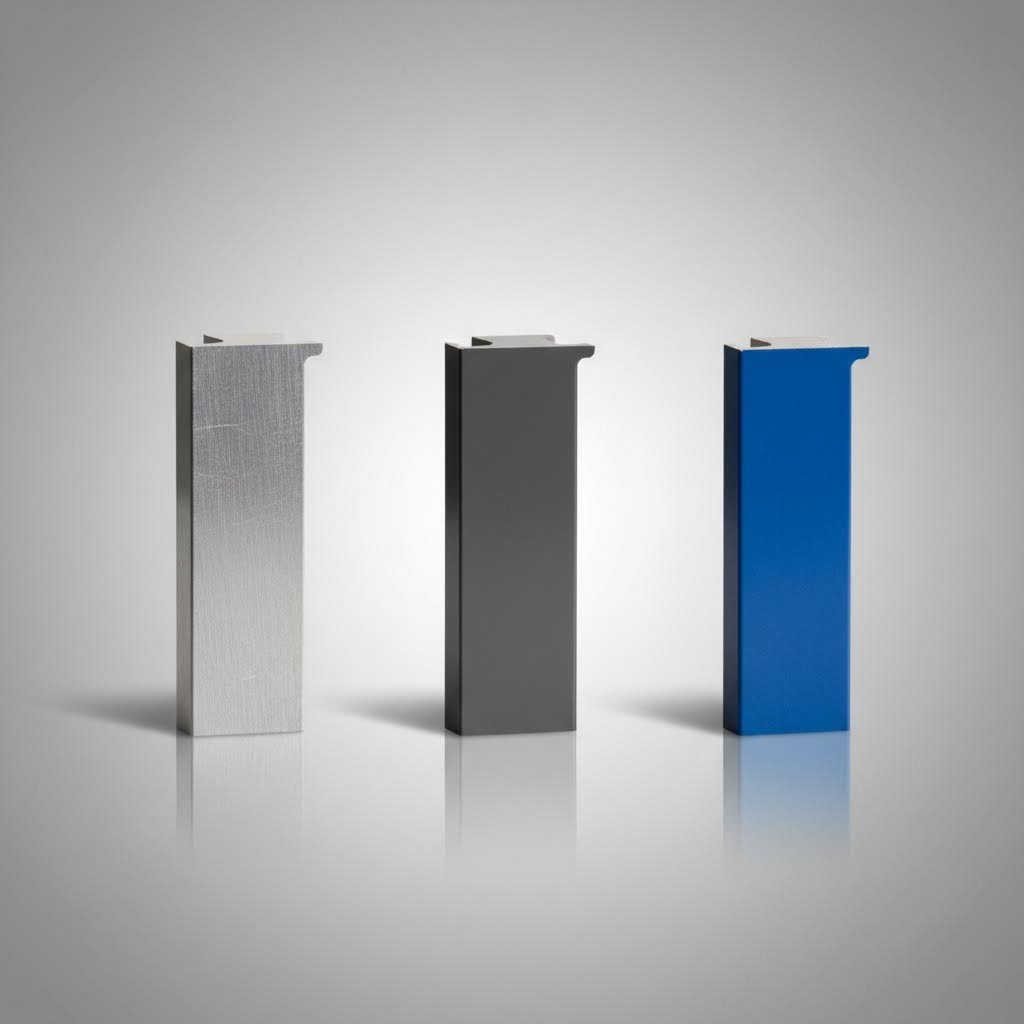
You've designed your profile and selected your alloy. Now comes a decision that can add anywhere from zero to several hundred dollars per metric ton to your project: surface treatment. The finish you choose affects not only aesthetics but also durability, maintenance requirements, and long-term value. Understanding the cost hierarchy helps you select the right treatment for your application without overspending.
Think of surface treatments as insurance policies for your custom aluminum profiles. The more protection you need, the higher the premium. Here's how the options stack up from most economical to most expensive:
Choosing the right finish isn't about selecting the cheapest option. It's about matching protection levels to your application requirements. Here's a practical framework:
Exterior architectural applications: Building facades, curtain walls, and metal roofing face relentless UV exposure, acid rain, and temperature cycling. For these uses, PVDF coatings have dominated the market because they maintain color stability and resist chalking for decades. The higher upfront cost pays dividends when you avoid repainting entire buildings.
High-traffic interior surfaces: Storefronts, door frames, and handrails endure constant physical contact. Anodizing's superior abrasion resistance makes it ideal here because organic coatings can chip and scratch under repeated impact.
Industrial components: Parts hidden inside machinery or equipment rarely justify premium finishes. Mill finish or basic clear anodizing usually provides adequate protection at minimal cost.
One often-overlooked advantage of anodizing: the coating is renewable. When anodized surfaces accumulate dirt and stains over years of service, cleaning with mild detergent and abrasive techniques can restore the appearance for another two decades. Once painted coatings fail, your only options are complete recoating or replacement.
The anodizing versus powder coating decision frequently comes down to application requirements and budget constraints. Here's a detailed comparison to guide your selection:
| Factor | Anodizing | Powder Coating | PVDF Coating |
|---|---|---|---|
| Durability | Excellent abrasion resistance; coating integral to metal | Good for indoor use; may chip in high-impact areas | Superior weather and chemical resistance |
| Lifespan | Proportional to thickness; Class I lasts 20+ years exterior | 5-15 years depending on environment | 20+ years with proper maintenance |
| Color Options | Limited to metallic tones and dyed colors | Extensive; hundreds of stock colors available | Wide range including metallic finishes |
| Initial Cost | Moderate | Lower | Higher |
| Maintenance Cost | Low; can be cleaned and renewed | Moderate; may require touch-ups | Low; excellent long-term stability |
| Environmental Impact | No VOCs; byproducts often beneficial | Low VOCs; overspray recyclable | May contain VOCs; requires specialized equipment |
| Best Applications | Storefronts, handrails, high-traffic areas | Indoor furniture, general architectural | Curtain walls, metal roofing, building facades |
When requesting quotes for custom aluminium extrusion with surface treatments, always specify the exact finish requirements. A quote simply stating "anodized" could mean anything from a 0.1 mil decorative coating to a robust Class I architectural finish. The price difference is substantial, and so is the performance gap.
For bespoke aluminium profiles requiring precise color matching across large projects, request Florida exposure test results from coating suppliers. AAMA 2605 specification requires actual ten-year South Florida exposure, providing real-world performance data rather than laboratory projections.
With surface treatment costs now clear, your next consideration involves a factor that dramatically influences per-unit pricing: order volume. Understanding minimum order quantities and volume breakpoints positions you to negotiate more effectively.
Here's a pricing reality that catches many buyers off guard: the exact same custom extrusion aluminum profile can cost dramatically different amounts depending solely on how many pieces you order. Volume isn't just a logistics consideration. It's one of the most powerful levers you have for controlling your per-unit costs.
Minimum order quantities exist for practical economic reasons, not arbitrary supplier policies. When you understand what drives MOQs, you gain negotiating power and realistic expectations.
Every custom aluminium extrusion order involves substantial setup costs before a single piece ships:
When these fixed costs spread across fewer units, your per-unit cost becomes disproportionally high. A die costing $1,500 adds $15 per piece to a 100-unit order but only $0.15 per piece when amortized across 10,000 units.
There's another factor buyers rarely consider: die maintenance economics. Producing small batches means higher costs for maintaining or replacing dies, and these expenses can outweigh sale profits entirely. For suppliers, accepting orders below MOQ thresholds often means losing money on the transaction.
Understanding typical volume tiers helps you plan purchases strategically and recognize when you're approaching meaningful price breaks:
The exact breakpoints vary by supplier, profile complexity, and market conditions. However, the pattern remains consistent: doubling your order quantity rarely doubles your total cost. The incremental cost of additional pieces drops significantly once fixed expenses are covered.
Should you order just what you need now, or invest in larger quantities for future requirements? This decision involves balancing inventory carrying costs against per-unit savings.
Consider this scenario: you need 200 custom extrusion profiles immediately with anticipated requirements of 800 more over the next year. Ordering 200 now might cost $12 per piece. Ordering 1,000 upfront might drop that to $7 per piece. The math seems obvious until you factor in:
A practical middle ground exists. Many suppliers offer release programs where you commit to annual volumes but receive shipments in scheduled increments. You lock in volume pricing while avoiding massive upfront inventory investments.
When negotiating with suppliers on MOQs, come prepared with:
Some suppliers offer stock holding services where they maintain inventory on your behalf, releasing material as needed. Others provide split-shipment options for initial orders. The key is demonstrating that your business represents ongoing value, not a one-time transaction.
Volume strategy directly connects to your next major cost consideration: secondary operations. The processing steps that transform raw extrusions into finished components add significantly to your total investment, and understanding these costs helps you evaluate whether integrated suppliers offer genuine advantages.
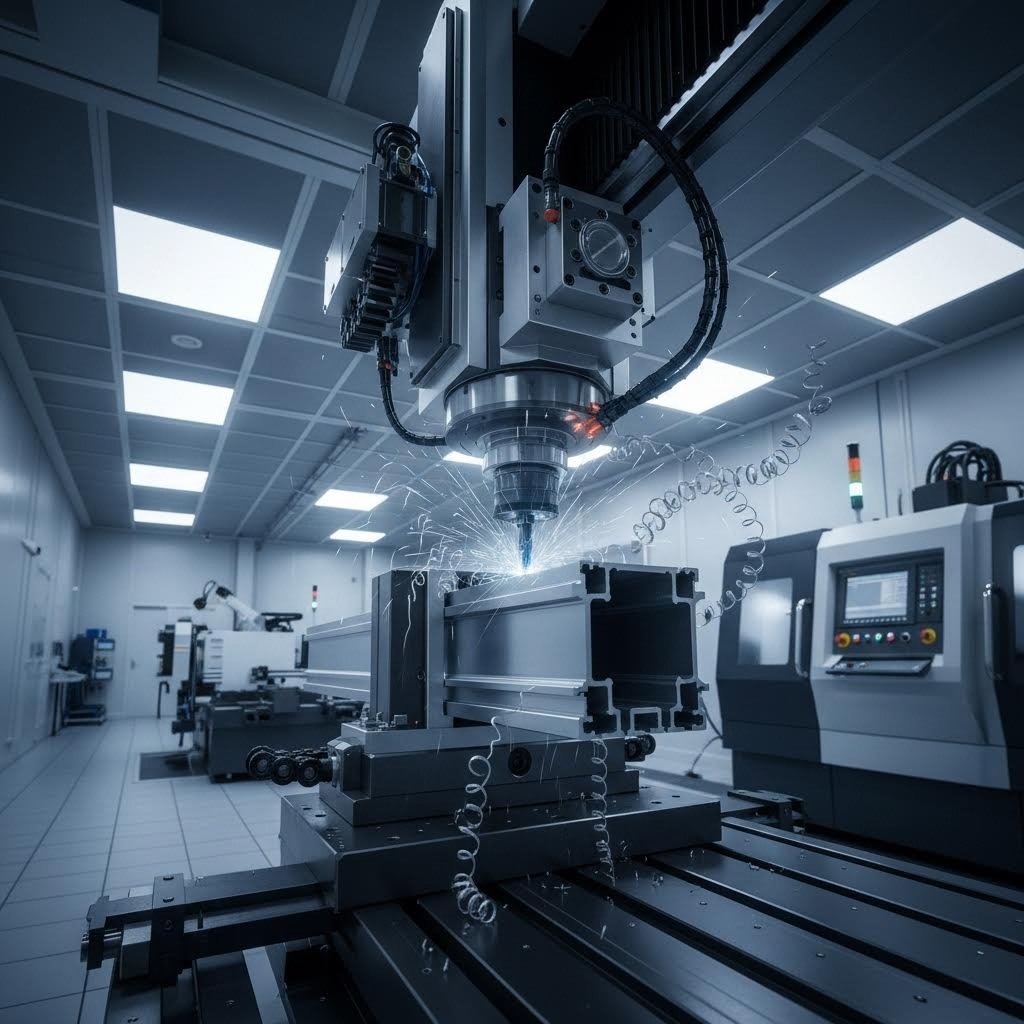
Your custom extruded aluminum profiles rarely ship straight from the press to your production floor. Most applications require additional processing steps that transform raw extrusions into ready-to-install components. These secondary operations can add anywhere from 15% to over 100% to your base extrusion cost, making them essential to understand when evaluating quotes from custom aluminum extruders.
Think about the journey from extruded profile to finished part. Each processing step involves dedicated equipment, skilled labor, and quality checkpoints. Here's what you're paying for when secondary operations appear on your quote:
Each additional operation requires its own setup, adding fixed costs that get distributed across your order quantity. A profile requiring cutting, drilling, and tapping might see secondary processing costs exceed the raw extrusion price for small batches.
Here's where many buyers get surprised: specifying tighter tolerances doesn't just add a small premium. It can multiply your processing costs exponentially.
Research from precision machining specialists reveals the true cost impact of tolerance specifications:
Why such dramatic increases? Tighter tolerances demand slower cutting speeds, multiple finishing passes, and intensive inspection procedures. A part requiring ±0.001" precision might need 2-3 times longer cycle times compared to standard tolerance work. Add the cost of CMM verification and detailed documentation, and you'll understand why that $50 standard part becomes $150-200 with tight tolerance requirements.
The timeline impact matters too. Standard tolerance parts typically ship in 5-7 days, while tight tolerance components may require 10-14 days for careful machining and quality verification. Ultra-tight specifications can extend lead times to 14-21 days.
Before specifying tight tolerances throughout your design, ask yourself: "What happens if this dimension varies by ±0.1mm?" If the answer is "nothing critical," standard tolerances will deliver identical performance at significantly lower cost.
Now imagine coordinating between separate suppliers for extrusion, machining, finishing, and assembly. Each handoff introduces shipping costs, communication overhead, quality risks, and timeline delays. This is where custom aluminum extrusion suppliers with integrated deep processing capabilities deliver substantial value.
When a single supplier handles everything from die development through mass production under one roof, you benefit from:
Consider what integrated capability actually means. Suppliers operating 35+ extrusion presses ranging from 600T to 5500T capacity can handle everything from small aluminum extrusions to large structural profiles. Pair that with state-of-the-art CNC machining centers for precise cutting, drilling, and bending, and you eliminate the complexity of managing multiple vendors.
This integration extends to surface treatments as well. Custom extruded aluminum profiles requiring anodizing, powder coating, or PVDF finishing move directly from machining to finishing lines without external handling. The result? Faster delivery, consistent quality, and competitive pricing that reflects genuine manufacturing efficiency rather than layered margins.
For projects requiring comprehensive aluminum extrusion and deep processing services, Shengxin Aluminium's deep processing capabilities demonstrate what integrated manufacturing looks like at scale. Their technical teams provide end-to-end support from die development through production, with extensive surface treatment options including custom color anodizing and specialty finishes.
When requesting quotes from custom aluminum extruders, ask specifically about in-house capabilities. Suppliers who must outsource machining or finishing will typically quote higher prices to cover coordination costs and external vendor margins. Those with comprehensive internal facilities can offer more competitive factory-direct pricing while maintaining tighter control over quality and delivery schedules.
With secondary processing costs now clear, you're ready for perhaps the most critical skill in aluminum extrusion procurement: comparing quotes from multiple suppliers accurately. Not all quotes are created equal, and understanding what to look for separates informed buyers from those who get burned.
You've gathered quotes from three different custom extruders. One comes in 20% lower than the others. Great deal, right? Not necessarily. That attractive bottom-line number might be hiding assumptions, exclusions, or quality compromises that will cost you far more down the road. Learning to decode and compare quotes accurately is perhaps the most valuable skill you can develop in aluminum extrusion custom procurement.
Ever tried comparing hotel prices only to discover one includes breakfast and parking while the other doesn't? Supplier quotes work the same way. Before evaluating any quote, verify it includes these essential elements:
When any of these elements are missing or vague, request clarification before making comparisons. A quote stating simply "anodized finish" tells you nothing about whether you're getting Class I architectural grade or decorative-only coating. The price difference between them is substantial.
Experience teaches buyers to recognize warning signs in quotes. Watch for these indicators that your final invoice may look very different from the initial quote:
Here's a critical insight from manufacturing experts: when reviewing quotes, price alone isn't the full story. Dig into the assumptions behind each number. A supplier quoting 15% less might be assuming a 10% scrap rate while competitors assume 5%. That difference alone could eliminate the apparent savings.
The secret to accurate quote comparison? Standardization. You control the comparison framework, not the suppliers. Here's how to level the playing field:
Create a uniform RFQ template: Develop a detailed request for quote document that specifies every variable. Include your expected annual volume, preferred alloy, surface finish requirements, tolerance specifications, and delivery schedule. When all suppliers respond to identical requirements, genuine price differences become visible.
Request full cost breakdowns: Ask each supplier to itemize tooling cost, estimated cycle time, press size requirements, piece price at different volumes, assumed scrap rate, and finishing costs. This transparency reveals where each supplier's pricing advantages lie.
Validate technical assumptions: Don't just look at price—understand how each supplier plans to achieve it. One might use a two-cavity die with faster cycle times while another proposes a single-cavity approach with lower tooling cost but higher piece price. Neither is inherently wrong, but you need to understand the tradeoffs.
Confirm lifetime and maintenance expectations: A cheaper tool might not survive your expected production run. Ask about die life expectancy, replacement costs, and maintenance schedules. A die lasting 50,000 pieces versus 200,000 pieces represents dramatically different long-term economics.
Factor in timeline costs: Lead time differences carry real financial impact. Consider these timeline factors when comparing quotes:
When your project timeline is critical, the lowest-priced supplier with an eight-week lead time may cost more than a slightly higher quote with four-week delivery. Calculate the business impact of delayed production or missed customer commitments.
Document everything: Before awarding the contract, summarize your understanding of the quote in writing and ask for supplier confirmation. This simple step prevents costly disputes later when invoices don't match expectations.
Armed with these comparison skills, you're prepared to evaluate quotes with confidence. However, even the most thorough quote analysis can miss certain expenses that only surface after production begins. Understanding these common pricing surprises helps you anticipate and avoid them.

You've compared quotes carefully, verified specifications, and selected what appears to be the best supplier. Then the invoice arrives, and suddenly your custom aluminum extrusion cost has ballooned by 15-25% beyond what you expected. What happened? Hidden costs struck again.
Understanding where these extrusion hidden costs originate helps you anticipate them during the quoting process rather than discovering them after production.
Even experienced procurement professionals get blindsided by expenses that weren't apparent in the original quote. Here are the most common culprits:
The pattern is clear: anything not explicitly included in your quote represents potential added expense. Assume nothing is covered unless the quote specifically states otherwise.
Transform surprises into planned expenses by asking these questions before accepting any quote:
Getting these answers in writing eliminates ambiguity and establishes clear expectations for both parties.
The decision between domestic and international sourcing involves far more than comparing unit prices. Each path carries distinct aluminum extrusion pricing factors that dramatically affect your total investment.
Overseas sourcing considerations:
International suppliers often quote attractive per-unit prices, but your total landed cost includes many additional variables:
Domestic sourcing advantages:
U.S. suppliers typically offer higher unit prices but provide compensating benefits:
The smartest approach involves calculating what industry professionals call total landed cost (TLC):
TLC = Ex-works price + Freight + Duties + Tariffs + Compliance costs + Carrying cost + Risk buffer
Consider this scenario: an overseas supplier quotes 8% less than a domestic alternative. Sounds attractive until you factor in an eight-week ocean transit requiring two extra months of inventory at 18% annual carrying cost. Add potential tariff exposure and customs documentation fees, and that apparent savings evaporates entirely.
The quoted price is never the true cost. Always calculate total cost of ownership including freight, duties, carrying costs, and risk factors before making sourcing decisions.
For aluminium airfoil extrusion and other specialized profiles requiring tight tolerances, domestic sourcing often proves more economical once you account for the engineering collaboration, iteration speed, and reduced quality risk that proximity enables.
With hidden costs now exposed, you're ready to take action on your custom extrusion project. The final step brings together everything you've learned into a practical framework for moving forward with confidence.
You've absorbed a lot of information about custom extrusion project planning. Now comes the moment that separates informed buyers from those who continue overpaying: putting this knowledge into action. Let's transform everything you've learned into a practical framework you can use immediately.
Before contacting any suppliers, work through this systematic approach to prepare yourself for productive conversations and accurate quotes:
Armed with your requirements documentation, use these extrusion quote request tips to ensure you receive accurate, comparable quotes:
Remember: the best suppliers act as technical partners, offering design-for-manufacturability feedback that can reduce your costs before production even begins. Suppliers who simply quote what you ask for without suggesting improvements may lack the expertise to optimize your project.
Aluminum extrusion supplier selection ultimately determines whether your project succeeds or struggles. The right partner brings more than competitive pricing. They bring decades of problem-solving experience that prevents costly mistakes.
Look for suppliers demonstrating these capabilities:
Established manufacturers with over 30 years of experience and comprehensive facilities—like those operating 35+ extrusion presses with state-of-the-art CNC machining centers—can provide factory-direct pricing advantages that fragmented supply chains cannot match. Shengxin Aluminium's deep processing and custom extrusion services exemplify this integrated approach, offering complete project support from initial die development through finished components with extensive surface treatment capabilities.
Your custom aluminum extrusion project deserves a partner who understands that transparent pricing builds lasting relationships. With the knowledge you've gained from this guide, you're now equipped to identify that partner, evaluate their quotes accurately, and negotiate from a position of informed confidence. The days of getting burned on extrusion pricing are behind you.
Raw aluminum material costs typically range from $1,500 to $3,500 per metric ton based on London Metal Exchange rates. However, your total cost per ton depends on additional factors including profile complexity, alloy selection, surface treatments, and secondary operations. Standard finished extrusions in Canada and the U.S. generally run between $3 to $8 per pound for basic processing. Working with integrated suppliers offering factory-direct pricing can help optimize your per-ton costs by eliminating middleman margins.
Custom extrusion dies typically cost between $400 and $2,000 depending on profile complexity. Solid profiles with simple shapes cost $300-$800, semi-hollow profiles run $800-$1,500, and hollow profiles with internal features range from $1,000-$3,000. Multi-void profiles can reach $5,000 or more. Many manufacturers refund tooling costs if you purchase a stipulated volume within two years. Die costs represent a one-time investment that gets amortized across your total order quantity.
Six core components determine your final price: raw aluminum material (40-60% of base cost), die/tooling investment, extrusion processing, surface finishing ($800-$1,400 per metric ton), secondary operations like CNC machining, and logistics. Profile complexity significantly multiplies costs through slower extrusion speeds and higher scrap rates. Order volume creates major per-unit savings, while alloy selection impacts both material cost and die life. Tight tolerances can increase machining costs by 3-4x compared to standard specifications.
The answer depends on total landed cost, not just unit price. Overseas quotes may appear 8-15% lower, but you must add ocean freight (32-52 days transit), Section 232 tariffs (potentially 50-100%), anti-dumping duties, inventory carrying costs, and compliance expenses. Domestic suppliers offer faster 3-8 week turnaround, simplified logistics, and easier quality resolution. Calculate TLC = Ex-works price + Freight + Duties + Tariffs + Compliance + Carrying cost + Risk buffer before deciding.
Create a standardized RFQ template specifying exact alloy, tolerances, surface finish requirements, annual volume projections, and all secondary operations. Request itemized breakdowns separating die costs, piece price, finishing, and machining. Verify packaging and shipping terms upfront. Ask about die ownership and replacement policies. Compare at least three suppliers using identical specifications for apples-to-apples evaluation. Experienced suppliers like Shengxin Aluminium provide comprehensive support from die development through production with transparent factory-direct pricing.



 un service en ligne
 0086 136 3563 2360
 sales@sxalu.com
 +86 136 3563 2360
 français
 English
 Deutsch
 русский
 español
 português
 العربية
 ไทย
ไทย Việt
Việt Українська