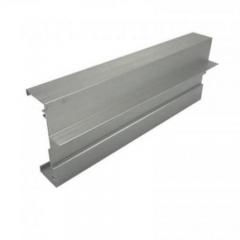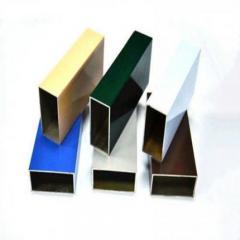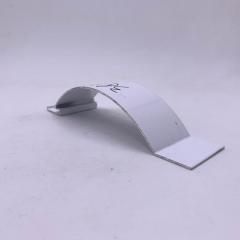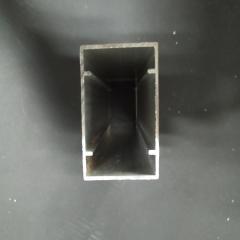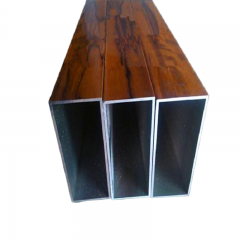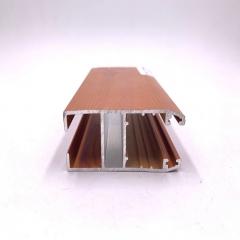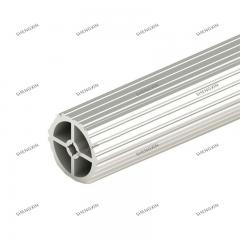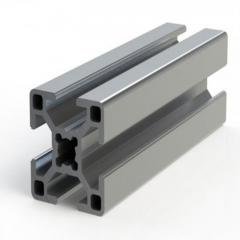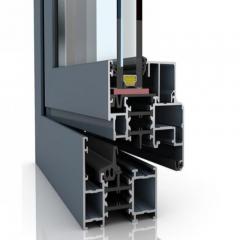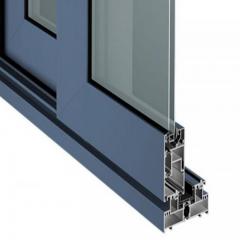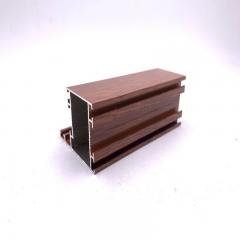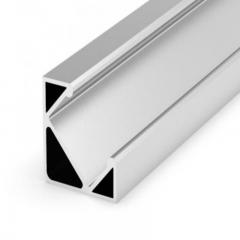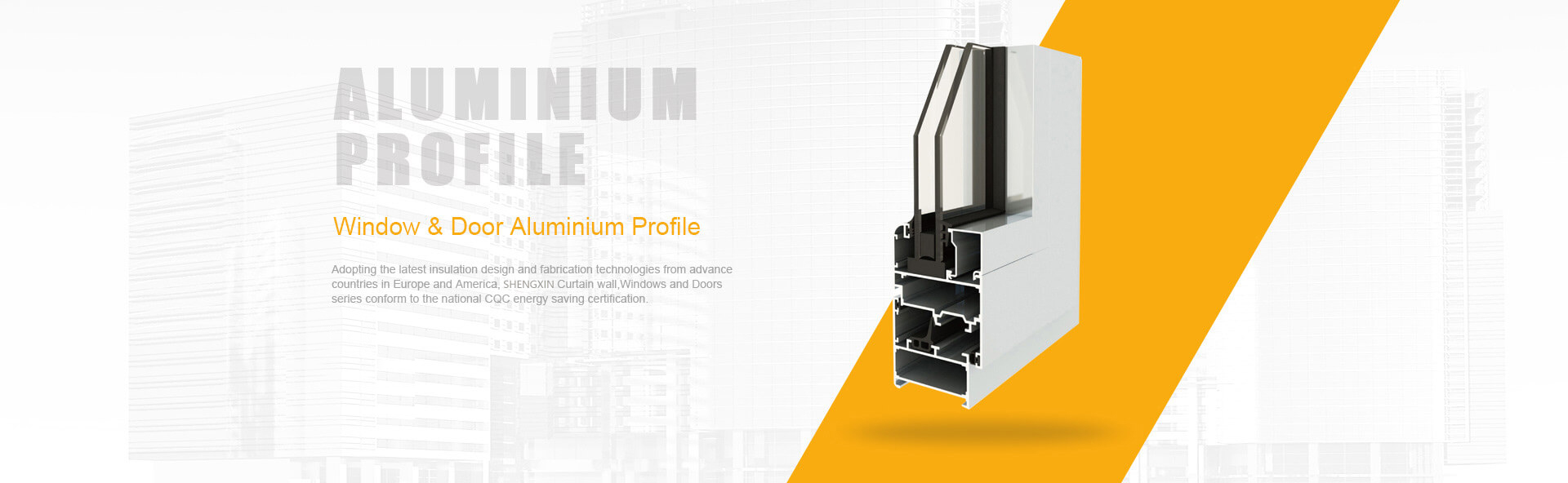
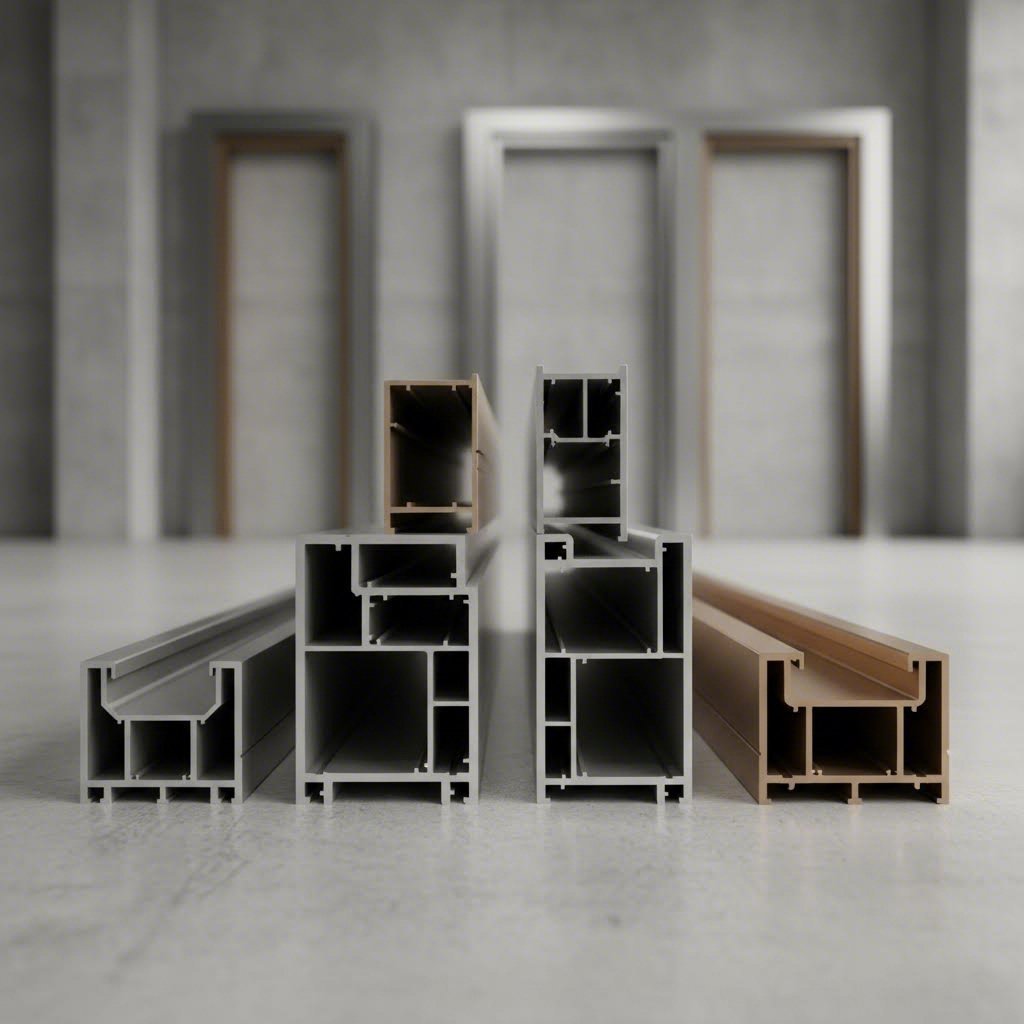
When you walk through a modern commercial building or step into a sleek residential space, chances are you're passing through an aluminum door frame without even realizing it. These precision-engineered components have quietly revolutionized how architects and builders approach door installations. But what exactly makes aluminum door frame extrusions so essential to contemporary construction?
Aluminum extrusion is a fabrication process that forces a heated aluminum billet through a custom-shaped steel die to produce a continuous profile with a consistent cross-section, allowing manufacturers to create everything from simple angles to complex architectural systems with high dimensional accuracy.
This manufacturing method delivers the precise, uniform profiles that modern aluminum door frames require. Unlike cast or machined alternatives, an extruded frame maintains consistent wall thickness and structural integrity throughout its entire length—a critical factor for both performance and aesthetics.
You might wonder why aluminum has overtaken traditional materials like steel and wood in door frame applications. The answer lies in a compelling combination of properties that neither competitor can match.
Consider weight first. A piece of aluminum weighs only one-third of an equivalent steel component. This lightweight nature doesn't sacrifice strength—it actually enables slimmer profiles and larger door openings without compromising structural integrity. Installation becomes faster, hardware requirements decrease, and transportation costs drop significantly.
Durability tells another compelling story. Aluminium extrusions resist rust, corrosion, and weathering naturally. Steel frames demand regular protective coatings to prevent oxidation, while wood remains vulnerable to rot, warping, and pest damage. Alum door frames, by contrast, require little more than occasional cleaning to maintain their appearance for decades.
Design flexibility seals the deal. Aluminum door extrusion can be powder-coated in virtually any color, anodized for enhanced hardness, or finished to mimic wood grain textures. Modern thermal break technology addresses the one historical drawback—thermal conductivity—making these frames suitable for energy-conscious exterior applications.
Understanding how aluminum extrusion works helps you appreciate why these profiles perform so consistently. The process begins with preheating a cylindrical aluminum billet to approximately 800-925°F. At this temperature, the metal becomes malleable without melting—imagine working with very firm modeling clay.
A hydraulic ram then applies tremendous force—often up to 15,000 tons of pressure—pushing the heated billet through a precision-machined steel die. The aluminum emerges in the exact cross-sectional shape of that die opening, whether it's a simple rectangular tube or an intricate multi-chamber profile designed for thermal performance.
What happens next is equally important. The emerging profile undergoes rapid cooling through water baths or forced air—a process called quenching. This controlled cooling locks in mechanical properties and prevents warping. Finally, stretching corrects any remaining deformation while work-hardening the aluminum at a molecular level.
The result? An aluminum door frame profile that maintains dimensional accuracy across its entire length, with consistent strength characteristics and a surface ready for finishing. This reliability explains why architects and contractors increasingly specify extruded aluminum for projects ranging from residential entries to high-traffic commercial storefronts.
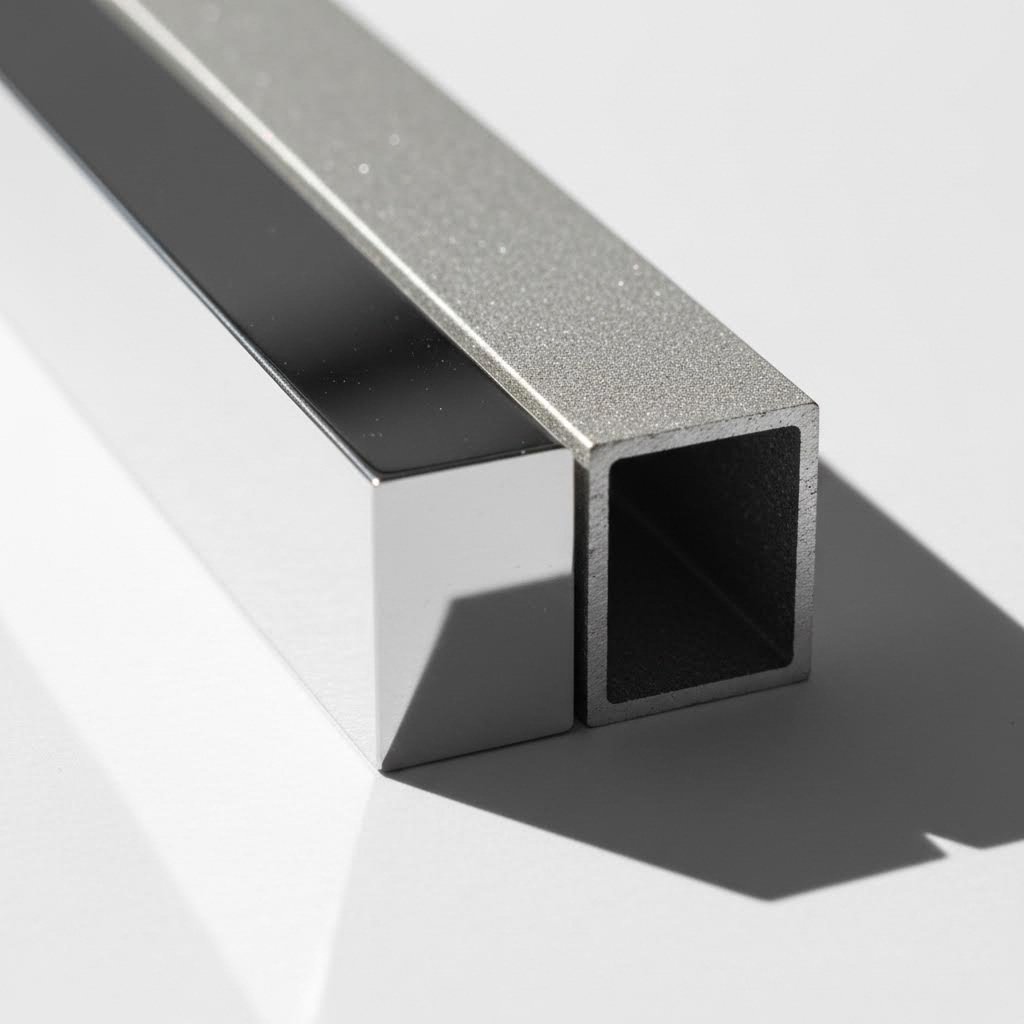
You've seen how aluminum extrusion works—but here's a question that often gets overlooked: which aluminum alloy should you actually choose? Not all aluminum is created equal, and selecting the right grade can mean the difference between a door frame that performs flawlessly for decades and one that falls short of expectations.
When evaluating aluminum extrusions for door frame applications, two alloys dominate the conversation: 6063 and 6061. Both belong to the 6000 series, which means they share silicon and magnesium as their primary alloying elements. However, their performance characteristics differ significantly—and understanding these differences helps you make informed decisions for your specific project.
Walk into any architectural aluminum supplier and ask about door frames. Nine times out of ten, they'll point you toward 6063 alloy. There's good reason for this industry preference.
6063 aluminum earns its reputation as the "architectural alloy" because it excels where door frames matter most: surface finish quality, extrudability, and corrosion resistance. When an item extruded aluminium profile emerges from the die, 6063 delivers remarkably smooth surfaces that accept anodizing and powder coating beautifully. This matters tremendously for visible elements like door frames where aesthetics impact first impressions.
The alloy's superior extrudability allows manufacturers to produce complex aluminum frame extrusion profiles with intricate details—thermal breaks, weatherstripping channels, and decorative features—without sacrificing dimensional accuracy. You'll notice this advantage in multi-chamber designs that enhance energy efficiency while maintaining sleek appearances.
Corrosion resistance comes naturally to 6063 aluminum frame extrusions. The magnesium-silicon composition forms a protective oxide layer that shields the metal from environmental degradation. For door frames exposed to moisture, salt air, or varying weather conditions, this inherent protection proves invaluable.
Sounds complex? It's actually straightforward once you understand the basics. Temper designations like T5 and T6 describe how the aluminum was heat-treated after extrusion—and this treatment dramatically affects mechanical properties.
Here's what happens during heat treatment: the alloy temperature rises to approximately 980 degrees Fahrenheit, dissolving all alloying elements into a solid solution. Rapid quenching follows, preventing those elements from precipitating as the metal cools. The subsequent aging process—heating at temperatures between 325 and 400 degrees Fahrenheit—creates ordered atomic arrays called GP zones that significantly strengthen the aluminum.
The difference between T5 and T6 involves when quenching occurs:
For most door frame applications, T5 provides adequate strength while offering cost advantages. T6 becomes the choice when projects demand maximum structural performance from extruded aluminum sections.
Sometimes door frame applications require more muscle than 6063 can provide. That's where 6061 aluminum enters the picture.
Consider the numbers: 6061-T6 delivers an ultimate tensile strength of at least 42,000 psi and yield strength of at least 35,000 psi. Compare this to 6063-T6's ultimate tensile strength of 28,000 psi and yield strength of 23,000 psi. When your project involves heavy doors, high-traffic commercial entries, or structural loads beyond typical residential use, 6061 provides the extra strength margin you need.
However, this strength advantage comes with tradeoffs. 6061 doesn't extrude as smoothly, meaning surface finishes won't match 6063's refined appearance. For visible architectural applications where aesthetics matter, you might sacrifice some visual appeal for structural capability.
| Property | 6063 Aluminum | 6061 Aluminum |
|---|---|---|
| Primary Use | Architectural extrusions, door/window frames | Structural applications, heavy-duty frames |
| Ultimate Tensile Strength (T6) | 28,000 psi minimum | 42,000 psi minimum |
| Yield Strength (T6) | 23,000 psi minimum | 35,000 psi minimum |
| Surface Finish Quality | Excellent—smooth, accepts anodizing well | Good—rougher than 6063 |
| Extrudability | Superior—complex shapes possible | Good—some limitations on intricate profiles |
| Corrosion Resistance | Excellent | Excellent |
| Best For | Visible door frames, custom profiles | Load-bearing frames, structural components |
The decision ultimately comes down to priorities. Need a beautiful, smooth-finished door frame for a residential entry or storefront? Choose 6063. Building heavy commercial doors or frames that must support significant loads? 6061 makes more sense. Many item extruded aluminium suppliers can help you evaluate which alloy matches your specific performance requirements.
With alloy selection clarified, the next consideration involves matching these materials to specific door types—where profile geometry and application requirements vary dramatically.
Now that you understand alloy grades and their performance characteristics, how do you match the right aluminum door frame to your specific application? The answer lies in understanding that different door types demand fundamentally different profile designs. Entry doors, sliding systems, commercial storefronts, and interior applications each present unique challenges—and the extrusion geometry must respond accordingly.
Think about it this way: a residential entry door faces weather exposure, security threats, and energy efficiency demands. A sliding patio door must support heavy glass panels while enabling smooth, effortless operation. Commercial storefronts endure thousands of daily openings while maintaining structural integrity. Each scenario requires purpose-built aluminum door frame solutions.
Exterior entry doors represent perhaps the most demanding application for aluminum extrusions. These frames must simultaneously block heat transfer, resist forced entry, support weatherstripping, and maintain aesthetic appeal through years of exposure to the elements.
Thermal break technology addresses the energy efficiency challenge directly. According to Hydro Aluminium, thermal break involves fabricating a non-conductive material—usually rolled polyamide plastic strip—between two aluminum components to reduce temperature exchange. This design keeps homes warm in winter by reducing heat escape while restricting external temperatures from entering during summer months.
Multi-chamber profile geometry enhances this thermal performance. Imagine the cross-section of a high-performance entry door frame:
Security considerations influence wall thickness and reinforcement options. Thicker profiles with solid sections at lock strike locations resist forced entry better than hollow alternatives. Many premium entry door frames incorporate steel reinforcement within the aluminum extrusion for maximum security without sacrificing the material's corrosion resistance advantages.
Sliding door applications demand an entirely different approach to profile design. Here, the aluminum sliding door track must accomplish something seemingly contradictory: support substantial weight while enabling nearly frictionless movement.
Consider the engineering challenge. A typical residential sliding glass door panel weighs between 150 and 300 pounds. That mass rests on rollers traveling along an extruded aluminum track that must remain perfectly level and dimensionally stable for decades. Any warping, deflection, or surface imperfection translates directly into difficult operation.
The sliding door aluminum track profile addresses these demands through specific geometric features:
The extruded aluminium track geometry varies based on panel weight and configuration. Single-track systems work for basic two-panel installations. Multi-track profiles accommodate stacking or pocket configurations where multiple panels slide past each other or disappear into wall cavities.
An aluminum extrusion slider system often incorporates both head (top) and sill (bottom) tracks with complementary profiles. The sill track bears most of the panel weight through roller assemblies, while the head track provides lateral guidance and weathersealing surfaces. This aluminum slide track channel design distributes loads appropriately while maintaining smooth operation.
As Profall notes, aluminum's lightweight yet strong properties aid seamless installation and reduce strain on structures, ensuring doors glide effortlessly while maintaining structural integrity over the years.
Commercial storefront applications push aluminum door frame extrusions into another performance category entirely. These installations face high-traffic durability demands, structural glazing requirements, and aesthetic expectations that differ markedly from residential projects.
The numbers tell the story. A busy retail entrance might experience thousands of opening cycles daily. The frame must withstand this repeated stress without loosening fasteners, degrading weatherseals, or showing visible wear. Additionally, storefront systems typically support large glass panels—sometimes spanning floor to ceiling—requiring substantial structural capacity.
Boyd Aluminum offers commercial storefront systems that illustrate this application's complexity, with options including:
Profile geometry for commercial applications typically features heavier wall thicknesses and larger overall dimensions than residential counterparts. The 4.5-inch depth common in storefront systems provides space for structural glazing, thermal breaks, and integrated hardware while presenting clean sightlines that architects demand.
Structural glazing presents particular challenges. The extruded aluminum track and frame system must securely grip glass panels—sometimes exceeding 500 pounds each—while accommodating thermal expansion, wind loads, and seismic movement. Specialized glazing channels with precise dimensional tolerances ensure proper glass fit and long-term seal integrity.
Interior applications offer more design freedom since thermal performance and weather resistance become non-factors. Here, aesthetics, weight reduction, and installation simplicity drive profile selection.
Hollow sections dominate interior door frame applications. Without thermal break requirements, single-wall hollow profiles provide adequate structural performance while minimizing material usage and weight. This lightweight construction simplifies handling during installation and reduces costs without compromising functionality.
Profile geometry for interior frames emphasizes visual refinement:
The reduced performance demands of interior applications allow specifiers to prioritize cost efficiency. Simpler profiles require less complex dies, extrude faster, and use less material—advantages that compound across large commercial interior projects with hundreds of door openings.
Understanding these application-specific requirements helps you select appropriate profiles, but surface finishing ultimately determines how those profiles look and perform over time. The next section explores coating options that protect and beautify aluminum door frames.
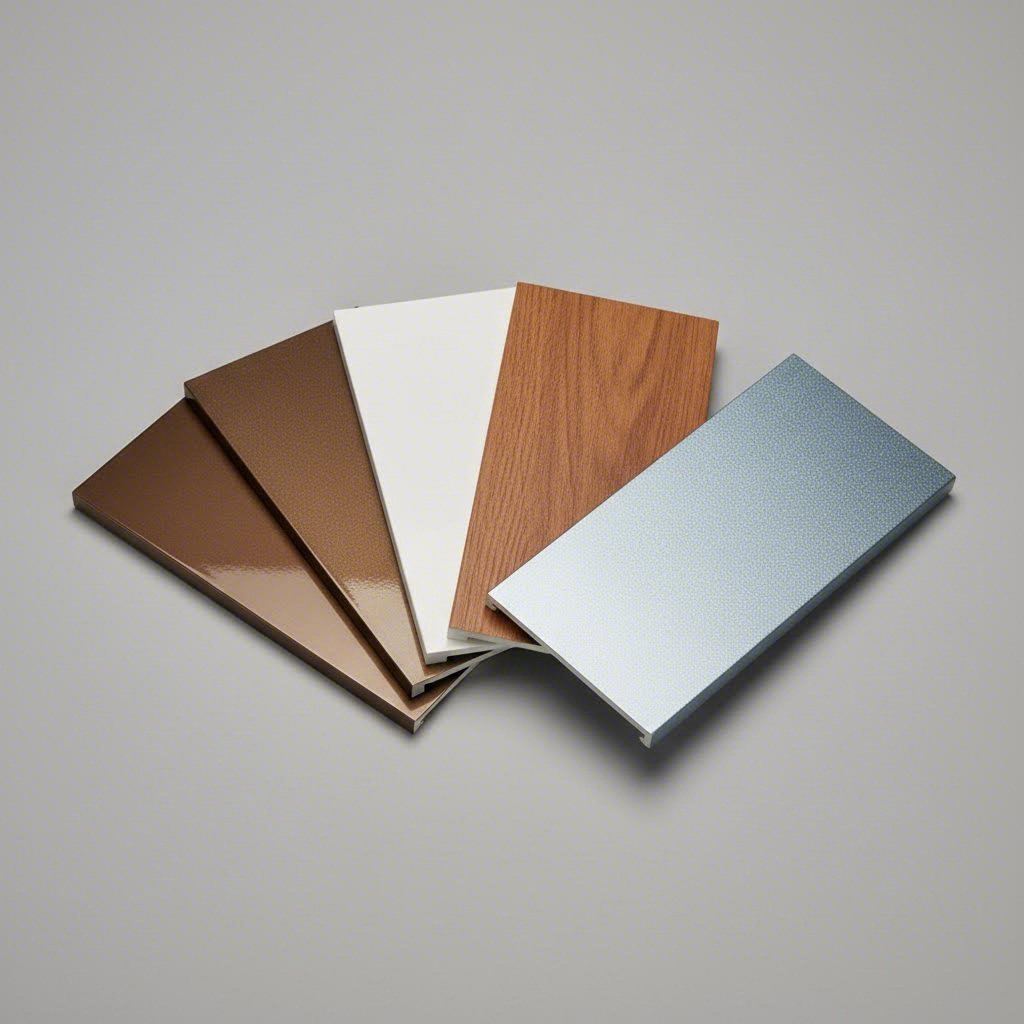
You've selected the right alloy and matched your profile to the application—but how will that aluminum door frame look five, ten, or twenty years from now? Surface finishing determines not just initial appearance but long-term durability, maintenance requirements, and protection against environmental degradation. Surprisingly, many specification guides overlook this critical decision entirely.
The finishing options available for aluminum panel extrusions range from utilitarian protection to decorative statements that mimic natural materials. Each approach offers distinct advantages, and understanding these differences helps you specify finishes that perform as beautifully as they appear.
When evaluating aluminum extrusion trim finishes, two processes dominate the conversation: anodizing and powder coating. Both protect aluminum surfaces effectively, but they accomplish this through fundamentally different mechanisms—and those differences matter for your specific application.
Anodizing works with the aluminum itself rather than covering it. According to Gabrian, technicians submerge the aluminum piece into an electrolytic bath and run an electric current through it. Using aluminum as the anode in the circuit causes oxidation on the metal's surface, creating an oxide layer significantly thicker than the naturally occurring one. This enhanced oxide layer improves wear resistance, corrosion protection, and heat dissipation while providing excellent adhesion for dyes.
The resulting finish becomes integral to the aluminum—you can't peel it off because it's actually part of the metal. This integration delivers exceptional durability in high-wear applications like commercial door frames. Anodized surfaces maintain their appearance even when scratched, since the color penetrates into the oxide layer rather than sitting on top.
Powder coating takes a different approach. This dry application process applies electrostatically charged powder particles to grounded aluminum components. The powder adheres to the surface during application, then cures in an oven where it transforms into a uniform, solid layer. No solvents are involved, making powder coating an environmentally friendly alternative to liquid paints.
Consider the practical implications for extruded aluminum panels and door frames:
For window extrusion and door frame applications requiring metallic appearances with maximum wear resistance, anodizing often proves ideal. When projects demand specific colors or budget-conscious durability, powder coating delivers excellent value.
Standard anodizing and powder coating serve most applications well, but architectural projects often demand performance levels that exceed typical specifications. This is where PVDF coatings and wood grain finishes enter the picture.
PVDF (polyvinylidene fluoride) coatings—commonly known by brand names like Kynar 500—represent the gold standard for architectural aluminum window extrusion profiles and door frames exposed to severe environmental conditions. These 70% fluoropolymer resin-based coatings provide exceptional resistance to UV degradation, chemical attack, and weathering.
AAMA 2605, the most stringent performance specification for architectural coatings, requires products to demonstrate outstanding durability through rigorous testing. After ten years of exposure in South Florida—one of the harshest UV environments in North America—compliant coatings must show no more than 5 Delta E units of color change and maintain at least 50% original gloss. This real-world performance verification ensures specified finishes maintain their appearance for decades.
The AAMA establishes three primary performance tiers for organic coatings:
Wood grain finishes offer another specialty option that's gaining popularity for aluminium extrusion trim applications. Linetec explains that these finishes use heat-transfer dye sublimation processes to create textures that mimic not just the look but also the feel of natural wood. Unlike real wood, these coatings resist weather, humidity, chemicals, corrosion, fire, UV light, insects, and scratches—while never warping, rotting, or requiring extra maintenance.
Wood grain finishes should be specified to meet AAMA 2604 for architectural aluminum products. This makes them suitable for exterior applications where biophilic design goals call for natural aesthetics without wood's inherent maintenance burdens.
| Finish Type | Durability | Maintenance | Color Options | Typical Applications |
|---|---|---|---|---|
| Clear Anodizing | Excellent wear and corrosion resistance; integral to metal | Minimal—periodic cleaning | Natural aluminum appearance | Commercial storefronts, modern residential entries |
| Color Anodizing | Superior scratch resistance; color won't peel | Minimal—periodic cleaning | Limited integral colors (bronze, black, champagne) | Architectural facades, premium door frames |
| Powder Coating (AAMA 2604) | Good UV and weather resistance | Low—occasional cleaning | Virtually unlimited colors and textures | Residential doors, interior frames, moderate exterior use |
| PVDF Coating (AAMA 2605) | Superior—10+ year proven performance | Very low—self-cleaning properties | Wide range including metallic finishes | High-rise facades, coastal environments, monumental projects |
| Wood Grain Finish | Weather, UV, insect, and scratch resistant | Very low—no refinishing needed | Multiple wood species appearances | Traditional aesthetics, biophilic design, historic renovation |
Regardless of which finish you select, proper maintenance extends service life and preserves appearance. The good news? Aluminum door frame finishes require far less attention than their wood or steel counterparts.
Expected lifespans vary by finish type and environment. Properly maintained anodized finishes routinely exceed 30 years in service. AAMA 2605 coatings are warranted for 10 years but typically perform well for 20 or more. Even standard powder coatings deliver 15-20 years of service when properly specified and maintained.
With finishing options clarified, attention naturally turns to the engineering specifications that govern how these profiles perform structurally—including the dimensional tolerances and quality standards that ensure consistent performance.
You've explored alloys, applications, and finishes—but how do you know the aluminum door frame you're specifying will actually fit and perform as expected? This is where dimensional tolerances, structural calculations, and quality standards come into play. These engineering fundamentals separate professional-grade aluminum window extrusions from products that create headaches during installation and underperform in service.
Understanding these specifications isn't just academic. When an aluminum extrusion track arrives on site with dimensions outside acceptable limits, installation schedules suffer and costs escalate. When wall thickness falls short of structural requirements, safety becomes a concern. Let's decode the technical language that ensures your aluminum door frame extrusions perform exactly as intended.
Every aluminum window frame extrusion has specified dimensions—but perfect precision is neither achievable nor necessary. What matters is controlling variation within acceptable limits. This is where ASTM B221 becomes essential.
ASTM B221 (and its metric counterpart B221M) serves as the foundational standard governing aluminum extruded products. This specification addresses chemical composition, mechanical properties, heat treatment, and critically—dimensional tolerances. The standard references ANSI H35.2M for permissible variations from specified dimensions, ensuring components fit properly during assembly.
Tolerance classes establish how much deviation from nominal dimensions is acceptable:
Wall thickness tolerances deserve particular attention. For aluminum extrusion track profiles supporting sliding doors, consistent wall thickness ensures uniform strength across the entire length. Variations can create stress concentrations that lead to premature failure under repeated loading.
Beyond dimensional control, quality standards establish performance benchmarks. AAMA (American Architectural Manufacturers Association) specifications govern everything from coating durability to thermal performance. ASTM standards address material properties and testing methods. Together, these frameworks ensure aluminium window frame extrusions meet expectations for strength, durability, and long-term performance.
When you specify aluminum door frame extrusions for demanding applications, structural adequacy becomes paramount. How much weight can a profile support? How does profile geometry affect load-bearing capacity? These questions require understanding how wall thickness, section shape, and alloy selection interact.
Wall thickness directly influences structural performance. Thicker walls increase the moment of inertia—the geometric property that determines resistance to bending. For door frames supporting heavy glass panels or experiencing significant wind loads, adequate wall thickness prevents deflection that could compromise weatherseals or cause operational problems.
Profile geometry matters equally. Consider these structural principles:
Thermal break technology introduces additional structural considerations. When polyamide barriers separate interior and exterior aluminum components, the connection method between these elements affects overall frame rigidity. Quality thermal break systems maintain structural integrity while interrupting heat flow—a balance that requires careful engineering.
For exterior applications, thermal breaks have become increasingly important for energy code compliance. These systems reduce heat transfer through the aluminum frame, preventing the condensation issues and energy losses that plagued early aluminum door installations. Modern aluminum extrusion track systems for sliding doors routinely incorporate thermal breaks to meet current performance standards.
The interaction between specifications becomes clear in practice. A door frame might require 6063-T6 alloy for surface finish quality, minimum 2mm wall thickness for structural adequacy, precision tolerances for proper hardware fit, and thermal break construction for energy efficiency. Each specification addresses a different performance aspect, and overlooking any one element compromises the final result.
With engineering requirements understood, the focus shifts to practical implementation—specifically, how to handle, cut, assemble, and install these precisely manufactured profiles without damaging their carefully controlled properties.
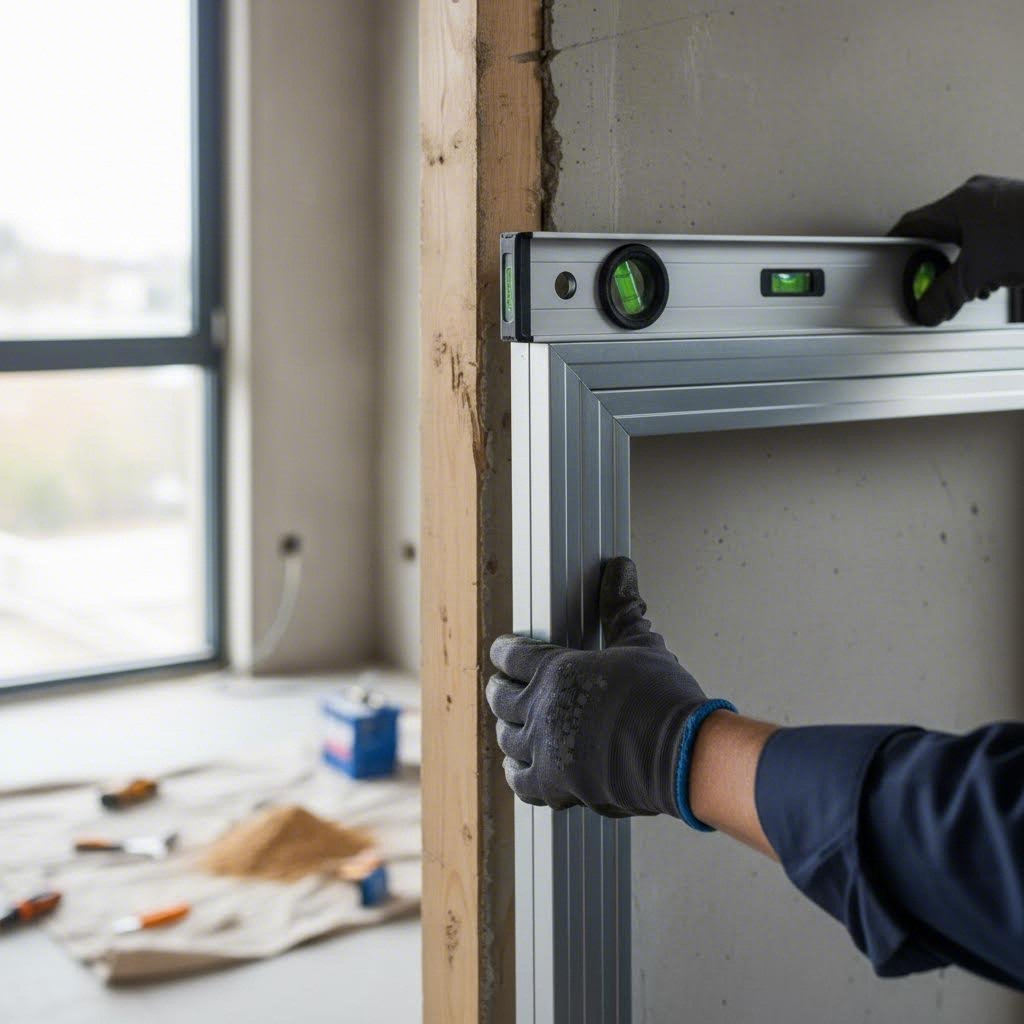
You've specified the right alloy, selected appropriate profiles, and chosen a durable finish—but none of that matters if installation goes wrong. Improper handling, poor cutting techniques, or sloppy assembly can undermine even the highest-quality aluminum door frame extrusions. Whether you're tackling a DIY project or managing professional installers, understanding proper installation methods protects your investment and ensures long-term performance.
The good news? Aluminum extrusion assembly is more forgiving than welded steel framing and far simpler than working with wood. With the right approach, you can achieve professional results consistently.
Before cutting a single piece, proper handling prevents the surface damage that becomes permanent once installation is complete. Aluminum door and frame components arrive with carefully applied finishes—scratches, dents, or abrasions at this stage mean visible defects for the life of the installation.
Follow these handling and storage guidelines:
Cutting and fabrication require appropriate tools and techniques. Use carbide-tipped saw blades designed for non-ferrous metals—wood blades create rough edges and excessive burrs. Apply cutting lubricant to improve finish quality and extend blade life. Always deburr cut edges before assembly to ensure proper fit and prevent injury during handling.
Successful aluminum extrusion kit assembly follows a logical sequence that ensures proper alignment and structural integrity. Rushing through steps or skipping verification causes problems that compound as work progresses.
Corner joints determine the structural integrity and long-term stability of your extruded aluminum housing or door frame. Three primary methods exist, each with distinct advantages:
Mechanical fasteners offer the simplest approach for most aluminum door frame installations. Screws, bolts, and specialized corner brackets create strong connections without special equipment. The advantage of mechanical connections is adjustability—if alignment shifts over time, you can loosen, realign, and retighten.
Welding creates permanent joints with maximum strength but requires skilled technicians and specialized equipment. For aluminum, TIG welding produces the cleanest results. However, welding affects heat treatment and can compromise finishes—post-weld treatment may be necessary. Most architectural door frame applications avoid welding in favor of mechanical methods.
Structural adhesives offer an alternative for applications where visible fasteners are unacceptable. Modern structural adhesives create bonds that approach weld strength while distributing stress across the entire joint area. Adhesive joints require proper surface preparation and controlled curing conditions for reliable performance.
For plexiglass aluminum frame assemblies or similar glazed applications, corner joint selection also affects glazing seal integrity. Mechanical connections that allow slight movement may better accommodate thermal expansion than rigid welded joints.
Proper weatherstripping transforms a bare aluminum frame into an effective barrier against air and water infiltration. Most aluminum door frame extrusions incorporate channels specifically designed to accept weatherstrip profiles—but proper installation technique matters.
Press weatherstripping firmly into channels without stretching. Stretched material relaxes over time, creating gaps. At corners, miter weatherstrip ends for continuous contact rather than butting square-cut pieces together. Replace any weatherstripping that shows wear, cracking, or compression set during installation—new frames deserve new seals.
Hardware mounting requires attention to reinforcement. Door handles, locks, and hinges concentrate stress at mounting points. Ensure the frame profile provides adequate material thickness at hardware locations. For heavy commercial doors, internal steel reinforcement may be necessary even with robust aluminum profiles.
Experience teaches which mistakes create the biggest headaches. Avoid these common pitfalls:
Proper installation transforms quality aluminum door frame extrusions into lasting architectural elements. But what if standard profiles don't meet your project's unique requirements? The next section explores when custom extrusions make sense—and how the development process works.
You've mastered installation techniques and understand what makes aluminum door frame extrusions perform—but here's a decision that can significantly impact your project's timeline, budget, and final results: should you specify standard off-the-shelf profiles or invest in custom extrusions? This choice affects everything from initial costs to long-term performance, and getting it right requires understanding when each option delivers the best value.
Imagine browsing an extruded aluminum shapes catalog with hundreds of standard profiles. Many projects find exactly what they need within these existing options. Others discover that no standard shape quite fits their vision. Knowing which situation applies to your project—before procurement begins—prevents costly mid-project pivots.
Standard aluminum profile extrusions exist because certain shapes work well across countless applications. Manufacturers maintain inventories of these proven designs, making them immediately available without tooling delays or minimum order complications.
Consider specifying standard profiles when your project meets these criteria:
The aluminum shapes catalog from a quality supplier typically includes channels, angles, tubes, and specialized architectural profiles that address most common door frame applications. These profiles undergo regular production, ensuring consistent quality and reliable availability. For prototyping, replacement parts, or straightforward residential projects, standard options often represent the smartest choice.
Standard profiles also simplify specification. When you select from established product lines, performance data, tolerance specifications, and finishing options are already documented. There's no guesswork about whether the profile will perform as expected—it already has.
Sometimes standard just doesn't cut it. Unique architectural visions, specialized performance requirements, or high-volume production economics push projects toward custom aluminum extrusions. Understanding the development process helps you plan realistic timelines and budgets.
According to Star Extruded Shapes, the custom extrusion journey begins with alloy selection—choosing the right aluminum grade that delivers your required strength, corrosion resistance, and surface finish characteristics. This foundational decision influences every subsequent step.
Next comes design and die development. Using specialized software like AutoCAD or SolidWorks, engineers translate your requirements into precise digital models. These models enable faster and more precise quoting, streamlined prototyping, and reduced time to market. The digital design becomes the blueprint for manufacturing the steel die through which aluminum will be forced.
The die itself represents the primary custom tooling investment. As The Fabricator notes, die costs typically run into the thousands of dollars—but this remains a relatively small amount within the scope of an entire architectural project. Lead times for die development often run less than a month, making custom extrusions more accessible than many assume.
Once the die is complete, production follows the standard extrusion sequence: heating the aluminum billet, forcing it through the die under hydraulic pressure, cooling, straightening, cutting to length, and applying specified finishes. Quality control ensures each piece meets dimensional and surface requirements before shipping.
What exactly can you customize? Nearly everything about an aluminum extrusion profile is adjustable when you control the die design:
For aluminum enclosure extrusion applications or extruded aluminum enclosures housing sensitive equipment, custom profiles can incorporate specific channel geometries for gaskets, slots for panel insertion, or integrated mounting features. An aluminium extrusion box designed from scratch accommodates exact component dimensions rather than forcing components to fit available profiles.
Custom extrusions come with practical constraints that affect project planning. Most extruders establish minimum order quantities—often 1,000 to 2,000 pounds per shape—to justify production setup. For small batches, an order charge may substitute for meeting stated minimums. Importantly, these minimums are sometimes negotiable, especially for projects that may lead to repeat orders.
Lead time expectations should include:
Total timeline from initial design to finished aluminum extrusions for panels or door frames typically runs 6-10 weeks. Planning custom extrusion procurement early in the project schedule prevents timeline compression that forces compromises.
| Factor | Standard Profiles | Custom Extrusions |
|---|---|---|
| Upfront Cost | Lower—no die investment required | Higher—die tooling adds thousands to initial costs |
| Per-Unit Cost | May be higher for specialized needs met through fabrication | Often lower at volume—integrated features reduce secondary operations |
| Lead Time | Immediate to 1-2 weeks from inventory | 6-10 weeks including die development |
| Design Flexibility | Limited to available catalog options | Nearly unlimited—create exactly what you need |
| Minimum Quantities | Often available in small quantities | Typically 1,000-2,000 lbs minimum per shape |
| Ideal Applications | Prototypes, small projects, conventional requirements, tight timelines | Signature designs, high-volume production, specialized performance, integrated functionality |
The decision often becomes clearer when you consider total project economics. A custom die costing $3,000-$5,000 sounds significant—until you realize it eliminates $2 per piece in secondary machining across a 5,000-piece order. At volume, custom extrusions frequently cost less than standard profiles modified through fabrication.
For projects requiring distinctive aluminum door frame extrusions that define architectural character, custom development offers creative freedom that standard profiles simply cannot match. The investment pays dividends in differentiation, performance optimization, and long-term value.
Whether you choose standard or custom profiles, the next critical decision involves selecting the right supplier—a partner whose capabilities, quality systems, and technical support align with your project's demands.
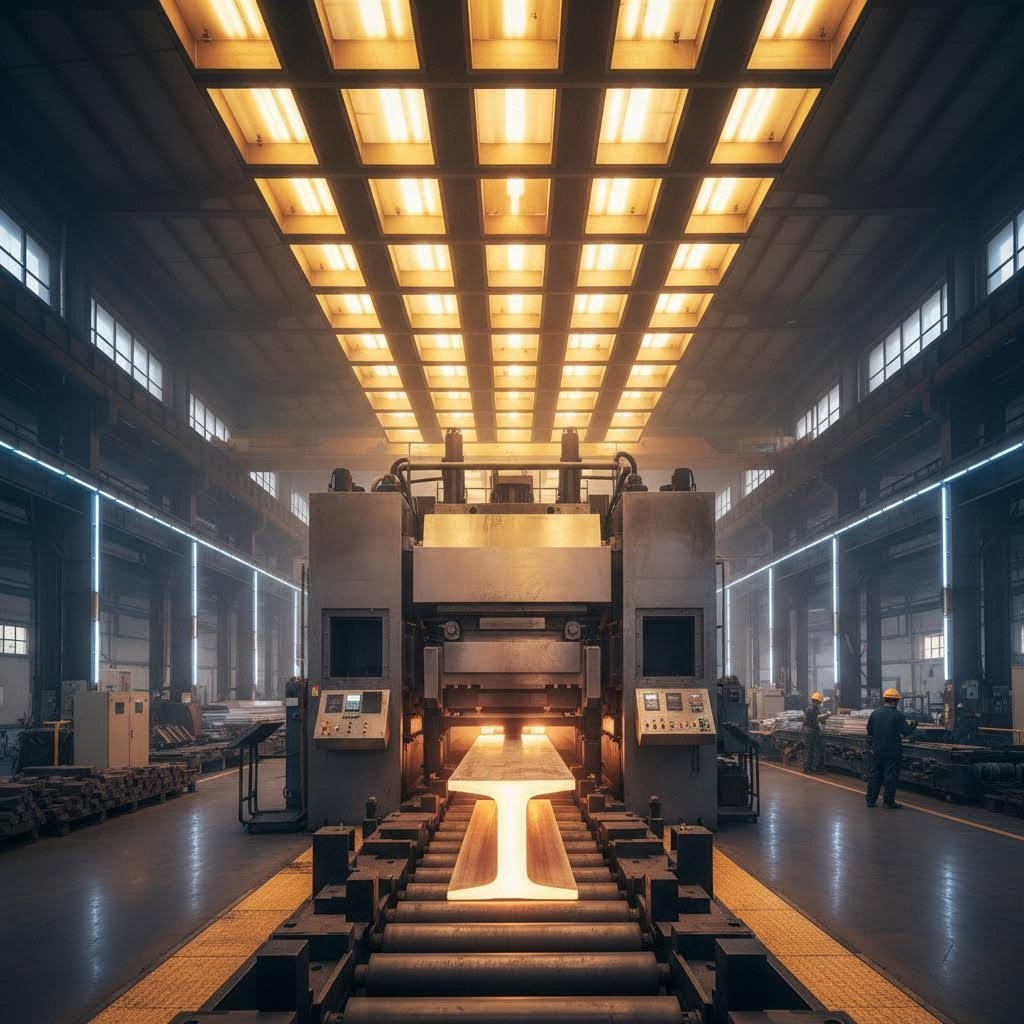
You've determined your alloy requirements, selected appropriate profiles, and decided between standard and custom options—but who actually manufactures and delivers these aluminum door frame extrusions? This final decision may be the most consequential of all. A capable supplier acts as a technical partner throughout your project, while a poor choice creates quality issues, delivery headaches, and long-term support gaps that haunt you for years.
Think about it this way: the aluminum extrusion itself represents just the starting point. What happens during production, how problems get resolved, and whether your supplier can scale with future needs—these factors determine whether your project succeeds or stumbles. Whether you're sourcing from established names like CRL U.S. Aluminum or evaluating international manufacturers, applying consistent evaluation criteria helps you identify partners worth trusting.
Before requesting quotes, prepare specific questions that reveal supplier capabilities beyond surface-level claims. According to industry experts at Minalex, the answers to these questions often determine project success or failure.
Industry experience matters significantly. Ask potential suppliers which industries they most commonly serve. A manufacturer experienced with architectural aluminum extrusions understands curtain wall specifications, AAMA coating standards, and the dimensional precision that door frame applications demand. General metal fabricators may lack this specialized knowledge. Look for evidence of long-term partnerships with reputable clients and a robust portfolio of similar projects.
Tolerance capabilities separate premium suppliers from commodity producers. What precision can they achieve, and what size limitations apply? For aluminum extrusion case applications requiring tight fits, you need specific answers—not vague assurances. Quality suppliers document their capabilities precisely, such as +/- 0.001" tolerances or specific wall thickness minimums.
Minimum order requirements affect project economics. Many aluminum extruders work in quantities of 1,000, 5,000, or higher. If your project requires smaller batches, confirm whether the supplier accommodates lower volumes—and at what cost premium. Some manufacturers specialize in smaller custom runs, while others focus exclusively on high-volume production.
Post-extrusion services determine how much coordination you'll manage. Can the supplier handle CNC machining, cutting-to-length, deburring, and finishing in-house? Integrated services reduce your coordination burden and improve turnaround times. Fragmented supply chains multiply potential failure points.
Project support throughout development phases reveals partnership potential. Will they collaborate during initial design, prototyping, and testing—or simply produce what drawings specify? The best suppliers identify ways to reduce cost, improve performance, or accomplish both through design refinements that leverage their extrusion expertise.
Manufacturing infrastructure directly influences what a supplier can produce, how quickly they can deliver, and whether quality remains consistent across production runs. As Ya Ji Aluminum explains, evaluating production scale and technical capability prevents mismatches between your requirements and supplier limitations.
Press capacity determines what profiles are possible. Extrusion presses range from small machines suitable for miniature profiles to massive equipment producing large architectural sections. A supplier with diverse press tonnage—from 600T for precision work up to 5500T for substantial structural profiles—handles a wider range of applications without outsourcing.
Consider these manufacturing capability indicators:
For glass showcase applications, aluminum door frames, or any project where surface appearance matters, verify the supplier's finishing capabilities specifically. Not all anodizing is equal—architectural-grade results require specialized processes and quality control that commodity finishes don't provide.
Certifications provide independent verification that a supplier maintains consistent quality systems. According to Taber Extrusions, certifications matter significantly for high-stakes industries—and they should matter for your door frame applications too.
At minimum, look for ISO 9001 certification, which validates quality management systems, process control, and continuous improvement practices. For automotive applications, IATF 16949 demonstrates additional rigor. Aerospace and defense work typically requires AS9100 certification.
Beyond management system certifications, ask about material and process compliance:
Request documentation rather than accepting verbal claims. Quality suppliers provide certification copies readily—hesitation suggests problems worth investigating before committing.
Manufacturing capability means nothing if orders arrive late or technical questions go unanswered. Evaluate the softer aspects of supplier relationships with equal rigor.
Technical support availability becomes critical when problems arise. Does the supplier assign dedicated account managers? Can you reach engineers who understand extrusion design when questions emerge during your project? Responsive, knowledgeable customer service often distinguishes excellent suppliers from adequate ones.
Delivery reliability depends on supply chain management, inventory practices, and logistics planning. As industry guidance suggests, suppliers with diversified material sources, automated tracking systems, and local warehousing options typically perform more reliably than those operating with minimal buffers.
Ask specific questions about delivery performance:
Understanding what comprehensive capabilities look like in practice helps calibrate your evaluation. Shengxin Aluminium exemplifies the full-service approach that simplifies complex aluminum door frame extrusion projects.
With over 30 years of industry experience, Shengxin operates 35 advanced extrusion presses ranging from 600T to 5500T—capacity that handles everything from precision architectural trim to substantial structural profiles. This press diversity means a single supplier relationship covers varied project requirements without capability gaps.
Their integrated approach extends beyond extrusion. State-of-the-art CNC machining centers perform precise cutting, drilling, and bending to exact specifications. Rather than coordinating multiple vendors for secondary operations, customers receive finished components ready for installation.
Surface treatment options demonstrate similar comprehensiveness. Available finishes include:
Technical support extends from initial die development through mass production, with experienced engineers providing guidance throughout. For CRL aluminum alternatives or projects requiring custom aluminum extrusions for sale to end customers, this end-to-end capability streamlines procurement significantly.
Before finalizing any supplier relationship, verify these critical factors:
Building a structured evaluation approach—scoring potential suppliers across these dimensions—enables objective comparison rather than decisions based on quoted prices alone. The lowest bid rarely delivers the best value when quality issues, delivery failures, or technical support gaps consume project management time and compromise results.
Selecting the right aluminum door frame extrusion supplier completes the knowledge foundation this guide has built. From understanding extrusion fundamentals and alloy selection through finishing options, installation techniques, and sourcing decisions, you now possess the comprehensive perspective needed to specify, procure, and install aluminum door frames that perform beautifully for decades.
6063 aluminum is the industry standard for door frame extrusions due to its excellent extrudability, superior surface finish quality, and strong corrosion resistance. It accepts anodizing and powder coating beautifully, making it ideal for visible architectural applications. For heavy-duty frames requiring higher structural strength, 6061 aluminum offers greater tensile and yield strength, though with slightly rougher surface finishes.
Anodizing creates an integral oxide layer that becomes part of the aluminum itself, offering exceptional scratch resistance and durability that won't peel. It's limited to integral colors like bronze, black, and champagne. Powder coating applies an electrostatically charged powder that cures into a uniform layer, offering virtually unlimited color options and easier touch-up repairs. Both protect against corrosion, but anodizing excels for high-wear commercial applications while powder coating provides greater color flexibility at lower cost.
Thermal breaks use non-conductive polyamide plastic strips between interior and exterior aluminum sections to interrupt heat transfer. This design keeps buildings warm in winter by reducing heat escape and restricts external temperatures from entering during summer. Multi-chamber profile geometry enhances this thermal performance further, making aluminum door frames suitable for energy-efficient exterior applications that meet modern building codes.
Choose custom extrusions when your project requires unique architectural designs, specialized performance characteristics, or high-volume production that justifies die investment. Custom dies cost $3,000-$5,000 but can eliminate secondary machining costs across large orders. Standard profiles work best for conventional dimensions, small quantities, tight timelines, or projects where proven performance matters more than distinctive design. Custom development typically requires 6-10 weeks from design to delivery.
Evaluate suppliers based on industry experience with architectural applications, press capacity diversity (ranging from 600T to 5500T for various profile sizes), quality certifications like ISO 9001 and AAMA compliance, and in-house capabilities including CNC machining and surface treatments. Ask about tolerance capabilities, minimum order quantities, and on-time delivery rates. Suppliers like Shengxin Aluminium offer comprehensive services from die development through finishing, simplifying procurement for complex door frame projects.



 un service en ligne
 0086 136 3563 2360
 sales@sxalu.com
 +86 136 3563 2360
 français
 English
 Deutsch
 русский
 español
 português
 العربية
 ไทย
ไทย Việt
Việt Українська